Vietnam's energy transition: solar's stop-start progress and the explosive rise of EVs
With solar power and EVs spreading fast, Vietnam is trying to leapfrog the fossil-fuel-centred sequence of development. At the same time, a lagging grid, continued reliance on coal and an uneven distribution of burdens between cities and the countryside are coming into sharp relief. The latest data and developments on the ground help locate where the “electric fast-track” now stands.
On the streets of Hanoi, electric two-wheelers run quietly among the engine noise. Look south and solar panels line the dry land of provinces such as Ninh Thuận. These two scenes are not separate. “Electrotech” — switching generation to sun and wind, and mobility from petrol to electricity — is advancing in Vietnam at the same time.
The country’s change does not simply retrace the sequence the industrialised world followed. Rather than replacing an existing fossil-fuel system piece by piece, it is installing cheap solar, batteries and EVs all at once. This is what Ember calls the “electric fast-track” (Walter et al., 2026). Being able to move fast, though, is not the same as arriving. What Vietnam’s current situation shows is the gap between the speed at which technology spreads and the speed at which grids, institutions and local communities change.
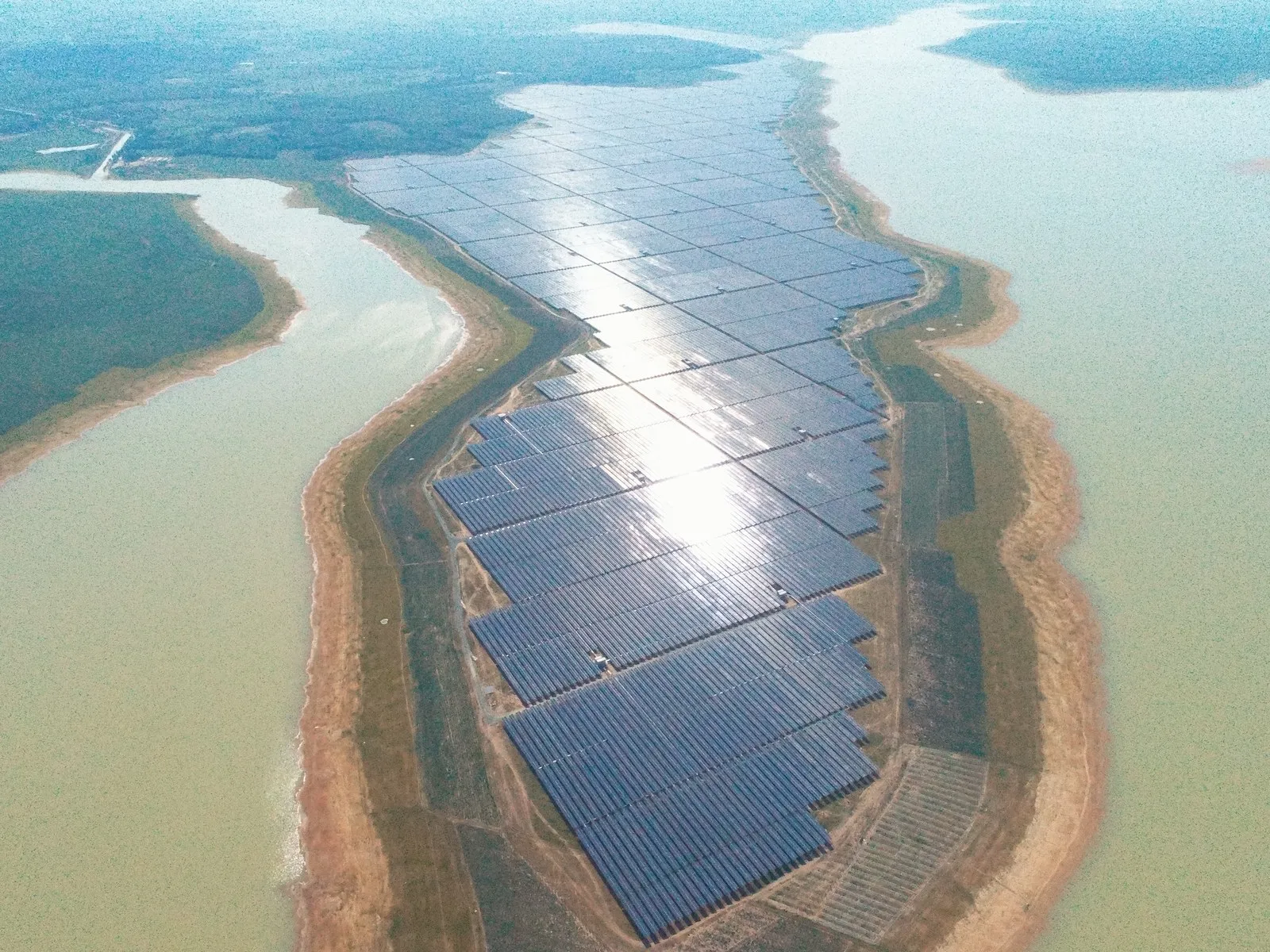 The Dau Tieng Solar Power Project in southern Vietnam. Photo: TammyLe (Wikimedia Commons, CC BY-SA 4.0)

A solar power in a few years
The starting point was a feed-in tariff (FIT). The Vietnamese government offered favourable purchase terms to plants that began operating by a deadline, and drew in private investment. Developers concentrated on solar, which can be built quickly, and capacity rose sharply from around 2019 (Ghosal, 2025b). According to the International Renewable Energy Agency (IRENA), renewable capacity at the end of 2024 was about 49 GW, 58% of all generating capacity: 23.7 GW of hydro, 18.7 GW of solar and 6.2 GW of wind. Over the five years from 2019, solar grew about 3.7-fold and wind about 16.5-fold (IRENA, 2025).
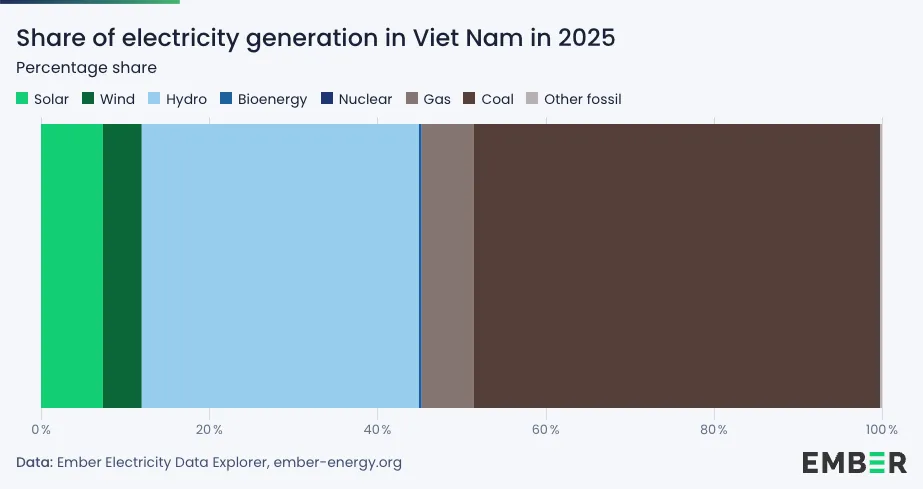
Installed capacity and the electricity that actually flows have to be looked at separately, though. Ember’s latest annual data puts renewables at 45.4% of generation in 2025 — hydro 33.0%, solar 7.4% and wind 4.6%. Solar and wind together come to 12.1%, much less than their presence in capacity terms. And while hydro generation rose 15.4% year on year in 2025, solar generation fell 10.8% (Ember, 2026). Vietnam took the lead in Southeast Asia at the stage of “building plant,” but is marking time at the stage of “delivering it where and when it is needed.”
The grid takes the lead role next
The FIT created a market quickly, but it also triggered a rush to beat the deadline. Plants clustered in the south-central region with its good solar resource, and the transmission lines needed to carry the power to cities and industrial zones with large demand did not keep up. Curtailment left capacity unable to generate, and after the FIT ended no successor pricing scheme was settled; an expert interviewed by the Associated Press described the market as having “almost stopped” (Ghosal, 2025b).
The eighth National Power Development Plan (PDP8), revised in 2025, set targets of 46.5–73.4 GW of solar and 26.1–38.0 GW of onshore and nearshore wind by 2030. The policy is for self-consumption rooftop solar at government and public facilities and at 50% of homes, and for utility-scale solar to be paired with storage of at least 10% of output for two hours. The targets have grown large again (Prime Minister of Viet Nam, 2025).
At the same time, coal-fired capacity for 2030 is set at 31.1 GW and imported-LNG capacity at 22.5 GW. It is a big plan that includes not only renewables but a return to nuclear and electricity imports from neighbouring countries. Behind it is an assumption that generation plus imports in 2030 will reach 560–625 TWh, roughly double the 2025 outcome (Prime Minister of Viet Nam, 2025). To support high growth while cutting emissions, the mix stacks up every kind of generation.
What matters here is not to follow the number of generating plants alone. The International Energy Agency (IEA) notes that a net-zero power sector in Vietnam requires grid expansion, system flexibility and demand-side efficiency (IEA, 2024). In the 2023 drought, hydro output fell and the north suffered power shortages (Ghosal & Delgado, 2026). With that memory, coal is hard to let go of as firm capacity. According to Ember, coal generation rose 17.7% year on year in 2024, reaching 50.3% of the mix. It fell 2.3% in 2025 but still accounts for 48.1% (Ember, 2026). The IEA also expects Indonesia and Vietnam to lead the growth in ASEAN coal demand to 2030 (IEA, 2025). Vietnam has become a renewables power, but it is not yet a country moving off coal.
Coal imports exceeded 65 million tonnes in 2025, a record, according to the Associated Press. The Just Energy Transition Partnership (JETP) agreed in 2022 was a framework to support the coal phase-out financially, but project development and the mobilisation of funds have lagged, and in 2025 the United States withdrew (Ghosal & Delgado, 2026). Judged on renewable additions alone it is a success; once security of supply and finance are included, the transition is not proceeding in a straight line.
On the other hand, a scheme allowing large consumers to buy electricity directly from renewable generators was introduced in 2024. For manufacturers such as Samsung and LEGO, whether they can procure clean power bears on export competitiveness (Ghosal & Delgado, 2026). If rooftop solar, batteries and direct power purchase agreements can be linked to demand in industrial parks, renewables can grow while avoiding grid congestion. In other words, reliable access to renewable electricity is becoming a condition on which companies decide where to site factories.
Electrification advancing from the roads
On the demand side, change is faster still. According to the IEA’s Global EV Outlook 2026, about 40% of new vehicles sold in Vietnam in 2025 were electric, making the country Southeast Asia’s largest EV market. The domestic maker VinFast accounts for almost the entire EV market, with the small and relatively affordable VF 3 and VF 5 driving adoption (IEA, 2026). VinFast says it delivered 175,099 EVs domestically in 2025 (VinFast, 2026b).
Two-wheelers matter more to everyday life. The IEA reports electric two-wheeler sales of about 735,000 in 2025, more than double the previous year and over 20% of all two-wheeler sales. Vietnam alone generated more than 30% of the global increase in electric two-wheeler sales (IEA, 2026). VinFast by itself sold 406,453 electric two-wheelers (VinFast, 2026a). The company has, however, posted large losses alongside its rapid expansion, and a firm’s sales record is not the same as the sustainability of the transition (Ghosal, 2026).
VinFast does not only sell vehicles. Through its affiliated ride-hailing service Green SM, its charging network and a planned battery-swap network, it is building demand and infrastructure itself (Ghosal, 2025a). This vertical integration is a force for standing up a market quickly. It also creates a concentration risk, in which a whole country’s electrification depends on one company’s finances and management decisions. Reconciling the growth of a national champion with competition and common standards is the next problem.
Policy, too, is proceeding by trial and error. Hanoi began operating a low-emission zone on 1 July 2026. Attention initially focused on a plan to exclude petrol two-wheelers broadly inside Ring Road 1, but what took effect was phased regulation in part of the Hoàn Kiếm district, limited by vehicle type and time of day (Government News, 2026). This is less a retreat than an accommodation with daily life. Two-wheelers are not only a way to commute but a tool of work supporting deliveries, street stalls and school runs. If regulation runs ahead without charging, battery swapping, public transport and replacement support in place, the cost falls hardest on people with lower incomes (Ghosal, 2025a).
A different transition seen from the countryside
While cities wrestle with switching to electric two-wheelers, in rural areas the focus is land and livelihoods. A study of 294 households in Ninh Thuận province, where solar development concentrated, that had sold farmland to renewable energy projects found that ethnic minority households placed greater weight on “natural capital” such as cropland, grazing land, water and agricultural ecosystems (Quang, 2025). It is not a simple story in which compensation money makes life better. What is in question is whether people can go on working locally after losing their land.
This is also a lag between city and countryside. Urban consumers gain a new option in cheaper EVs, while residents where the generating plant goes accept a change in land use for a long time. If the electricity generated and the returns on investment flow to the cities while all that stays behind is compensation money and constraints on land, it cannot be called a “just transition.” Who decides, who owns and who the revenue returns to all have to be examined.
One answer is agrivoltaics — farming and generating on the same land. Vietnam’s Ministry of Agriculture and Environment and the German development agency GIZ have begun a project to create at least ten demonstration models in 2025–2027 (Ministry of Agriculture and Environment of Viet Nam, 2025). If crops can be grown or livestock raised under the panels, generation income can support stable rural incomes. But it only works if crop selection, sunlight, water use, land rights and revenue sharing are all designed in. The question is not whether farmland can be turned into a power plant, but whether power plants can be turned into places where farming continues.
The fast track is not a short cut
Vietnam is skipping the sequence of getting rich first and starting on the environment later, pursuing industrialisation, renewables and EVs at once. In that sense it is one of the clearest embodiments of the electric fast-track. In 2025 renewable generation rose and fossil generation fell (Ember, 2026). Its markets for EVs and electric two-wheelers are growing faster than those of many European countries (IEA, 2026).
Even so, solar curtailment, reliance on coal, concentration around VinFast, the replacement costs borne by urban workers and rural land questions all remain. The lesson is plain: technology can be deployed quickly, but the social arrangements that support a transition do not appear by themselves. Can grids and storage, market rules, public transport, and local participation and benefit sharing be put in place at the same speed? What decides Vietnam’s next stage is not the number of solar panels or EVs but the infrastructure and governance that connect them.
References and data sources
- Ember. (2026). Yearly electricity data. Retrieved August 16, 2026, from https://ember-energy.org/data/yearly-electricity-data/
- Ghosal, A. (2025a, October 20). Vietnam’s love affair with gas bikes is colliding with a new electric reality. Associated Press. https://apnews.com/article/4ab76826787a806392655b843c374f3a
- Ghosal, A. (2025b, February 27). Vietnam plans energy shift toward building more solar, less reliance on gas and coal. Associated Press. https://apnews.com/article/832e7b8bb7c103fb17e1f86121f735cf
- Ghosal, A. (2026, July 29). Vietnam’s biggest company, Vingroup, goes global as its home market slows. Associated Press. https://apnews.com/article/vietnam-vingroup-uzbekistan-congo-property-vinfast-290c77eb74d682f6ac5dd8cab4866880
- Ghosal, A., & Delgado, A. L. (2026, January 22). Rising coal demand overshadows Southeast Asia’s transition to renewable energy. Associated Press. https://apnews.com/article/southeast-climate-fossil-coal-energy-renewable-3dceea3bfa849edd9ccb78ff1e2f9b52
- Government News. (2026, July 5). Công bố Đề án “Vùng phát thải thấp trong vành đai 1, thành phố Hà Nội”. https://xaydungchinhsach.chinhphu.vn/cong-bo-de-an-vung-phat-thai-thap-trong-vanh-dai-1-thanh-pho-ha-noi-119260703145217105.htm
- International Energy Agency. (2024). Achieving a net zero electricity sector in Viet Nam. https://www.iea.org/reports/achieving-a-net-zero-electricity-sector-in-viet-nam
- International Energy Agency. (2025). Coal 2025. https://www.iea.org/reports/coal-2025
- International Energy Agency. (2026). Global EV outlook 2026. https://www.iea.org/reports/global-ev-outlook-2026
- International Renewable Energy Agency. (2025). Viet Nam energy profile. https://www.irena.org/-/media/Files/IRENA/Agency/Statistics/Statistical_Profiles/Asia/Viet-Nam_Asia_RE_SP.pdf
- Ministry of Agriculture and Environment of Viet Nam. (2025, September 10). Agri-PV project deploys at least 10 agricultural solar power models. https://en.mae.gov.vn/Pages/chi-tiet-tin-Eng.aspx?ItemID=9001
- Prime Minister of Viet Nam. (2025, April 15). Decision No. 768/QD-TTg approving the adjustment of the National Power Development Plan VIII. https://chinhphu.vn/?classid=2&docid=213388&pageid=27160
- Quang, N. N. (2025). Differences in livelihood satisfaction between ethnic groups after selling farmland for renewable energy power projects in Ninh Thuan province, Vietnam. Frontiers in Sustainable Food Systems, 8, 1492400. https://doi.org/10.3389/fsufs.2024.1492400
- VinFast. (2026a, January 26). VinFast đạt doanh số kỷ lục 406.453 xe, dẫn đầu thị trường xe máy điện Việt Nam năm 2025. https://vinfastauto.com/vn_vi/vinfast-dat-doanh-so-ky-luc-406453-xe-dan-dau-thi-truong-xe-may-dien-viet-nam-nam-2025
- VinFast. (2026b, January 13). VinFast lập kỷ lục bàn giao 175.099 xe ô tô điện tại Việt Nam năm 2025. https://vinfastauto.com/vn_vi/vinfast-lap-ky-luc-ban-giao-xe-o-to-dien-tai-viet-nam-2025
- Walter, D., Butler-Sloss, S., Issac, A., & Bond, K. (2026). The electric fast-track for emerging markets: How electrotech can serve the billion people left behind by the fossil system and open up a faster path to prosperity. Ember. https://ember-energy.org/latest-insights/the-electric-fast-track-for-emerging-markets/