Cuba's energy crisis: can solar keep daily life running?
As oil supplies dwindle and an ageing grid collapses, Chinese solar panels are spreading rapidly across Cuba. Is this a turn towards energy independence, or merely a shift of dependence from oil to Chinese equipment? Official data and local reporting help map the structure of the crisis and the limits of what solar can change.
In early August 2026, nationwide blackouts hit Cuba one after another. In a household the Associated Press visited in Havana, when the power returns at three in the morning the family boils beans, does the laundry and charges their phones. The supply might last twenty minutes, or a few hours. Chores that once took ten hours are compressed into the two hours the current is on. To escape the heat, some people now spend the night out on the Malecón, the seafront promenade (Rodriguez, 2026).
Seen only through that scene, Cuba’s crisis looks like a story about a shortage of oil. And indeed, since January 2026 the United States has used tariff measures against countries that supply oil to Cuba to warn off third parties, and supplies from Venezuela have also stopped (Nicoll, 2026; Tan & Lu, 2026). The Cuban government calls this an “energy blockade.” In May the United Nations reported that fuel reserves were almost exhausted and that power generation, transport, health care, water supply and food distribution were severely affected. More than 96,000 operations had been postponed, including 11,000 on children (United Nations, 2026).
Yet if the oil arrived, things would not simply go back to how they were. What is happening is a crisis in which three problems overlap: the cutting off of fuel supplies from abroad, ageing generating plant, and an economic system that cannot attract investment. Into that gap, Chinese solar panels are moving at unprecedented speed. Is this a decarbonisation success story? Or just a shift of dependence from oil to Chinese equipment?
A power system built on the assumption of oil
Cuba’s electricity supply developed on the assumption of preferentially priced oil, first from the Soviet Union and later from Venezuela. Large oil-fired plants are backed by distributed generators burning diesel and heavy fuel oil, and by gas generation associated with domestic oil fields. The IEA’s country profile explains that oil products account for more than 80% of generation (International Energy Agency [IEA], n.d.).
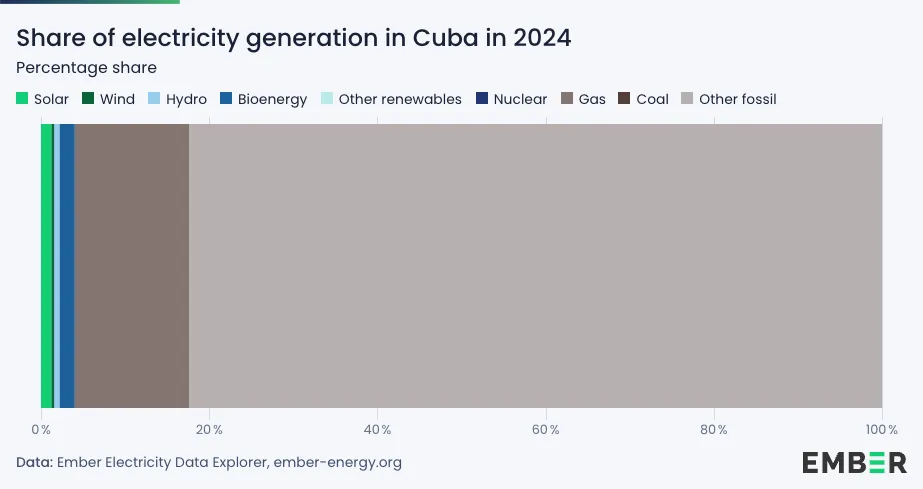
Data from the independent think tank Ember likewise shows that of the 19.43 TWh generated in 2024, fossil fuels supplied 96.0% — “other fossil fuels” 82.4% and gas 13.6%. Renewables accounted for only 4.0%, with solar at 1.2% (Ember, 2026a). In other words, right up to the solar construction drive that began in earnest in 2025, Cuba had one of the world’s most fossil-fuel-dependent power systems.
The thermal plants, moreover, were mostly built decades ago. Figures presented by an executive of Cuba’s electricity utility in 2024 showed that, apart from one of the sixteen thermal units that was permanently out of service, almost all had fallen outside their intended maintenance cycles (Granma, 2024). A lack of funds, US sanctions that make spare parts hard to obtain, the strain of heavy, high-sulphur domestic crude on equipment, and insufficient government investment all compound each other. Fuel shortages cut generation, and equipment failures disturb frequency and trigger nationwide blackouts. Pinning the cause of the crisis on either US pressure or the Cuban government’s mismanagement alone means missing this chain.
Chinese solar changed the picture in a year
The speed of the shift shows up in the numbers. According to IRENA, Cuba’s renewable capacity at the end of 2024 was 816 MW, of which solar was 292 MW. Even though renewables made up 12.2% of installed capacity, they supplied only around 4% of actual generation (IRENA, 2025). Installed capacity and annual generation are not the same thing, and thermal plant that can burn fuel through the night cannot be compared straightforwardly with solar that generates only in daylight.
The growth since then has been rapid. Reuters reports that the Cuban government, backed by Chinese loans and donated equipment, installed more than 1,000 MW of solar in roughly a year from 2025 (Rios & Fernandez, 2026). The government says the renewable share of generation rose from about 3–4% in 2024 to 10% in 2025 (Granma, 2026a). Data compiled by Ember from Chinese customs statistics shows that Chinese solar panel exports to Cuba jumped from about $5 million in 2023 to $117 million in 2025 (Tan & Lu, 2026). Because Ember estimates capacity from export values and monthly panel prices, not every panel that cleared customs is necessarily installed. Even so, it is clear that the speed at which equipment is arriving has changed decisively (Ember, 2026b).
China’s role is not merely selling panels. Loans, donations and construction support underpin a plan to build 92 solar plants by 2028, aiming at some 2 GW in total (Tan & Lu, 2026). In May 2026, Cuba’s first solar plant with battery storage — a 5 MW plant donated by China combined with a 1 MW battery — began operating (Granma, 2026b). For a Cuba with little access to Western finance or fuel, China is one of the few partners that can supply equipment, money and engineers together, now.
There is something in it for China as well. It creates a new market for a solar industry with enormous production capacity, and demonstrates economic-diplomatic presence right next to the United States. If Chinese standards take hold not only in generating plant but in inverters, batteries, control systems and spare parts, a long-term relationship follows. At the same time, it is premature to call this simply a “new dependency.” Imported oil disappears once burned, whereas solar plant keeps generating after installation with no fuel cost. The question is less whether the equipment is Chinese than whether contract terms are transparent, whether maintenance capability stays in Cuban hands, and whether multiple sources of supply can be secured.
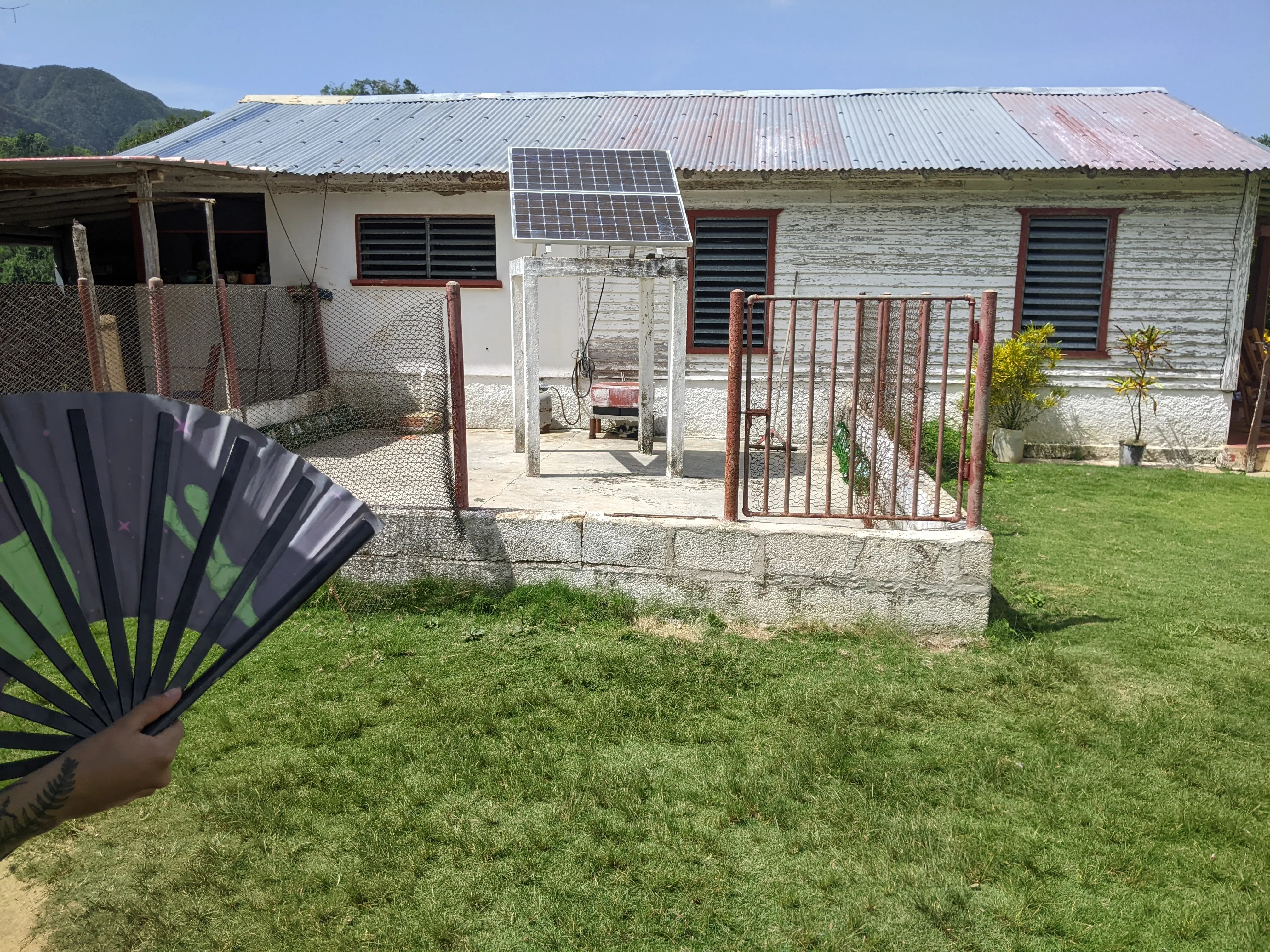 Solar panels and batteries installed near a coffee farm in Viñales, western Cuba (2023). Photo: UnifiedFunctionality / Wikimedia Commons, CC BY-SA 4.0

Will it become Pakistan-style adoption from below?
Pakistan has drawn attention as a case in which Chinese panels overtook the existing power system. According to Ember, the country imported 12.5 GW of panels from China in the first seven months of 2024 alone (Ember, 2024). Households, farmers and factories installed them on their own roofs and land to escape high tariffs and an unreliable grid. Consumers moved away from the utility before any plan for new power stations could be built — a transition from below.
Cuba shows similar movements. Reuters reports that private businesses and households receiving remittances from abroad have begun buying rooftop solar and batteries. Some drivers mount panels on the roofs of electric three-wheelers to extend their range without petrol (Rios & Fernandez, 2026). In Santa Clara, people have started bringing phones, cooking appliances and electric vehicles to a charging hub equipped with solar and batteries (Associated Press, 2026).
Even so, it is hard to imagine Cuba following Pakistan’s path as it is. Cuba’s rapid additions are mostly state-owned utility-scale plants, and household equipment is priced in foreign currency. It is out of reach for many citizens. Imports, financing and business licences all depend on government decisions. In Pakistan, the disorder of the market produced a cycle of grid defection and rising tariffs. In Cuba the greater risk is a widening gap between the households and private firms that can use solar and the people who have no choice but to live with blackouts.
What solar solves, and what it cannot
A gigawatt of solar is a powerful thing for reducing daytime fuel consumption and blackouts. Even after the national grid collapses, solar, hydro and small generators can be used to bring up local microgrids and restore power to hospitals and water facilities. For an island unable to import fuel, the point of using the sunlight falling on it is energy security even more than climate policy.
But solar alone cannot meet night-time demand. The first battery, which came online in May 2026, is 1 MW — tiny against more than 1,000 MW of solar. Unless investment in transmission and distribution, frequency control, batteries and demand management keeps pace, daytime generation cannot be carried into the night. And even as electricity improves, liquid fuels will be needed for some time for buses, farm machinery, logistics, aviation and starting up thermal plants. Solar softens the damage of an oil crisis; it does not make oil unnecessary overnight.
What is happening in Cuba is not model decarbonisation under well-ordered policy but an energy transition carried out in an emergency by a country that has lost its options. Even so, something important is changing: the basis of supply is beginning to shift from fuel that runs out when shipping routes are cut to electricity that can be obtained at home, over and over, as long as the equipment is there.
The numbers by which to judge success are not only the megawatts of panels installed. Do night-time blackout hours fall? Do hospitals and water pumps run? Does storage grow? Can low-income households also get access to electricity? Can spare parts be secured domestically? China’s support is giving Cuba time. Whether that time goes only into keeping ageing thermal plants alive, or leads to a robust power system with distributed generation and storage, is the question. Whether solar “saves” Cuba will be decided less by the number of panels than by the institutions and investment that come after them.
References
- Associated Press. (2026, May 6). A solar-powered charging station in central Cuba brings life to a darkened island.
- Ember. (2024, September 19). Solar power continues to surge in 2024.
- Ember. (2026a). Yearly electricity data (accessed 16 August 2026).
- Ember. (2026b). China solar export data methodology.
- Granma. (2024, May 24). ¿Cuál es la situación actual del Sistema Eléctrico Nacional?.
- Granma. (2026a, February 16). Suma Villa Clara nuevas capacidades de generación fotovoltaica.
- Granma. (2026b, May 8). Parque solar con almacenamiento refuerza el Sistema Eléctrico Nacional desde Ciego de Ávila.
- International Energy Agency. (n.d.). Cuba: Energy system of Cuba (accessed 16 August 2026).
- International Renewable Energy Agency. (2025). Renewable capacity statistics 2025.
- Nicoll, R. (2026, July 18). Cuba edges toward breakdown as power cuts and US meddling push society to brink. The Guardian.
- Rios, A., & Fernandez, A. (2026, February 20). Cubans fight blackouts with solar as US extends oil chokehold. Reuters.
- Rodriguez, A. (2026, August 7). As blackouts stretch for days, life in Cuba revolves around small bursts of electricity. Associated Press.
- Tan, R., & Lu, R. (2026, March 17). Trump has choked off Cuba’s oil supply. China is stepping in with solar. The Washington Post.
- United Nations. (2026, May 1). Noon briefing of 1 May 2026.