Pakistan's distributed energy surge: the electrification nobody planned
Faced with soaring electricity tariffs and blackouts, households and businesses in Pakistan are installing solar themselves at a remarkable rate. This “electrification from below,” which official statistics cannot capture, reduces dependence on imported fuel while posing new problems for who pays for the grid and for groundwater use.
Seen from the air, Pakistan’s cities show the change of the past few years clearly. Blue-black solar panels have spread across the roofs of homes, factories and shops. This is not the result of a large national programme proceeding in an orderly way. People who had given up on expensive, unreliable grid electricity bought panels with their own money and put them on their own roofs and farmland.
The shift is not merely the spread of renewable energy. It reconnects household cooling, factory production, farm irrigation and even two- and three-wheeler travel to cheap electricity. At the same time, distributed generation that has grown rapidly without being integrated is shaking the existing electricity system and the way its costs are shared. In Pakistan, the benefits of electrification and the fraying of institutions are appearing at once.
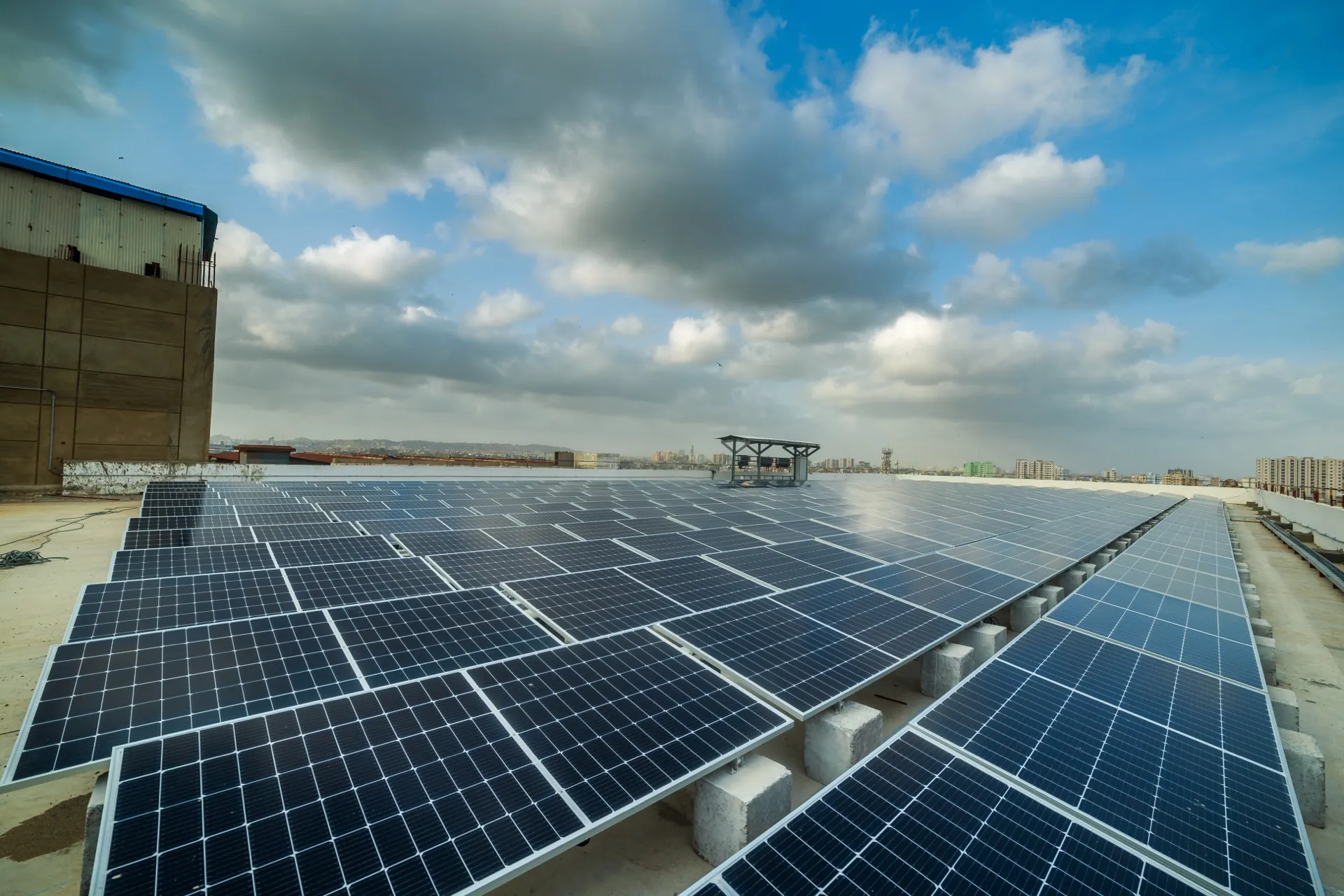
Rooftop solar at the Sindh Industrial & Trading Estate in Karachi. Photo: Crosji (Wikimedia Commons, CC BY-SA 4.0; reduced for display)

Thirty gigawatts missing from official statistics
The first surprise is that nobody fully knows how much solar has been added. The International Renewable Energy Agency’s Renewable Energy Statistics 2026 puts Pakistan’s solar capacity at the end of 2025 at 3,717 MW, or 3.717 GW (IRENA, 2026). The latest estimate by Ember and the local think tank Renewables First, by contrast, puts distributed solar alone at about 38 GW as of June 2025 (Imran et al., 2026). The dates and methods differ, but the gap is about tenfold.
The reason is that much of the capacity sits “behind the meter.” Rooftop installations for self-consumption and agricultural systems not connected to the grid rarely appear in official statistics as power plants. A survey by TransitionZero and PRIED, combining satellite imagery with 5,300 interviews, estimated distributed solar at 27.5–33.4 GW. It is less that IRENA’s figure is wrong than that statistics built around central power stations and the grid can no longer capture generation owned by consumers.
According to Ember and Renewables First, 27 GW was added in the two years from fiscal 2023 to fiscal 2025 alone. That is comparable to the total operating capacity of coal, gas and oil plants Pakistan has built over its history. Generation from distributed solar rose from 15 TWh to 51 TWh, meeting 28% of actual electricity demand. Grid-side generation fell 3%, while national electricity demand rose 21%. Looking only at grid statistics suggests stagnating demand; in reality electrification was surging outside the grid.
Trust in the grid collapsed before panels got cheap
What produced the surge was not only falling panel prices. It began with a dysfunctional power system: long outages, high tariffs, and capacity payments to plants that were not being used. The International Energy Agency (IEA) reports that Pakistan imported the equivalent of 19 GW of solar panels in 2024, about half the country’s grid-connected generating capacity (IEA, 2025b). Panels made cheap by Chinese oversupply appeared in front of consumers who were looking for a way out.
The difference in economics is large: electricity from a medium-sized residential solar system with storage is estimated at about 20 Pakistani rupees per kWh against roughly 40 rupees for grid power. Daytime outages are avoided as well. For factories and shops it was an investment to keep operating and hold down costs, rather than an environmental gesture.
The benefits go beyond replacing existing demand. About seven million households, 18% of all households, now own solar, and can use cooling, refrigerators and water pumps more than before. Commercial electricity demand rose 39% over two years, agriculture 34% and industry 22%, much of it supported by distributed solar. Electricity’s share of final energy demand rose from 17.0% to 21.7%, approaching the world average of 22%. Cheap electricity did not take demand away; it brought out demand that tariffs and outages had suppressed.
Roofs as protection from imported fuel
The other benefit is energy security. Pakistan is vulnerable to oil and LNG imports, and rising international prices feed directly into a shortage of foreign currency and domestic inflation. Ember and Renewables First estimate that the expansion of solar had avoided a cumulative $12 billion of oil and gas imports by February 2026.
Chloé Farand of The Guardian reported that even amid fears over fuel supply arising from Middle East conditions in 2026, distributed solar reduced daytime demand for gas generation and cushioned the shock (Farand, 2026). Before it is climate policy, solar has become insurance protecting households and businesses from fuel prices and blackouts.
In rural areas, solar-powered well pumps have replaced diesel. In 2022, 79% of agricultural wells ran on diesel; by 2025 that had fallen to 28%, with solar estimated at 61%. Operating costs fell and more farmers could irrigate. But there is a new risk behind the benefit. Reuters found that many farmers who switched to solar increased how often they irrigate, and in Punjab the groundwater table has fallen to dangerous levels across a widening area (Shahid, 2025). Policies that lower the marginal cost of energy have to be combined with measurement of water use and with shifts in what is grown.
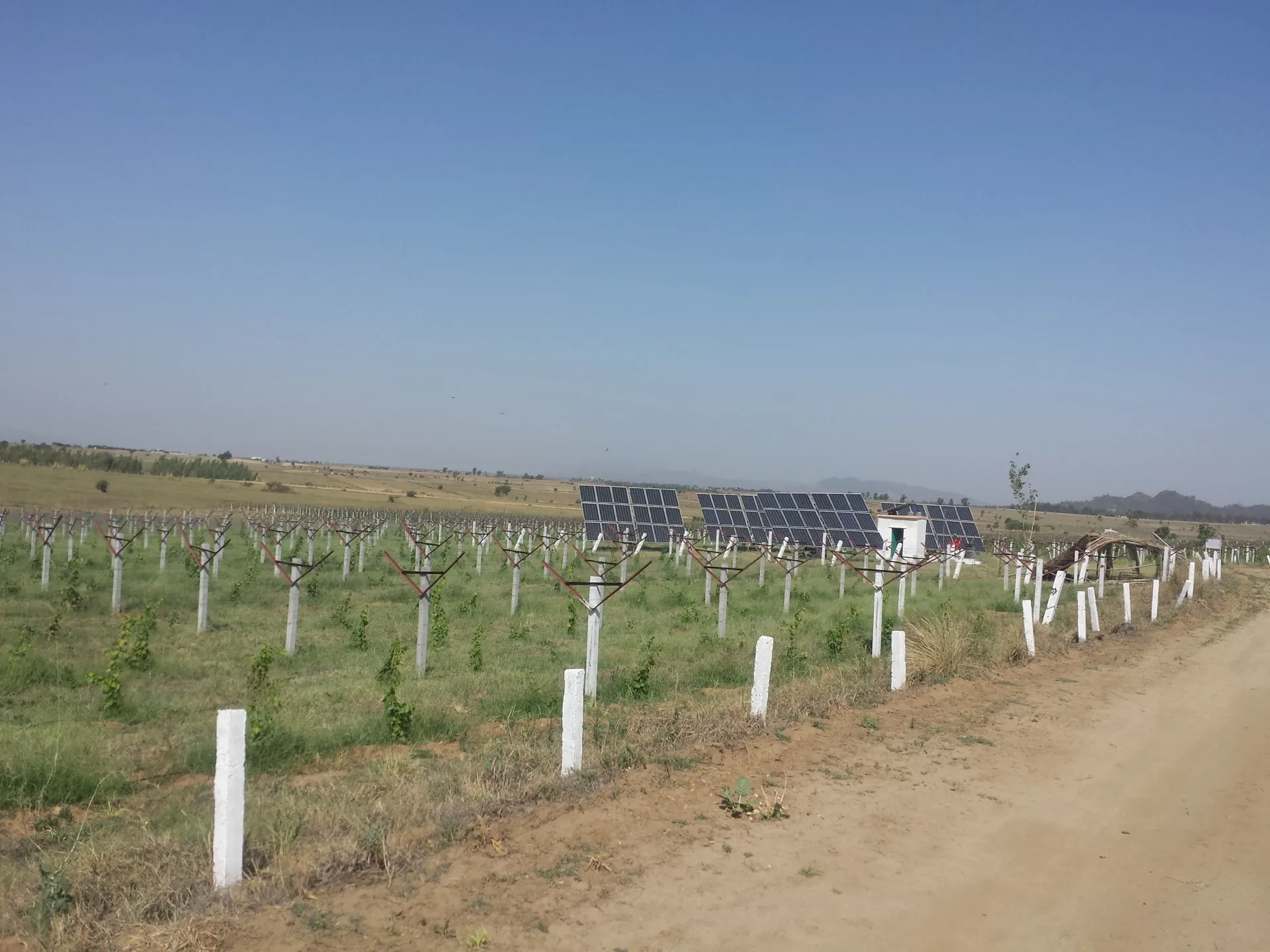
Solar panels on a grape farm near Attock, Punjab. Photo: Beautiful Attock (Wikimedia Commons, CC BY-SA 4.0)

Those who stay on the grid pay more
The serious problem is fairness. Wealthier households and firms able to raise finance move to solar sooner and cut the electricity they buy. But the cost of maintaining transmission and distribution networks, and capacity payments made whether or not plants generate, do not fall as quickly. Recovering fixed costs from fewer units sold raises the unit price for those who remain on the grid. That increase then encourages the next round of solar adoption — the “utility death spiral” is becoming real.
Reuters reported in 2025 on a divide in which much of the urban middle class cannot afford the upfront cost and cuts back on electricity use, while wealthier households that installed solar can run air conditioning freely (Shahid et al., 2025). The TransitionZero and PRIED survey likewise found an adoption rate of 38% among households with monthly electricity spending of 15,000 rupees or less, against 88% among those spending over 50,000 rupees.
In February 2026 the regulator NEPRA moved new contracts from net metering to net billing. Surplus electricity and purchased electricity are no longer netted at the same rate: surpluses are bought at the national average power purchase price, while purchases from the grid carry the retail tariff. Existing contracts were protected under the old scheme until expiry by an amendment in April (NEPRA, 2026a, 2026b). There is a rationale for limiting cost shifting. But if the terms for exports simply worsen, users will stop sending electricity to the grid and buy batteries to consume more of it themselves. Rather than halting grid defection, it may accelerate it.
As the IEA notes, a power system with a rising share of variable renewables needs investment in storage, demand-side flexibility and networks (IEA, 2025a). In Pakistan there are even projections of “negative demand” in cities such as Lahore and Faisalabad, where rooftop solar exceeds grid demand on sunny afternoons. In the evening, meanwhile, cooling and lighting demand remains. Storage to move midday surpluses into the night, time-of-use tariffs, smart meters and tariff design that shares network costs fairly are urgent.
Two- and three-wheel EVs start to move next
The change is beginning to extend to mobility. Pakistan has around 30 million two-wheelers and three-wheeled auto-rickshaws, which consume about 40% of the country’s petrol. According to Reuters, electric two-wheeler sales nearly tripled to about 90,000 in 2025, 5% of two-wheeler sales; by 2026 the monthly share passed 10%. Because running on petrol costs up to ten times as much as on electricity, high fuel prices are driving adoption (Shahid & Varadhan, 2026).
The government has a target of 30% of new vehicle sales being electric by 2030, with plans to put about 2.05 million electric two-wheelers and 54,000 electric three-wheelers on the road over five years (Government of Pakistan, 2025). What matters is that EVs become new demand for solar. Charging at workplaces and charging hubs during the day uses electricity in hours when grid demand falls, and cuts oil imports. Household panels, batteries and electric bikes could become a single distributed energy system.
The work that comes after adoption
Pakistan is not a success to be copied as it stands. Statistics cannot keep up, costs are shared unfairly, and other problems such as groundwater and the evening peak have appeared. Even so, the fact the country has demonstrated carries weight: once cheap solar, storage and electric equipment are available, people electrify by themselves, without waiting for institutions or large power stations.
The role of policy is not to stop this. It is to measure the invisible capacity, open routes to finance and shared ownership for lower-income households, and turn the grid from a one-way delivery system into a two-way shared platform. In agriculture it has to be designed together with water; in mobility with charging; in housing with cooling and cooking.
Energy transitions in emerging economies have usually been imagined in the order of building large generation and networks first and electrifying demand afterwards. In Pakistan the order reversed. Generation grew from roofs and farmland, and the lives and industries that use that electricity expanded afterwards. What the world should watch is not only the speed of solar adoption. It is how fast institutions can catch up once consumers have started running ahead.
References
- Farand, C. (2026, March 17). How Pakistan’s people-led solar boom is easing impact of Middle East energy crisis. The Guardian.
- Government of Pakistan, Ministry of Industries & Production. (2025). New energy vehicles policy 2025–30.
- Imran, N., Amjad, M. M., Malik, S., & Jones, D. (2026). The solarisation of Pakistan’s energy economy. Ember & Renewables First.
- International Energy Agency. (2025a). Renewables 2025: Executive summary.
- International Energy Agency. (2025b). World energy investment 2025: Executive summary.
- International Renewable Energy Agency. (2026). Renewable energy statistics 2026.
- National Electric Power Regulatory Authority. (2026a). National Electric Power Regulatory Authority (Prosumer) Regulations, 2026.
- National Electric Power Regulatory Authority. (2026b). Amendment in National Electric Power Regulatory Authority (Prosumer) Regulations, 2026.
- Shahid, A. (2025, October 2). How solar-powered farming is digging Pakistan into a water catastrophe. Reuters.
- Shahid, A., Varadhan, S., & Greenfield, C. (2025, April 29). Pakistan’s solar revolution leaves its middle class behind. Reuters.
- Shahid, A., & Varadhan, S. (2026, April 7). Soaring costs, fuel shortage fears drive Pakistan to electric motorbikes. Reuters.
- TransitionZero. (2025, October 28). Shedding light on Pakistan’s distributed solar revolution.