France's agrivoltaics: who is the solar above the field for?
To expand solar while protecting farmland, what should be measured, and to whom should the benefits return? France has set numerical criteria for agrivoltaics under the principle that farming comes first and generation second. Yet once the skew in land income and the midday surplus of electricity are taken into account, the problems do not end beneath the panels.
Europe’s electricity is changing substantially around sun and wind. According to Ember, wind and solar supplied 30.1% of generation in the EU in 2025, surpassing fossil fuels’ 29.0% for the first time. Solar alone accounted for 13% (Ember, 2026). The International Energy Agency (IEA) likewise reports that global solar generation rose by about 600 TWh that year, the largest increase ever recorded for a single technology (IEA, 2026).
Within this trend, France occupies a slightly complicated position. Nuclear supplied 68.1% of generation in 2025, and the low-carbon share of electricity reached 95.2% (RTE, 2026). On climate policy it already looks like a star pupil. On renewables, however, it was the only member state that failed to meet the EU’s 2020 target (Ministry of Agriculture, 2023).
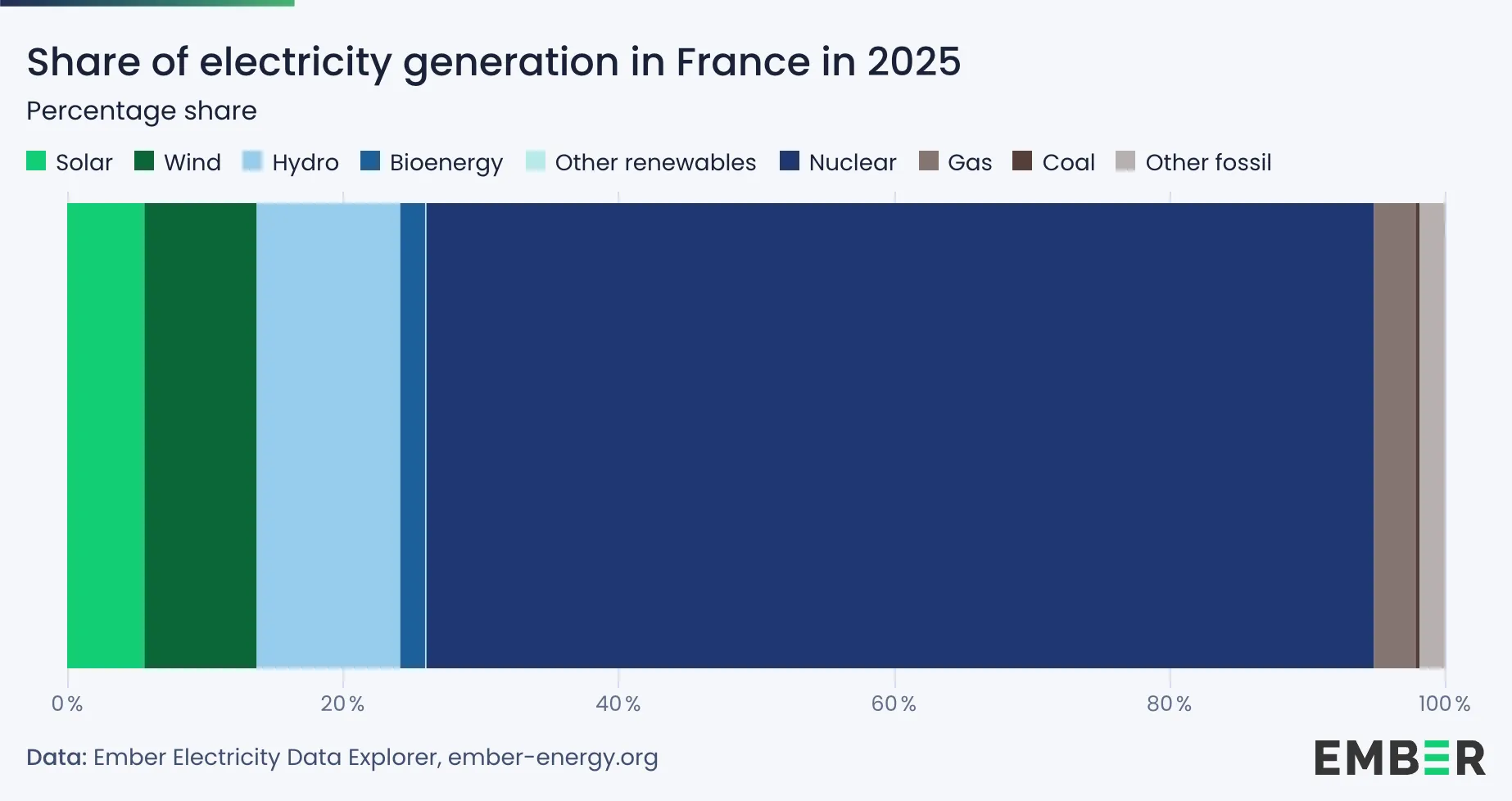
Solar is central to making up the lost ground. IRENA’s statistics show French capacity rising from 7.3 GW in 2016 to 31.4 GW in 2025, more than quadrupling in nine years (IRENA, 2026). French government statistics show 6.1 GW added in 2025 alone, with generation up 46% year on year at 37.0 TWh (SDES, 2026). The third multi-year energy plan (PPE3), decided in February 2026, set out policy to raise solar capacity to 48 GW by 2030 and 55–80 GW by 2035 (Government of France, 2026).
The government is also pushing the use of roofs and car parks. The 2023 law on accelerating renewable energy production (the APER law) requires existing outdoor car parks over 1,500 square metres to install, as a rule, shade structures incorporating renewable equipment over at least half their area. It also gives local authorities the power to designate renewable “acceleration zones.” Even so, expanding capacity substantially makes the question of how to treat large areas of farmland unavoidable. Hence the rise of agrivoltaics — reconciling farming and generation on the same land.
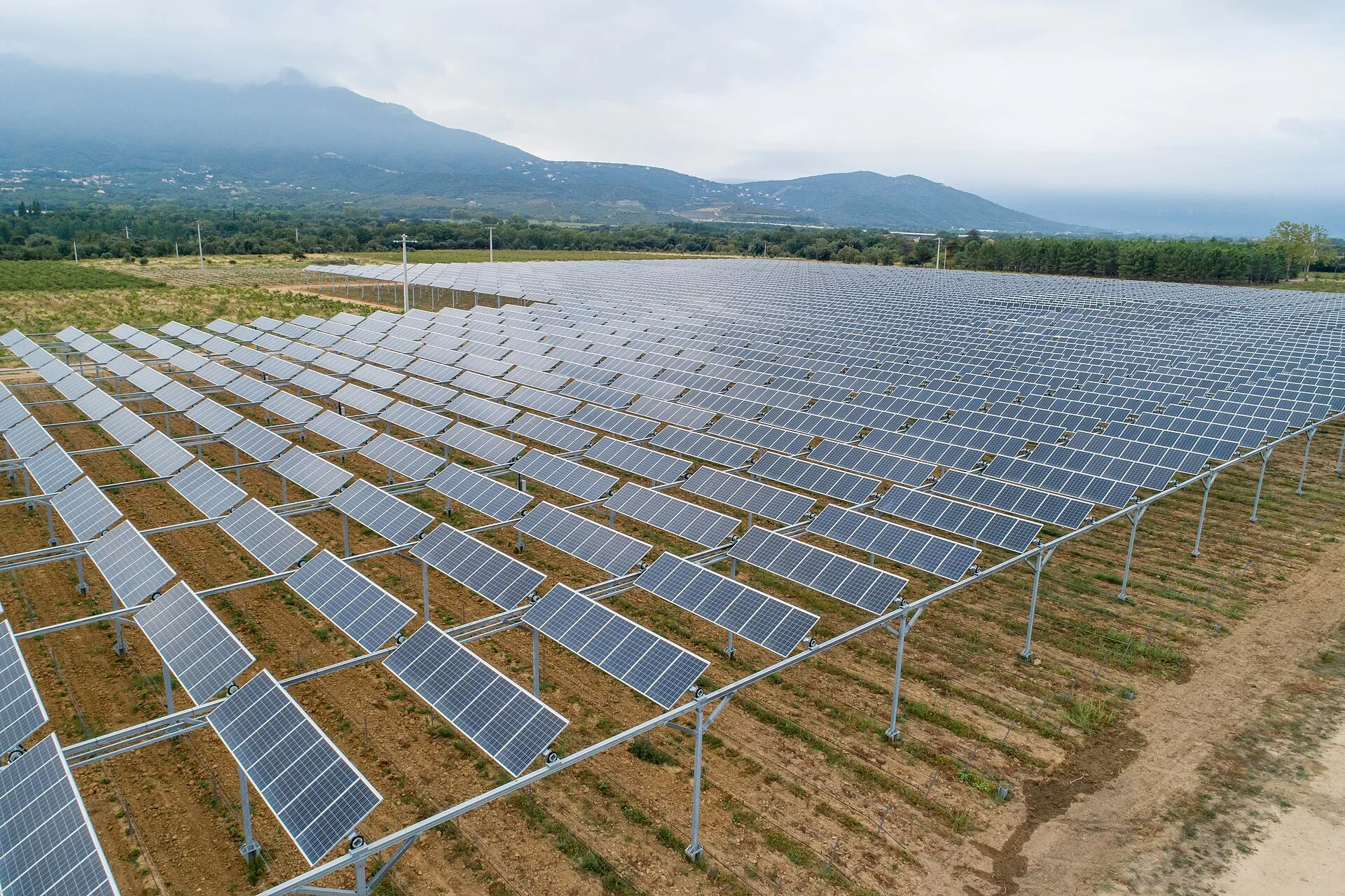 Agrivoltaics installed over vineyards at Tresserre, Pyrénées-Orientales, in southern France. Photo: Agrivoltaïsme / Wikimedia Commons, CC BY-SA 4.0

Putting “farming first, generation second” into numbers
What makes the French scheme interesting is that growing something under the panels is not enough to count as agrivoltaic. Under the definition the APER law inserted into the Energy Code, an installation must contribute over the long term to establishing, maintaining or developing agricultural production. On top of that, it must bring the farmland at least one of four direct benefits: (1) improved agricultural productivity, (2) adaptation to climate change, (3) protection from weather hazards, or (4) improved animal welfare. Installations where farming is not the principal activity, and installations that cannot be removed and the land restored, fall outside the scheme (Légifrance, 2023a).
A decree of April 2024 translated the principle into measurable criteria. The area that can no longer be farmed must stay within 10% of the total, and for certain large installations ground coverage by panels must stay within 40%. Crop yields must be maintained at 90% or more compared with a control plot, and agricultural income excluding generation revenue must, as a rule, not fall below the pre-installation average. Responses to breaches are not limited to corrective orders: they may extend to removing the installation and restoring the farmland (Ministry of Agriculture, 2024).
The 90% yield criterion comes with a clear method of measurement. As a rule, a control plot of at least 5% of the installation area, up to one hectare, is established nearby and compared under the same soil and climate conditions and cultivation methods. Inspections take place before operation and in the sixth year, and thereafter every five years for proven technologies, every three years where coverage is under 40%, and annually otherwise, verified by scientific or agricultural technical bodies. Generation and agricultural production data are submitted annually to the environment and energy agency ADEME. The design verifies “farming first” not only at the permitting stage but across decades of operation (Légifrance, 2024).
Worth distinguishing here is agrivoltaics from ordinary ground-mounted solar installed on farmland and similar land. The former continues farming as the principal activity and confers legally defined benefits on crops or livestock. The latter has no such function, so it cannot be installed anywhere at all. The prefect, acting on a proposal from the departmental chamber of agriculture, draws up a “framework document” (document-cadre) that sets out in advance the land where installation is possible: land difficult to farm because of terrain or soil, land unused for ten years or more, contaminated land and former industrial sites. Installations that genuinely contribute to farming are examined against strict agricultural criteria, and other installations are limited in where they can go. This two-stage arrangement is meant to prevent “alibi farming” — turning farmland into a power plant with a token agricultural activity attached (Ministry of Agriculture, 2023; Légifrance, 2024).
The distinction also bears on farm subsidies. Plots with certified agrivoltaics remain eligible for direct payments under the EU Common Agricultural Policy (CAP, or PAC in French), excluding non-agricultural parts such as the mounting structures (Légifrance, 2023b). Farmers can combine agricultural subsidies with income derived from generation while continuing to graze or grow. The aim of the scheme is not to prohibit combining the two but to ask whether the farming is real.
What the trial data show, and the caveats
As a technology for adapting to climate change, agrivoltaics has real potential. In 2025 trials by the solar developer TSE, potential evapotranspiration under the panels fell by 35% on average, and at some points temperatures were up to 7°C lower during heatwaves (TSE, n.d.). Sun’Agri, which installs movable panels over vineyards, reports cutting irrigation water by 41% on average and raising yields by 30% on average (Sun’Agri, n.d.). If shade suppresses evaporation from soil and crops and protects crops and livestock from extreme heat, hail and late frost, agrivoltaics becomes climate adaptation equipment as well as generating plant.
These figures include, however, numbers published by the companies themselves. Independent long-term verification and assessment by region and crop are essential. The French national research institute for agriculture, food and the environment (INRAE) notes that while shade eases high temperatures in the south, insufficient sunlight may reduce yields in the north and on highly productive grassland (INRAE, 2024). It is not a simple story in which putting up panels raises yields. Panel angle, spacing of supports, crop, soil, water and the movement of machinery all have to be designed from farm operations and production outwards, and verified over several years.
Who receives the value that comes from the land?
The other hard problem is not technology but money. Le Monde reported cases in which, against ordinary farmland rents of around €150 per hectare a year, solar developers offer €2,000–5,000 (Girard & Pécout, 2024). A 2025 survey found that 70% of farmers had already been approached by developers (Mouterde, 2025). Fixed income supports farmers exposed to weather and markets. But if the income concentrates on landowners alone, it risks terminated tenancy agreements, rising farmland prices and barriers to young entrants.
Local initiatives have begun on the benefit sharing that national rules alone cannot settle. In the Nièvre department, GUFA collects €1,500 per MW of capacity a year from developers and awards grants of €3,000–20,000 to projects by young farmers, cooperative sales outlets and the purchase of climate-adapted machinery. In the Ain department, Agriléa is trialling a structure in which farmers hold 40% of the project company, with the remaining 60% held by a public regional energy company, local authorities and private investors (J.-C. D., 2025). Whether benefits return not only to the individuals receiving rent but to surrounding agriculture and the local area shapes local consent.
In parliament, a bill was proposed in 2025 to cap installations at 10 MW or less and at 30% or less of the farmland used by a single holding, and to establish a local benefit fund. The solar industry worried about worsening economics, and farm organisations were divided (Mouterde, 2025). After committee examination the bill has not progressed, and as of August 2026 it has not been enacted (Assemblée nationale, 2025). Even with strict technical criteria, land contracts and benefit sharing still differ from place to place.
From how much is produced to when it can be used
The surge in solar has created new problems. The number of hours with negative prices on the French wholesale market rose from 352 in 2024 to 513 in 2025. Solar generation curtailed in response to negative prices reached 1.6 TWh. Moreover, even in hours when prices were at or above zero, the average price solar received was 32% below the market average for the same hours (CRE, 2026). Succeeding at dual use with agriculture does not make the problem of surplus electricity on sunny days go away.
In March 2026 the regulator CRE proposed trialling support contracts that combine solar with storage: during negative-price hours the electricity would be stored rather than fed to the grid, and the power supplied in high-demand hours would be what the support applies to. The expansion of grids, storage and demand management that the IEA emphasises applies to France as directly as anywhere.
The question French agrivoltaics poses is not only whether a field and a power plant can occupy the same place. It is also whether agricultural production can be measured, incomes protected, the value of the land shared locally, and surplus electricity moved to another time of day. Making “dual use” of food and electricity work requires protecting two public foundations at once: farmland and the power system. What deserves assessment is not the number of panels but whether farming continues beneath them and benefits remain in the locality. That is the standard by which to judge France’s experiment.
Note: this piece draws on material published as of 18 August 2026.
References
- Assemblée nationale. (2025). Proposition de loi visant à assurer le développement raisonné et juste de l’agrivoltaïsme.
- Commission de régulation de l’énergie. (2026, March 19). La CRE publie ses propositions pour optimiser le développement des grandes installations photovoltaïques.
- Ember. (2026). European electricity review 2026.
- Girard, L., & Pécout, A. (2024, April 10). L’agrivoltaïsme, ou produire de l’énergie solaire sur des terres agricoles, va être développé en France. Le Monde.
- Institut national de recherche pour l’agriculture, l’alimentation et l’environnement. (2024). L’agrivoltaïsme, la voie de l’avenir ?.
- International Energy Agency. (2026). Global energy review 2026: Electricity supply.
- International Renewable Energy Agency. (2026). Renewable energy statistics 2026.
- J.-C. D. (2025, January 2). Photovoltaïque : le partage de la valeur s’organise. Union Agricole.
- Légifrance. (2023a). Code de l’énergie, article L314-36.
- Légifrance. (2023b). Code de l’énergie, article L314-38.
- Légifrance. (2024). Décret n° 2024-318 du 8 avril 2024 relatif au développement de l’agrivoltaïsme.
- Ministère de l’Agriculture et de la Souveraineté alimentaire. (2023). Loi relative à l’accélération des énergies renouvelables : un cadre pour les installations photovoltaïques sur terres agricoles.
- Ministère de l’Agriculture et de la Souveraineté alimentaire. (2024, April 9). Publication au Journal officiel du décret relatif au développement de l’agrivoltaïsme.
- Ministère de l’Économie, des Finances et de la Souveraineté industrielle, énergétique et numérique. (2026). Programmation pluriannuelle de l’énergie 2026–2035.
- Mouterde, P. (2025, April 1). Agrivoltaïsme : une proposition de loi veut limiter la taille des projets d’énergie solaire. Le Monde.
- Réseau de transport d’électricité. (2026). 2025 review: Key findings.
- Service des données et études statistiques. (2026). Solaire photovoltaïque : parc au 31 décembre 2025.
- Sun’Agri. (n.d.). Protégez vos vignes du gel et du stress hydrique. Retrieved August 18, 2026.
- TSE. (n.d.). Agrivoltaïsme : protection des cultures et élevages des aléas climatiques. Retrieved August 18, 2026.