Egypt's renewable transition: the desert sun and the economy
Egypt has set out 45% renewables and power exports to Europe. On the ground, a weak grid, a shortage of foreign currency and declining gas output constrain the transition. A small agrivoltaic pilot in South Sinai points to the conditions for turning renewables into electricity that reaches people’s lives.
In Nuweiba, on the South Sinai peninsula, there is a solar installation of just 6 kW. The Belgian renewables firm 3E, Habiba Community and a water research centre at Alexandria University, among others, put panels up over farmland. It is a pilot in agrivoltaics: partly shading intense sunlight to reduce heat stress on crops and evaporation from the soil, while also generating electricity for local use (3E, 2026).
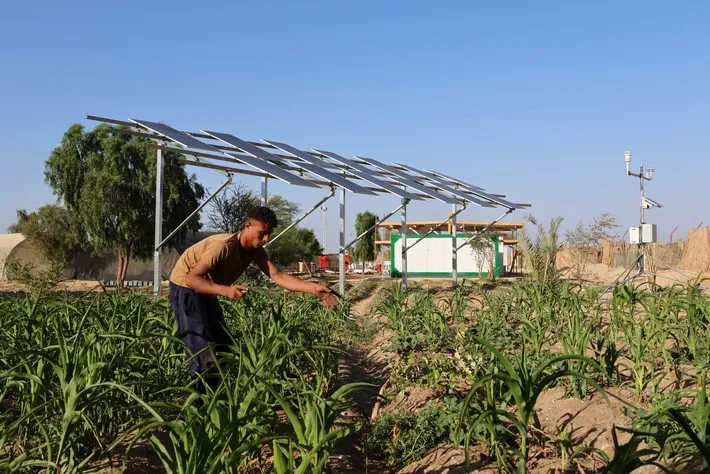 The 6 kW agrivoltaic pilot in South Sinai. Photo: 3E (photographer) / ORG (copyright), Presseportal
Egypt is also advancing a plan to send 3 GW of electricity to Greece by submarine cable across the Mediterranean. One project is 6 kW in a village; the other is 500,000 times that. This extreme difference in scale captures both the promise and the difficulty of Egypt’s energy transition.
The targets have risen, and the numbers have started to move
In June 2026 Egypt’s presidency announced a policy of raising the renewable share to “45% over the next two years,” advancing some 105 projects covering solar, wind, batteries and grid reinforcement, with 2028 as the target date (Presidency of the Arab Republic of Egypt, 2026). The previous targets were 42% by 2030 and over 60% by 2040. The timeline has suddenly contracted.
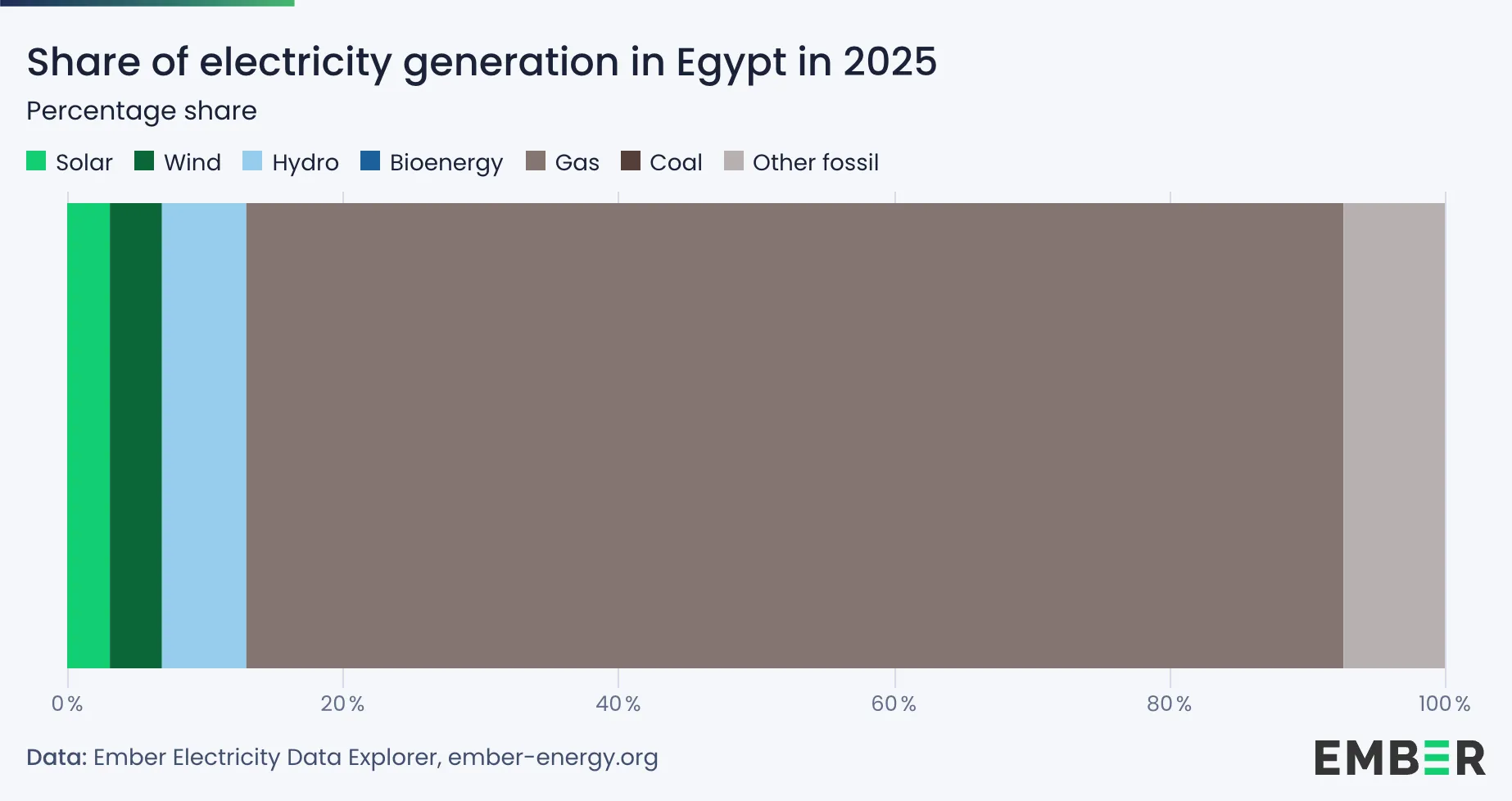
The distance from current figures is large. According to Ember’s latest annual data, of the 245.7 TWh generated in 2025, renewables supplied 31.9 TWh, or 13% — hydro 6.1%, wind 3.8% and solar 3.1%. Gas alone accounted for 79.6%, and fossil fuels in total 87%. Since the renewable share in 2020 was 12%, the rise over five years comes to about one percentage point (Ember, 2026).
Even so, it would not be accurate to speak only of stagnation. According to IRENA, renewable capacity grew from 7.72 GW at the end of 2024 to 9.26 GW at the end of 2025, an increase of about 20% in a year. Wind reached 3.03 GW and solar 3.27 GW, and the renewable share of all generating capacity rose from 12.5% to 14.6% (IRENA, 2026). Projects under construction have clearly begun to come through.
One thing to watch here is the denominator of the target. REN21 classifies Egypt’s 42% target as capacity, while the text of Egypt’s NDC states it as generation (REN21, 2024; Government of Egypt, 2023). Installed capacity and the electricity actually produced are not the same. The 45% for 2028 is likewise described in the announcement as applying to the “energy mix,” a definition that is not clear. To evaluate the target, the government needs to state consistently what it is that will be 45%.
The comfort of gas turned into insecurity of supply
Egypt’s reasons for hurrying on renewables are not only about climate change. The vast Zohr gas field was found in 2015, and Egypt returned to being a gas exporter. After the roughly 1.65 GW Benban solar complex was completed in 2019, the comfort of cheap domestic gas sapped the momentum of renewable development, notes Hatem Tawfik, a local solar developer (Nader, 2026).
That premise did not last. According to the IEA, Egypt’s gas production fell by about 30%, or 21 bcm, between 2021 and 2024, and dropped a further 20% year on year in January–April 2025. Egypt became a net LNG importer in 2024, and pipeline gas from Israel accounted for 17% of primary gas supply in January–April 2025 (IEA, 2025).
In 2023 and 2024, as heat drove up cooling demand, load-shedding caused by fuel shortages hit daily life directly. In June 2024 outage times were temporarily extended by an hour, reaching up to three hours on some days. The government halted the cuts that summer by procuring additional LNG and heavy fuel oil (Reuters, 2024). Dependence on gas that had been thought of as a domestic resource turned into exposure to import prices, foreign currency and neighbouring countries’ supply conditions.
Grids and finance come before power plants
Panels and turbines in the desert are of no use if the electricity cannot be moved. Carrying power from good sites on the Red Sea coast and the Gulf of Suez to demand centres such as Cairo requires substations, backbone transmission lines, batteries and digital control. In March 2026 President Sisi said that a complete renewal of transmission and grid equipment would require $50 billion (Nader, 2026).
Europe has begun putting up money. In June 2026 the EU and the European Investment Bank announced a €690 million package of loans and grants. The state-owned Egyptian Electricity Transmission Company (EETC) plans to connect and integrate 22 GW of solar and wind into the national grid by 2030 and to reduce transmission losses (European Investment Bank, 2026). This is, however, a fraction of the sum said to be needed for the nationwide renewal.
Financial constraints compound matters. The fall of the Egyptian pound raises the burden of imported panels, wind turbines and batteries. The IMF projects inflation of 16.7% in the second half of 2026, citing energy prices and currency depreciation (International Monetary Fund, 2026). Without guarantees and long-term lending from international financial institutions, it becomes hard to structure businesses that buy equipment in foreign currency and recover revenue from electricity tariffs in local currency. Abundant renewable resources do not automatically make investment conditions good.
Electricity that can be used at home, before an export hub
The GREGY submarine cable linking Egypt and Greece is emblematic. Planned capacity is 3 GW over about 1,000 km, at a cost of some €4 billion. As of May 2025 an ambitious schedule of five years to start-up was presented, but the Associated Press reported the plan as still only “proposed” (Gatopoulos, 2025).
Green hydrogen shows the same gap. The government’s dedicated website lists 23 active memoranda of understanding and 15 binding framework agreements. Yet the project pipeline the government itself sets out has feasibility studies, final investment decisions, project contracts and financial close all following the framework agreements (Egypt Green Hydrogen, n.d.). The number of agreements and the number that actually proceed to construction need to be counted separately.
Exports earn foreign currency and help Europe decarbonise. But if export facilities are prioritised while domestic electricity shortages persist, the benefits of the transition will struggle to reach households and rural areas. Speaking to Climate Home News, Tawfik said the country can become a hub only once it can produce beyond what it needs. Expanding rooftop solar and mini-grids is not the opposite of the export vision but its foundation (Nader, 2026).
A small pilot on farmland suggests another path
The Habiba Community pilot described at the outset gives concrete form to this distributed possibility: partial shade from the panels eases high temperatures and evaporation, and the electricity generated is used locally. Following the 6 kW in South Sinai, a 100 kW installation is under construction in Marsa Matruh. Long-term agricultural and environmental data are yet to be collected, so results cannot be asserted at this point (3E, 2026).
There is evidence for the technology’s potential from research elsewhere. In a 45-day experiment in China, cumulative evaporation from the soil surface fell by 21% or 33% depending on the agrivoltaic design (Omer et al., 2022). But if the shade is too deep, crop yields fall. Which crops, at what panel height and spacing, has to be tested site by site.
Agrivoltaics is not a technology that can meet a country’s electricity demand on its own. Even so, if it can run irrigation pumps and small desalination units without waiting for the grid to be finished, it becomes a way of supporting water, food and electricity in the same place. It needs less foreign currency, grid capacity and construction time than large projects, and it spreads the risk of failures and of investment.
Egypt needs thick transmission lines that carry electricity across the Mediterranean. It equally needs small installations that deliver electricity to farmland and villages. The question is not a choice between the giant and the distributed, but in what order, and whose demand is met first. The value of a 45% target cannot be measured by capacity figures alone. Only when blackouts fall, payments for imported gas fall, and farmers’ water and harvests are protected does the transition become something people feel in their lives.
Note: this piece draws on material published as of 20 August 2026.
References
- 3E. (2026, May 28). How a multi-stakeholder partnership is advancing agrivoltaics in Egypt.
- Egypt Green Hydrogen. (n.d.). Green hydrogen. Retrieved August 20, 2026.
- Ember. (2026). Electricity data explorer. Retrieved August 20, 2026.
- European Investment Bank. (2026, June 15). Egypt and EU join forces on €690 million clean-energy grid investment.
- Gatopoulos, D. (2025, May 7). Greece and Egypt reaffirm their commitment to an undersea power cable. Associated Press.
- Government of Egypt. (2023). Egypt’s updated first nationally determined contribution 2030.
- International Energy Agency. (2025). Gas market report, Q3-2025.
- International Monetary Fund. (2026, July 30). IMF Executive Board completes the seventh review under the Extended Fund Facility and second review under the Resilience and Sustainability Facility arrangement for Egypt.
- International Renewable Energy Agency. (2026). Renewable energy statistics 2026.
- Nader, A. (2026, August 3). Egypt seeks to unlock renewable potential to power regional clean energy hub. Climate Home News.
- Omer, A. A. A., Liu, W., Li, M., Zheng, J., Zhang, F., Zhang, X., Mohammed, S. O. H., Fan, L., Liu, Z., Chen, F., Chen, Y., & Ingenhoff, J. (2022). Water evaporation reduction by the agrivoltaic systems development. Solar Energy, 247, 13–23. https://doi.org/10.1016/j.solener.2022.10.022
- Presidency of the Arab Republic of Egypt. (2026, June 14). President El-Sisi meets the Prime Minister and the Minister of Electricity and Renewable Energy.
- REN21. (2024). Renewables 2024 global status report: Renewables in energy supply.
- Reuters. (2024, July 17). Egypt will halt summer load-shedding power cuts Sunday, PM says.