Spain's power system: what changed after the blackout
Spain, where renewables supply more than half the electricity, suffered in 2025 what is considered Europe’s worst blackout in twenty years. The cause was not too much solar but voltage control and market rules that had not kept pace with a changed generation mix. Looking at the battery investment that followed, and at the revenue and regulation behind it, this piece asks what comes next for a country at the front of the transition.
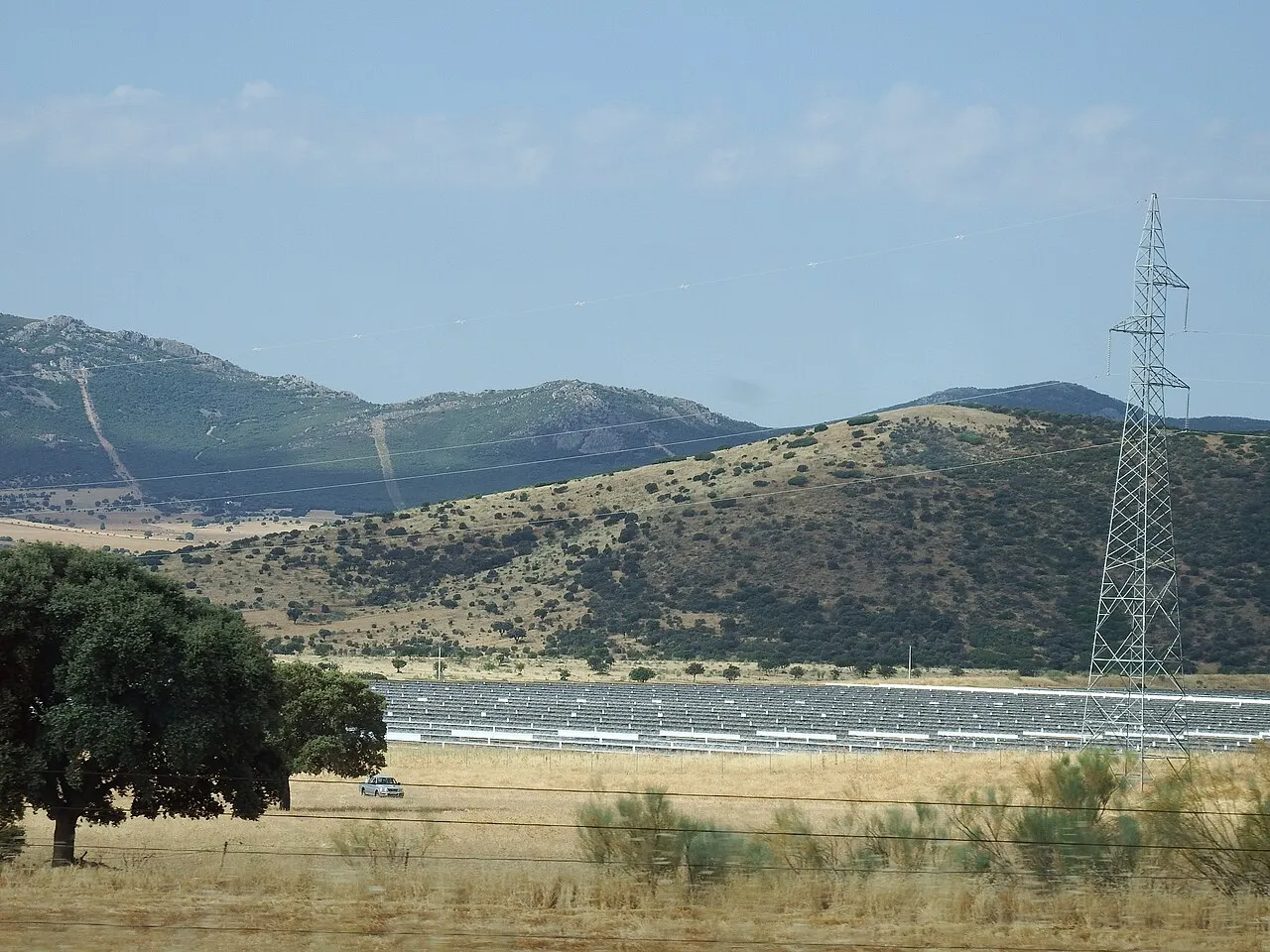
A solar plant and transmission lines in Castilla-La Mancha, Spain. Photo: 19Tarrestnom65 (Wikimedia Commons, CC BY-SA 4.0)

At 12:33 on 28 April 2025, the Spanish and Portuguese power systems collapsed. Traffic lights went dark, the Madrid metro stopped, and mobile base stations and shop payment terminals fell silent one after another. Preliminary figures given by the Spanish government that day put the loss at about 15 GW — roughly 60% of demand at the time — in five seconds. Transmission was restored in Portugal at 00:22 on the 29th and in Spain by 04:00. For several hours, citizens were reminded how deeply a city depends on electricity and communications (La Moncloa, 2025; ENTSO-E, 2026; Joshi, 2026).
The argument that followed leaned towards a simple question: had renewables been pushed too far? Solar and wind had been supplying about 70% of Spain’s electricity in the period before the blackout. But the final report published by ENTSO-E, the European network of transmission system operators, in March 2026 rejected the share of renewables as the cause. What emerged was a more complex problem: system operation, connection rules, monitoring and voltage control had not kept up with the speed at which generation was being replaced (ENTSO-E, 2026).
The cause was not “too much solar”
A power system manages frequency, which balances the quantity of electricity, and voltage, the force that pushes it along. Much of the commentary on the blackout held that fewer rotating machines in thermal and nuclear plants had left the system short of inertia. Inertia is an important system service. But ENTSO-E’s analysis found that even assuming substantially more inertia at the moment of the event, the chain that followed would not have been stopped. What was at the centre this time was voltage rather than frequency.
Several electrical oscillations occurred beforehand. Output then fell sharply in southern Spain and elsewhere, and some generating plants disconnected under conditions other than their intended protection settings. Some conventional plants failed to absorb enough reactive power to bring voltage down. The equipment available to operators for absorbing surplus reactive power and limiting voltage rise, such as shunt reactors, did operate, but static equipment alone has limits against a rapid change. Voltage rose, protection systems acted, and more generation disconnected in a chain.
ENTSO-E concluded that oscillations, insufficient voltage and reactive power control, differing regional practice, rapid loss of output, generator disconnection and an uneven distribution of stabilising capability all came together. The cause cannot be placed on operators, generators or regulators alone. What was exposed was that, although the generation mix had changed, it was unclear who should provide the services that hold the system up, and to what performance (ENTSO-E, 2026).
Generation moved faster than the grid
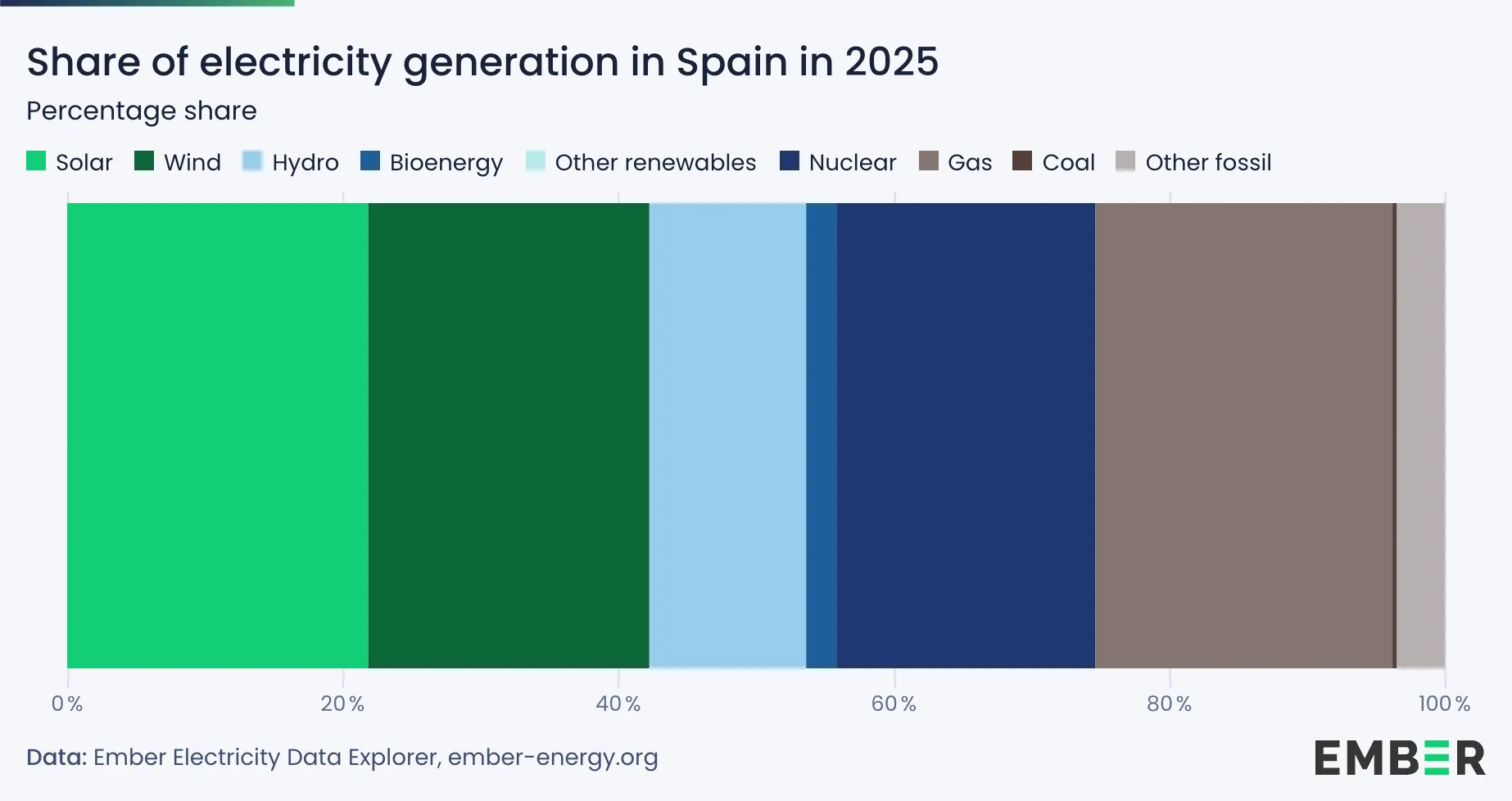
Spain’s renewable expansion is not a failure. It has been a rapid success. According to Red Eléctrica, renewables supplied 56.6% of electricity in 2025 including self-consumption. Solar capacity reached about 50 GW including self-consumption, 33.1% of all installed capacity. Ember’s data puts solar and wind together at about 42% of generation in 2025 (Red Eléctrica, 2026; Ember, 2026a).
Spain is not alone in this. IRENA reports 692 GW of renewables added worldwide in 2025, 85.6% of all new generating capacity. The IEA likewise reports that batteries were the fastest-growing technology in the power sector in 2025 (IRENA, 2026; IEA, 2026). This is no longer an era of accommodating solar and wind as exceptions on an existing grid; it is the stage of redesigning the grid around them.
As solar grows, electricity is abundant at midday in clear weather and output falls away sharply after sunset. A system built to send power one way, from plant to city, now has generation, self-consumption, electric vehicles and batteries all over it. What is needed is not only energy. Transmission lines, interregional links, tariffs that move demand, instantaneous voltage regulation and storage that shifts supply across hours have to be redesigned as one system.
How to read the battery boom
What moved visibly after the blackout was storage. Fundación Renovables, a renewables advocacy group, compiled data from Red Eléctrica and others showing grid-scale batteries in Spain rising from 28 MW in April 2025 to 193 MW in April 2026 — an increase of 589%. Batteries installed alongside self-consumption also grew 119% during 2025, from 155 MWh to 339 MWh (Fundación Renovables, 2026).
The growth rates look dramatic. Even so, 193 MW is a small starting point, far from the several gigawatts of Germany, Italy or the United Kingdom. Red Eléctrica puts storage capacity at the end of 2025 at 3.427 GW, but most of that is pumped hydro (Red Eléctrica, 2026). Lithium-ion batteries, which respond quickly over short periods, and pumped hydro, which suits longer duration, play different roles. Adding capacity figures together does not show what performance the system actually needs.
Batteries have two jobs. One is to store surplus midday electricity and deliver it in the evening. Fundación Renovables estimates that 5,414 GWh of renewable generation went unused in 2025 because of congestion and similar constraints. Batteries reduce that loss and move electricity from cheap hours to expensive ones. The other job, given the right inverters and controls, is to support frequency and voltage quickly. It is not enough to install a large box of electricity: where it connects, which system services it contracts for, and how it behaves during a disturbance all have to be designed.
Layer on the work of Modo Energy, which analyses battery markets, and the business case turns out to depend on more than the day-night price spread. The firm models a 50 MW, four-hour battery operating across energy and balancing markets at actual prices from 2024 onwards. In that model, the average price at which batteries discharged in 2025 was about €90/MWh, 50% above the market average of €60/MWh, because participating in frequency regulation and congestion services widened the revenue opportunity beyond day-ahead and intraday markets (Martinez, 2026a).
This is a simulation under stated assumptions, though, not the accounts of an existing plant. Nor will every installation earn the same as batteries multiply. Modo Energy’s August 2026 estimate has annual revenue from outside the day-ahead market falling 72% per MW as size grows, from €196,000 for a 5 MW battery to €55,000 for a 500 MW one. Balancing markets have limited volume, and batteries compete not only with each other but with pumped hydro, thermal plants and demand response. The larger the pipeline, the more the arrangements that stabilise revenue — long-term contracts, capacity markets — come to matter (Martinez, 2026b).
Gas for now, flexibility later
As an emergency measure after the blackout, operators ran more gas generation in advance than usual to keep voltage control in reserve — the precautionary mode Red Eléctrica calls reinforced operation. Cinco Días, compiling Red Eléctrica’s data, found combined-cycle gas generation from May to October 2025 up about 50% year on year, with additional emissions of some 2.54 million tonnes of CO2. A grid built to advance decarbonisation leaned temporarily harder on fossil fuel in order to stay safe (Ruiz, 2025).
That is not a reason to retreat from renewables; it shows how few means of stabilisation other than gas were available. More batteries, synchronous condensers, pumped hydro, interregional links, demand response and dynamic voltage control from renewable plants would reduce the need to keep thermal plants on standby. In July 2026 Spain’s regulator, the CNMC, revised operating procedures to encourage renewables to take part in voltage control — a step towards turning capability that went underused during the blackout into a remunerated system service (CNMC, 2026).
22.5 GW is not a target for batteries alone
Spain’s national energy and climate plan sets a 2030 storage target of 22.5 GW. That covers not only lithium-ion batteries but pumped hydro and storage at concentrated solar plants. REN21 counts at least 26 countries with policies supporting storage as of the end of 2024, which places Spain’s target among the larger ones internationally (MITECO, 2024; REN21, 2025).
Money to turn the target into plant has started moving. In October 2025 the government announced a provisional allocation of €839.7 million to 143 storage projects totalling 2.4 GW and 8.9 GWh. In July 2026 it awarded €165 million to seven pumped hydro projects, for 2.071 GW and 21.091 GWh (MITECO, 2025, 2026). Yet without permitting, grid connection and a revenue framework, a pile of applications does not become operating plant. Because storage sits between generation and transmission, double charging on the electricity it buys and sells, and how system services are valued, also shape the business case.
The heatwave of summer 2026 showed the next problem early. Ember’s analysis found Spanish electricity demand during the heatwave up as much as 13% on the preceding days, with solar generation 5% above the average for normal days in June and July. Solar carried the daytime balance, while after sunset the balance tightened and Spanish day-ahead prices reached their highest levels since the gas crisis of winter 2022–23. The ability to move daytime electricity into the night now shapes both security of supply and price (Ember, 2026b).
The lesson of the Iberian blackout is not a choice between renewables and reliable supply. It is that adding generation quickly does not complete an energy transition. Spain is moving from the stage of producing a lot of cheap electricity to the stage of delivering it where and when it is needed, and holding the system up when things go wrong. More important than the figure of 22.5 GW is whether batteries, pumped hydro, the grid, demand and inverters can be placed on the same drawing. What the blackout put in question is not the limits of renewables but the speed at which institutions and operations learn to run them as public infrastructure.
References
- Comisión Nacional de los Mercados y la Competencia. (2026, July 10). La CNMC aprueba modificar dos procedimientos de operación para incentivar que las renovables participen en el control de tensión. https://www.cnmc.es/prensa/procedimientos-control-tension-20260710
- Ember. (2026a). European Electricity Review 2026. https://ember-energy.org/latest-insights/european-electricity-review-2026/
- Ember. (2026b, August 13). Solar helps Europe’s grid withstand extreme heat. https://table.media/assets/documents/solar-helps-europe-s-grid-withstand-extreme-heat.pdf
- European Network of Transmission System Operators for Electricity. (2026, March 20). 28 April 2025 blackout. https://www.entsoe.eu/publications/blackout/28-april-2025-iberian-blackout/
- Fundación Renovables. (2026, April 28). The storage revolution: A 589% increase in battery capacity following the power cut. https://fundacionrenovables.org/en/after-the-blackout-the-battery-revolution-installed-capacity-increased-by-more-than-500/
- International Energy Agency. (2026). Global Energy Review 2026. https://www.iea.org/reports/global-energy-review-2026
- International Renewable Energy Agency. (2026). Renewable capacity statistics 2026. https://www.irena.org/Publications/2026/Mar/Renewable-capacity-statistics-2026
- Joshi, K. (2026, April 28). One year after Spain’s blackout, its shift to renewables and grid evolution power on. The Guardian. https://www.theguardian.com/world/2026/apr/28/blackout-spain-renewable-energy-grid-solar-wind
- La Moncloa. (2025, April 28). Pedro Sánchez anuncia que ya “se ha restablecido casi el 50% del suministro eléctrico nacional”. https://www.lamoncloa.gob.es/presidente/actividades/Paginas/2025/280425-presidente-red-electrica.aspx
- Martinez, P. (2026a, July 6). What would a battery have earned in Spain? Introducing the ME BESS ES benchmark. Modo Energy. https://modoenergy.com/research/es-bess-me-benchmark-revenue-stack
- Martinez, P. (2026b, August). August 2026 Spain benchmark update: Liquidity restrictions added. Modo Energy. https://modoenergy.com/research/spain-bess-asset-size-liquidity-methodology
- Ministerio para la Transición Ecológica y el Reto Demográfico. (2024, September 24). Plan Nacional Integrado de Energía y Clima 2023–2030. https://www.miteco.gob.es/content/dam/miteco/es/energia/files-1/pniec-2023-2030/PNIEC_2024_240924.pdf
- Ministerio para la Transición Ecológica y el Reto Demográfico. (2025, October 27). Sara Aagesen anuncia la asignación de 840 millones a 143 proyectos que reforzarán el almacenamiento energético. https://www.miteco.gob.es/es/prensa/ultimas-noticias/2025/octubre/sara-aagesen-anuncia-la-asignacion-de-840-millones-a-143-proyect.html
- Ministerio para la Transición Ecológica y el Reto Demográfico. (2026, July 20). El MITECO adjudica 165 millones en ayudas a siete proyectos innovadores de almacenamiento energético mediante bombeo reversible. https://www.miteco.gob.es/es/prensa/ultimas-noticias/2026/julio/el-miteco-adjudica-165-millones-en-ayudas-a-siete-proyectos-inno.html
- Red Eléctrica. (2026, March 11). The Spanish electricity system in 2025. https://www.ree.es/en/press-office/news/press-release/2026/03/the-spanish-electricity-system-in-2025-electricity-demand-generation-and-installed-power-capacity-increase
- REN21. (2025). Renewables 2025 global status report. https://www.ren21.net/gsr-2025/
- Ruiz, C. (2025, November 4). La producción eléctrica con gas se dispara un 50% por la gestión reforzada de REE tras el apagón. Cinco Días. https://cincodias.elpais.com/companias/2025-11-04/la-produccion-electrica-con-gas-se-dispara-un-50-por-la-gestion-reforzada-de-ree-tras-el-apagon.html