Ethiopia's EV shift: a future without importing petrol
In 2024 Ethiopia banned imports of petrol and diesel cars as a matter of principle. Why would a country with neither an adequate charging network nor universal electricity access choose a policy without precedent anywhere in the world? Following a giant dam, Chinese EVs and a Japanese entrepreneur’s electric two-wheelers, this looks less like the story of an environmental leader than a national survival strategy built around foreign currency and fuel.
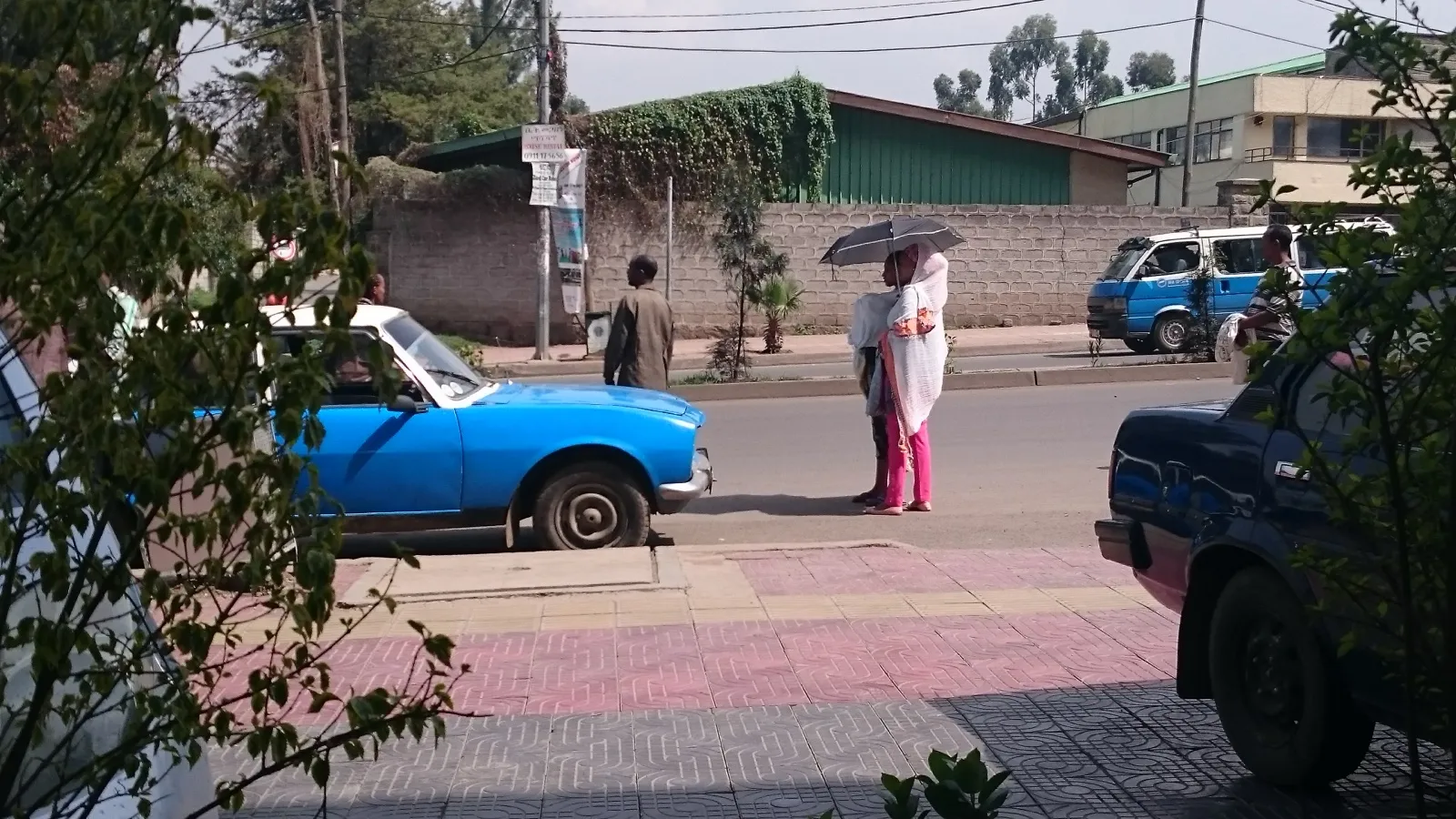
People waiting for a taxi in Addis Ababa (2015). Even after the import ban, the petrol and diesel vehicles already in the country keep running. Photo: Alacoolwiki (Wikimedia Commons, CC BY-SA 4.0)

In the spring of 2026, fuel shortages once again shook how people in Ethiopia get around. According to the Associated Press, the country spends about $4.2 billion a year on fuel imports, with subsidies running as high as $128 million a month. When conditions in the Middle East left import volumes more than 180,000 tonnes short of plan, the government renewed its case for the shift to EVs as a way to cushion supply shocks from abroad (Olingo, 2026).
That scene captures well how the decision in January 2024 — the world’s first general ban on imports of petrol and diesel cars — was about more than climate policy. Ethiopia produces no crude oil and depends on imports for almost all its fuel. At home, meanwhile, it has electricity made from water. Keep paying foreign currency for oil, or turn its own water into motive power: the government chose the latter.
Foreign currency comes before decarbonisation
The timing of the policy matters too. Ethiopia failed to make an interest payment on its eurobond in 2023 and effectively defaulted. In July 2024 it liberalised its exchange rate regime and embarked on reforms supported by about $3.4 billion over four years from the International Monetary Fund (IMF). The IMF explains that before the reforms the economy suffered from a shortage of foreign currency, high inflation and debt problems. Foreign reserves had recovered to about $4 billion by April 2025, still short of two months of imports (IMF, 2025a, 2025b).
A fuel bill of $4.2 billion a year is on the scale of nearly exhausting those recovered reserves. EVs do not avoid foreign currency entirely, since batteries and components are imported. Even so, once a vehicle is bought, its daily motive power can be switched to domestic electricity. The import ban is a policy that turns each future new car, one at a time, from a machine that continuously drains foreign currency into a consumer of domestic electricity.
Tax policy points the same way. EVs are exempt from value-added tax on import and on domestic sale, and semi-knocked-down kits and local assembly face lower tariffs than fully built vehicles (International Trade Administration, 2024). Into a market where old petrol cars had been changing hands at high prices, relatively cheap Chinese EVs poured in. What is banned is not driving existing vehicles but new imports. In practice, therefore, old internal-combustion cars and new EVs will coexist for a long time.
A giant dam created the precondition
Underpinning the policy is the Grand Ethiopian Renaissance Dam (GERD) on the Blue Nile. Completed in September 2025, this huge project with over 5,000 MW of generating capacity and a cost of some $5 billion is expected to roughly double the country’s generating capability (Associated Press, 2025).
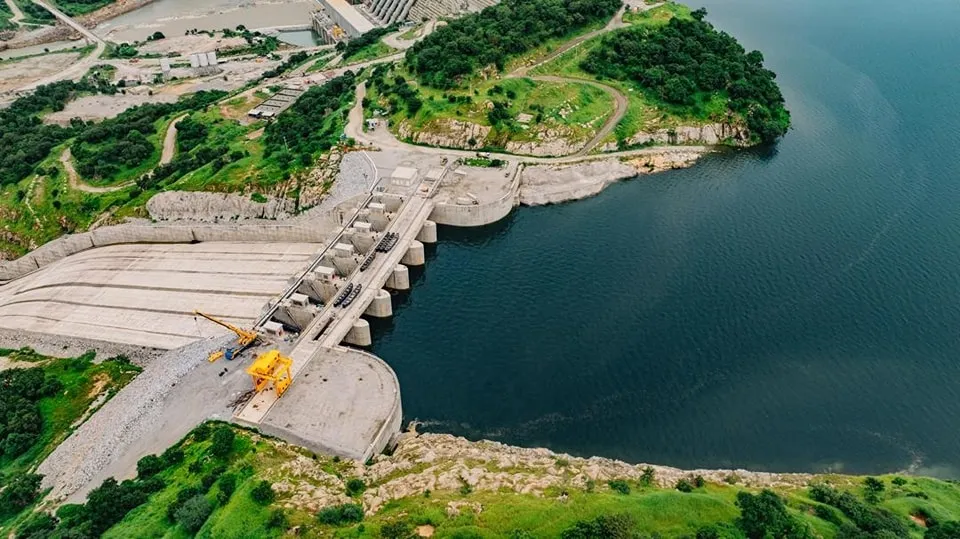
The Grand Ethiopian Renaissance Dam on the Blue Nile (August 2024). Photo: Prime Minister Office Ethiopia (Wikimedia Commons, public domain)

Even before GERD was finished, generation was heavily weighted towards renewables. The latest statistics from the International Renewable Energy Agency (IRENA) put hydro capacity at the end of 2025 at 9,214 MW (IRENA, 2026). REN21 also reports that Ethiopia was among the world’s largest additions of hydro capacity in 2024 (REN21, 2025). Even as EVs grow, this is not a mix in which demand for oil or coal rises sharply at the generation stage.
But “having power stations” and “being able to use electricity reliably anywhere” are different things. The World Bank’s latest figure puts the electricity access rate in 2023 at 55.4%. Some 56.4 million people still cannot use electricity (World Bank et al., 2025). Even in Addis Ababa there are outages and voltage drops, and in rural areas there is no distribution network at all. The government’s 2025 national electrification target, noted on the IEA’s country page, was not met either (IEA, n.d.). Transmission and distribution networks that carry the electricity from a large dam to homes, factories and chargers are the next problem.
The opacity of the figures also deserves attention. Ember, examining electricity statistics for 54 African countries, judged that for Ethiopia it could not confirm public domestic data allowing the breakdown of generation to be tracked (Cunliffe & Tunbridge, 2025). The figure for “what percentage of electricity is hydro” differs slightly between international agencies and news reports. Unless installed capacity, actual generation and the electricity that could be transmitted are distinguished, one misreads a reality in which abundant generation and blackouts sit side by side.
A market of 115,000 vehicles, and dependence on China
The vehicle shift has nonetheless moved quickly. A new strategy from the Ministry of Transport and Logistics says EV registrations rose from 7,000 in 2022 to 115,000 in 2025. The Associated Press likewise reported more than 115,000 as of May 2026, about 8% of the national fleet (Ministry of Transport and Logistics, 2026; Olingo, 2026). If new-vehicle choices are restricted to EVs, a sharp rise in the adoption rate is only to be expected. What matters is who supplies that market.
Africa imported 44,358 EVs from China in 2025, more than double the year before. Ethiopia accounted for about a third of them. The government is trying to grow not just imports but local production, planning 17 EV assembly plants with a vision of expanding to 60 by 2030 (Olingo, 2026).
There is a new dependence here. Even as dependence on oil falls, much of the supply of bodies, batteries, electronic components, diagnostic equipment and maintenance expertise rests on Chinese supply chains. In AP’s reporting in 2024, owners described EVs immobilised while waiting for parts, a shortage of mechanics able to repair them, and the difficulty of charging (Asadu, 2024). Local assembly, too, stops without the dollars to buy imported components — the contradiction that an industry meant to relieve the foreign currency shortage needs foreign currency at the start-up stage.
Filling the charging gap from two-wheelers
Closer to daily life than four-wheelers, Dodai — founded by the Japanese entrepreneur Yuma Sasaki — assembles electric two-wheelers. It sold 850 units in a little under a year to March 2025, winning support from delivery businesses. One shop told Rest of World it had replaced three petrol two-wheelers and reduced fuel and maintenance costs that had run to $150 a month per vehicle (Dosunmu, 2025).
What Dodai chose next was not charging a vehicle plugged in for hours but battery swapping — exchanging a depleted battery for a fully charged one in about two minutes. A planned joint venture with a state investment fund was terminated in March 2025 (Ethiopian Investment Holdings, 2025). The company nonetheless carried on alone, and in April 2026 raised $13 million in equity and debt combined. With more than 2,000 vehicles already deployed, it is aiming for 30 swap stations and 3,000 users in Addis Ababa over the coming year (Dodai, 2026).
This is the idea of electrifying, without waiting for public chargers to be built, the people who ride every day for deliveries and work. Separating the battery from the vehicle price also lowers the purchase cost. On the other hand, swap stations need reliable distribution supply, standardisation, and enough spare batteries. In mid-2025 there were only a dozen or so public charging sites in the country, against a government estimate of more than 1,170 needed (Chan et al., 2026). The very business of filling the charging gap requires investment in transmission and distribution.
Creating the market first, without waiting for infrastructure
It would not be accurate to call Ethiopia’s attempt simply a success of environmental policy. People who cannot replace their existing vehicle bear rising fuel prices, and people who have bought an EV struggle with outages, repairs and parts shortages. For the many who cannot own a car, the benefits arrive only if electric buses and two-wheeler taxis increase. On GERD, agreement with downstream Egypt and Sudan on water use also remains outstanding.
Even so, the policy has shown a different order for an emerging economy’s energy transition. Rather than expanding EVs once an adequate charging network and incomes are in place, it uses import restrictions to create the market first and has generation, transmission and distribution, charging, assembly and maintenance catch up afterwards. The order looks rough, but a country short of the foreign currency it spends on fuel imports cannot afford to wait patiently.
The numbers by which to judge it are not only EV counts. Do fuel imports fall? Does rural electricity access improve? Do public transport fares fall? Do components and jobs stay in the country? Are the people who depend on old cars left behind? What Ethiopia is pursuing is not a luxurious choice made for the environment. It is an experiment in replacing imported oil with electricity made at home, and keeping the country running on limited foreign currency.
References
- Asadu, C. (2024, November 3). Ethiopia bans imports of gas-powered private vehicles, but the switch to electric is a bumpy ride. Associated Press.
- Associated Press. (2025, September 9). Ethiopia inaugurates Africa’s largest hydroelectric dam as neighbors eye power imports.
- Chan, H.-H., Delgado, A. L., & Ghosal, A. (2026). Chinese EVs make inroads in developing countries, but charging networks lag. Associated Press.
- Cunliffe, G., & Tunbridge, P. (2025). African electricity data transparency. Ember.
- Dodai. (2026, April 28). Dodai raises $13 million Series A to build the future of urban e-mobility in Africa.
- Dosunmu, D. (2025, March 24). How a Japanese entrepreneur built Ethiopia’s fastest-growing EV maker. Rest of World.
- Ethiopian Investment Holdings. (2025, March 22). EIH announces termination of MoU with Dodai Group Inc..
- International Monetary Fund. (2025a). The Federal Democratic Republic of Ethiopia: 2025 Article IV consultation.
- International Monetary Fund. (2025b, May 28). Ethiopia’s central bank: Leading transformative reform.
- International Energy Agency. (n.d.). Ethiopia (accessed 25 August 2026).
- International Renewable Energy Agency. (2026). Renewable capacity statistics 2026.
- International Trade Administration. (2024, January 18). Ethiopia: Import tariffs.
- Ministry of Transport and Logistics. (2026). E-mobility strategy and implementation plan 2025–2030.
- Olingo, A. (2026, May 9). Fuel shortages and high prices push adoption of EVs in Africa, led by Ethiopia. Associated Press.
- REN21. (2025). Renewables 2025 global status report: Hydropower.
- World Bank, International Energy Agency, International Renewable Energy Agency, United Nations Statistics Division, & World Health Organization. (2025). Tracking SDG 7: The energy progress report 2025.