Romania's power flexibility: sun to spare, and not enough at night
Romania combines a diverse set of generating resources: hydro, nuclear, coal and gas, wind and solar. Few countries in Europe have such a varied mix. Yet Romania now faces the paradox of surplus electricity on sunny afternoons and reliance on imports after sunset. The problem is not a shortage of renewable energy. It is that grids, storage and market rules have not kept pace with the addition of generating capacity.
In August 2026 that weakness became visible. Record drought lowered the level of the Danube, and both units at Cernavodă, the country’s only nuclear plant, shut down. Hydro output was also poor, and the government asked households and businesses to save electricity. Even with solar meeting 40% of demand at midday, imports from Bulgaria and Ukraine were essential in the evening. Citing the shortfall, the government told the EU it would keep coal plants that had been due to close. What Le Monde depicted was less a failure of decarbonisation than a power system lacking flexibility being tested by extreme weather. [1]
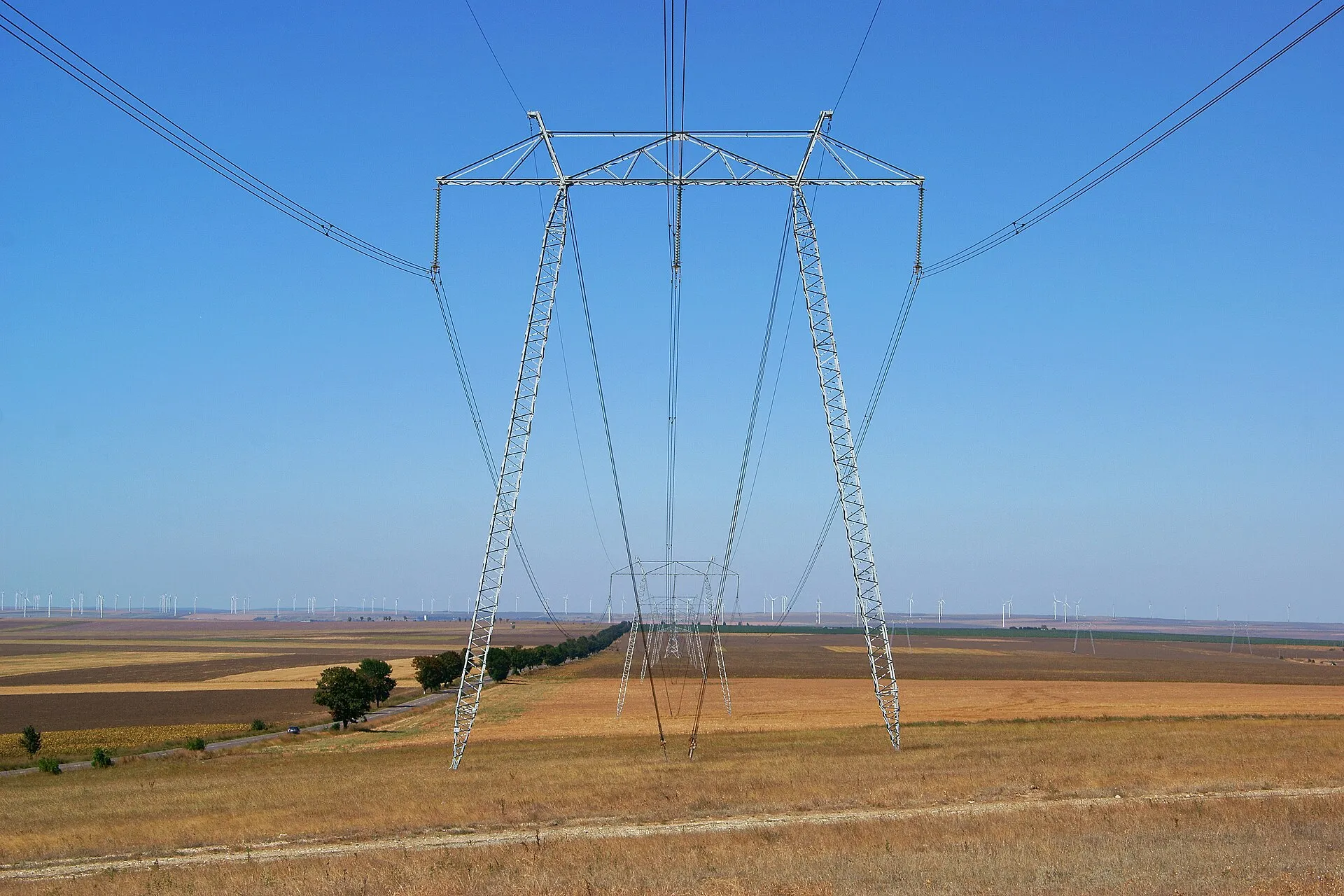
A 400 kV transmission line in Constanța County, Romania, with the Cogealac wind farm in the distance. Photo: Alexandru Panoiu / Wikimedia Commons (CC BY 2.0)

“Installed capacity” and “usable electricity” are not the same
Judged by the numbers alone, the transition is rapid. Ember’s 2025 data shows Romania’s renewable capacity reaching 16.3 GW, of which solar accounted for 6.24 GW. Solar grew by about 2 GW, or 46%, in a single year. In generation terms renewables reached 23.41 TWh, 47.0% of total generation. Including nuclear, the low-carbon share was 67.5%. IRENA’s statistics confirm solar capacity rising from 4.26 GW in 2024 to 6.24 GW in 2025. [2][3]
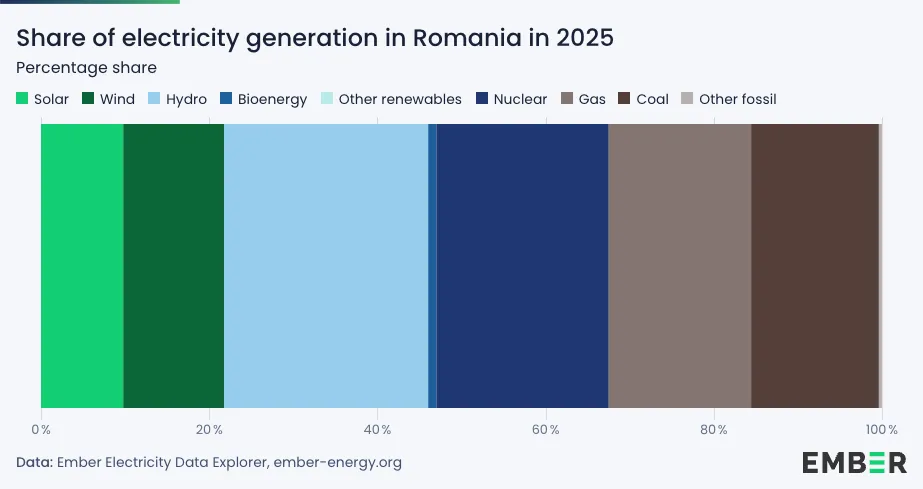
In the same year, however, total domestic generation came to only 49.78 TWh, below demand of 53.6 TWh. According to Ember, net imports were 3.82 TWh, 29% more than the year before. Weather and ageing plant lie behind this. While solar generation rose 42% year on year to 4.87 TWh, hydro fell 15%, wind 7% and nuclear 6.5%. Adding up the capacities on equipment nameplates does not produce “electricity that arrives when it is needed,” once rain, wind, sunlight, scheduled outages and transmission constraints are taken into account.
Within the EU single market, of course, imports need not be seen as a failure in themselves. Exchanging power with neighbours is cheaper than every country holding spare thermal plant, and it helps security of supply. The issue is the difference between importing deliberately in cheap hours and having to buy at high prices in the evening when domestic supply has fallen. Romania’s task is not complete self-sufficiency but having enough flexibility, at home and regionally, not to lose bargaining power when drought, still air and a nuclear outage coincide.
The 47% renewable share of generation is also a different indicator from the 2030 target of 38% of final energy consumption. The latter includes heating, industrial heat and transport fuels. Adding solar in the power sector alone will not get there; electrification of demand through heat pumps, EVs and district heating is also needed. Put the other way round, the more demand electrifies, the more new places there are to absorb midday surpluses.
Nor is this specific to Romania. IRENA’s figures show 692 GW of renewables added worldwide in 2025, 85.6% of all new generating capacity. [4] The IEA, meanwhile, stresses that expanding renewables requires modernising distribution networks, new transmission corridors and grid-scale storage. [5] What follows the race to build power plants is a stage of competing on when and where the electricity generated can be used.
Negative prices are a mark of success and an alarm
The surge in solar has split the wholesale day in two. At midday, oversupply pushes prices to near zero and sometimes below. After sunset, solar disappears, and the high generating costs of the thermal plant or imported power needed last pull the whole market price up. On 1 June 2025, the local journalist Mihai Nicuț reported eight consecutive hours of negative prices in the day-ahead market. [6] Yet according to the European Commission, Romania’s day-ahead prices that year averaged €110/MWh, the fourth highest in the EU. Cheap in the middle of the day, the evening highs squeeze households and industry. The average spread between high and low within the day was €156/MWh, well above the EU average of €121. [7]
Reading negative prices only as “evidence of too much renewables” is therefore a mistake. They are a mark of success in deploying cheap solar and, at the same time, an alarm signalling a shortage of ways to move demand into cheap hours, of storage, of cross-border transmission and of plant whose output can be adjusted easily. In its Renewables 2025 Global Status Report, REN21 noted that pairing solar with storage is becoming standard in many markets in order to reduce curtailment and price volatility. According to the same report, global battery deployment grew about 65% in 2024. [8]
Romania’s government has also shifted the emphasis of policy from installing panels to storing electricity. In August 2026 the environment ministry published a draft scheme putting 400 million lei into batteries for prosumers — households and others that generate with solar and sell the surplus. [9] Grid-scale storage has grown to about 1.1 GW and 2 GWh on industry estimates, but that is still too small to support moving solar from day to night. Across the border, Le Monde reports, Bulgaria has built 14–15 GWh with EU funds. Romania’s pattern of exporting midday surpluses cheaply and buying back dearly at night shows how a shortage of storage can also become an outflow of national wealth.
The success of CfDs and the bet on grid capacity auctions
The machinery for attracting investment is falling into place. In two contract-for-difference (CfD) auctions run with support from the European Bank for Reconstruction and Development (EBRD), a total of 4.2 GW of wind and solar won contracts stabilising their selling price for fifteen years, above the initial 3.5 GW target. In the second auction the lowest solar price was €35/MWh. [10] Rezolv Energy’s “Dama Solar,” with a planned capacity of 1.04 GW, would be among Europe’s largest when complete. With an average awarded solar price of about €40.4/MWh, Romania is clearly a low-cost development market. [11]
But contracting a great deal of cheap generation is worth nothing if it cannot connect to the grid. Because connection capacity could previously be reserved first come, first served, projects with little prospect of being built inflated grid planning. Order 53/2024 from Romania’s energy regulator ANRE made new generation and storage projects of 5 MW and above subject to connection capacity auctions from 2026. A further amendment set the 2026 participation guarantee at €20,000 per MW applied for; a 50 MW project must tie up €1 million in advance. [12]
The first call drew 12 projects totalling 491 MW, with bidding due to open on 30 October, pv magazine reports. [13] The reform turns grid capacity from a right to reserve for free into a scarce asset acquired by committing money. It can be expected to reduce speculative projects with little prospect of completion. On the other hand, there is a risk that the market tilts towards large players able to post the guarantees, shutting out local firms and innovative smaller developers. What should be examined is not financial strength alone but feasibility, including land, permits, procurement, storage and offtake.
The strategies required of developers change too. Rather than a model of obtaining a connection permit and selling the project on, it becomes advantageous to co-develop with local companies to contain permitting risk, and to combine CfDs with corporate PPAs under which companies buy electricity directly from generators. Beyond that, designs are needed that use storage to sell electricity from cheap hours into expensive ones and to earn from contributions to balancing and firm capacity. What matters is not the size of installed capacity but the timing of connection, the transmittable volume, and how many megawatts can be delivered for how many hours after sunset. Lenders, too, will look harder at revenue under curtailment and at delays in grid reinforcement, not just cost per MW.
Make the replacement capacity usable before closing coal
The remaining difficulty is political. The national energy and climate plan, as summarised by the IEA, sets out 38% of final energy consumption from renewables in 2030 and the phase-out of coal generation by 2032. [14] In August 2026, however, parliament amended the decarbonisation law so that coal closures can be delayed until equivalent low-carbon capacity is operating. The European Commission has said it will examine whether this affects the conditions for meeting the recovery and resilience plan. [15]
Simply setting “the EU’s ideals” against “domestic security of supply” gets nowhere. What is needed is not a choice between extending coal and closing it immediately but a roadmap that makes replacement capacity available, in usable form, by the deadline. Concretely: (1) investing ahead of need in networks and interconnectors; (2) building a connection regime that assesses solar and wind together with storage and demand response; and (3) revenue design that combines CfDs with corporate PPAs and payment for balancing services. Storage, too, should not be fixed on a uniform “four-hour” format: short-cycle frequency regulation, shifting the evening peak, and coping with several consecutive days of drought or still air should be considered separately.
Romania is not a renewables laggard. It is, rather, a leading case in which the pace of solar deployment has overtaken the institutions and infrastructure of the power system. The first act, competing on the quantity of generating capacity, is already succeeding. The lead roles in the second act belong to the grid, storage, flexible demand and market discipline that can tell which projects are real. Can a country with sun to spare become one with enough electricity at night? Whether it becomes eastern Europe’s green hub rests on that.
References
- [1] Le Monde. (2026, August 14). Romania’s only nuclear power plant shuts down over low Danube water levels.
- [2] Ember. (2026). Yearly electricity data [Data set].
- [3] International Renewable Energy Agency. (2026). Renewable capacity statistics 2026.
- [4] International Renewable Energy Agency. (2026, April 1). Near-700 GW surge in 2025 proves renewable energy resilience.
- [5] International Energy Agency. (2025). Power. In Breakthrough agenda report 2025.
- [6] Nicuț, M. (2025, May 31). Energia electrică se vinde la preț negativ azi în România, timp de opt ore. Economica.net.
- [7] European Commission. (2026). 2026 country report: Romania.
- [8] REN21. (2025). Renewables 2025 global status report: Solar PV factsheet.
- [9] Ministerul Mediului, Apelor și Pădurilor. (2026, August 18). Program pentru finanțarea bateriilor pentru sisteme fotovoltaice.
- [10] European Bank for Reconstruction and Development. (2025). Romania delivers second successful renewable energy auction.
- [11] Jowett, P. (2025, August 13). Romania awards 1.4 GW of solar at average €40.46/MWh in second auction. pv magazine.
- [12] Autoritatea Națională de Reglementare în Domeniul Energiei. (2026). ANRE a adoptat modificările la regulamentele de racordare și licențiere.
- [13] Jowett, P. (2026, August 21). Romania proceeds with first grid capacity auction. pv magazine.
- [14] International Energy Agency. (2024). National energy and climate change plan: Romania.
- [15] AGERPRES. (2026, August 6). EC to review impact of Parliament-approved amendments to decarbonisation law.