Taiwan's aquavoltaics: sharing a water surface, in technology and in rules
Lay solar panels over a fish pond and the same water yields both fish and electricity. Six years on, Taiwan’s “fishery-electricity symbiosis”, pursued as the answer to a shortage of land, faces a situation in which most of the projects now exporting power cannot be shown to be farming anything. Where did it come apart?
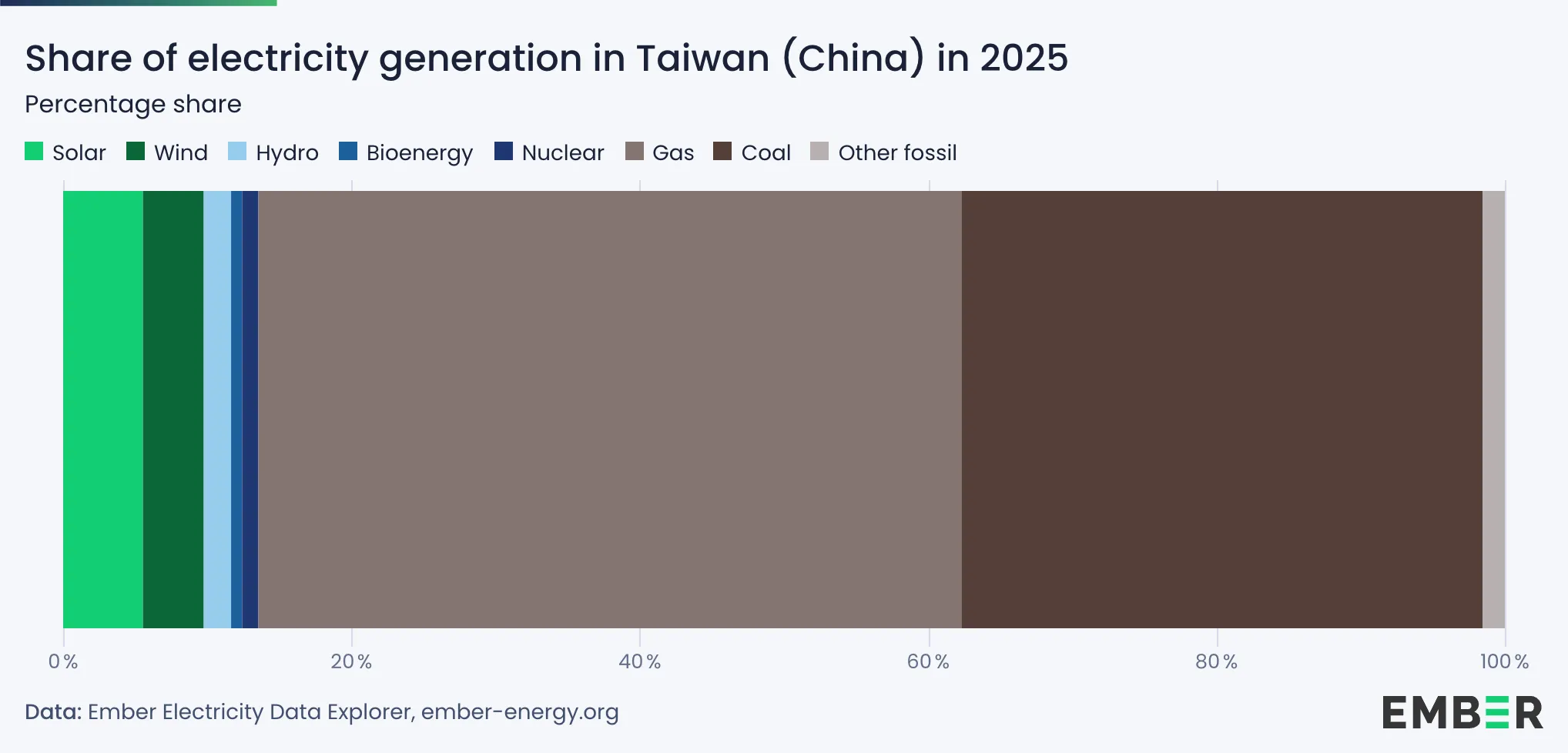
Taiwan’s electricity still leans heavily on fossil fuels. According to Ember’s data, fossil fuels supplied 86.5% of generation in 2025, while solar came to 5.6% (16.1 TWh) — below the world average of 8.8%, Japan’s 9.8% and South Korea’s 6.0% (Ember, 2026). Worldwide, solar capacity grew by about 510 GW in 2025, reaching a cumulative 2,383 GW (IRENA, 2026).
That is not to say Taiwan has stood still. IRENA’s statistics show solar capacity rising about twelvefold, from 1.2 GW in 2016 to 15.5 GW in 2025 (IRENA, 2026). Even so, the government’s target of 20 GW by 2025 was missed and the deadline pushed to November 2026. Rooftop installations have gone well, while ground-mounted capacity reached about 6 GW against a 12 GW target (Kang, 2026). The cumulative total as of August 2026 is around 16 GW (Hsieh, 2026).
Pressure from the demand side is building too. Taiwan Semiconductor Manufacturing Company (TSMC) used 28.77 billion kWh of electricity in 2025, about a tenth of the country’s total. Renewables make up only 11.4% of its supply in Taiwan, and the company has signed renewable purchase contracts for 7.3 GW (Reccessary, 2026). On a mountainous, densely populated island, where is solar to go? What the government settled on were the fish ponds spread along the western coast.
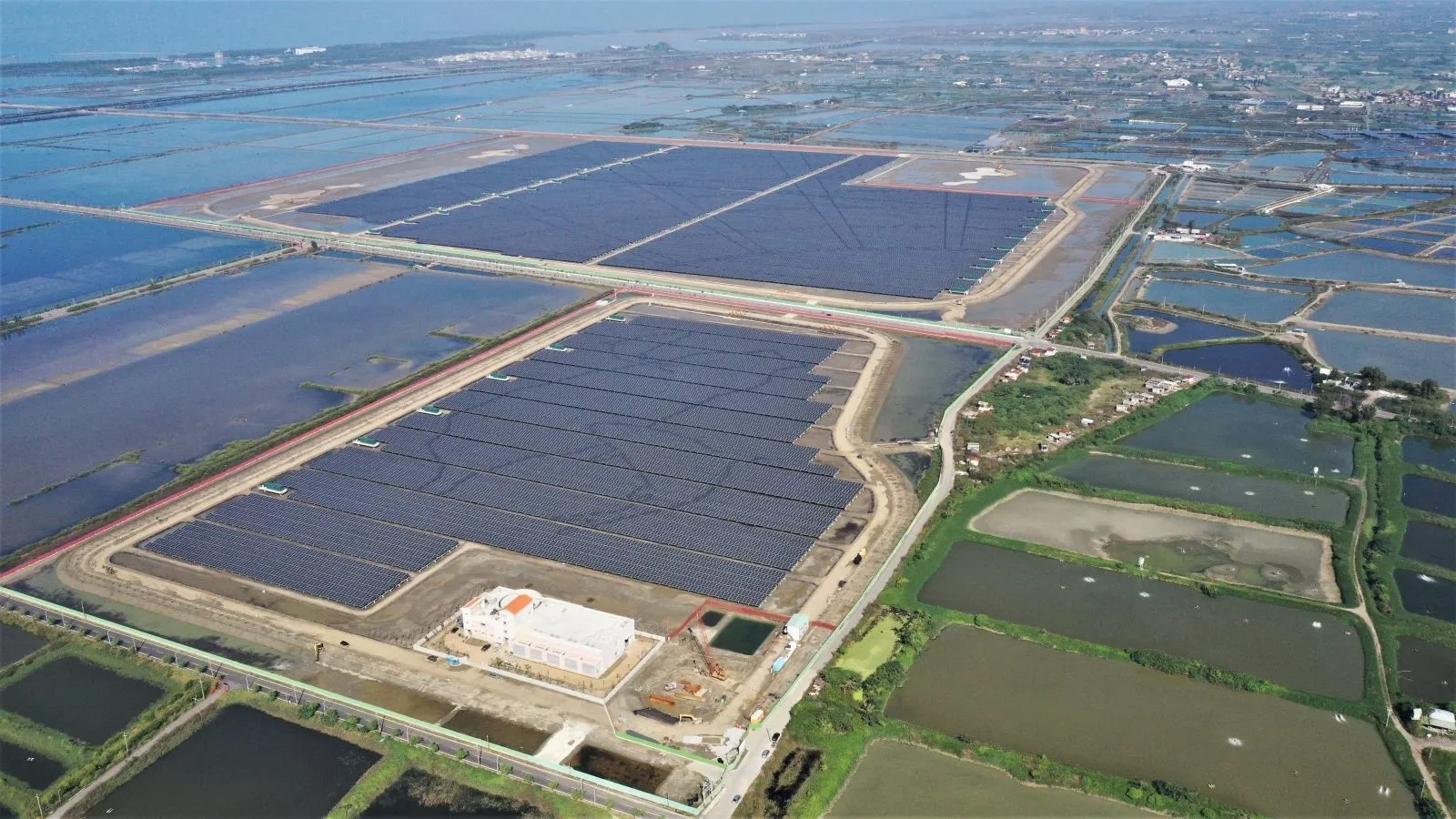
Taipower’s Tainan Salt Field solar plant in the Qigu and Jiangjun districts of Tainan (2022). Built on former salt pans, it is not an aquavoltaic project, but fish ponds surround it. Photo: Taiwan Power Company (Wikimedia Commons, attribution)

A design in which farming leads and generation follows
Fishery-electricity symbiosis, which began in earnest in 2020, allows solar to be installed over ponds, on embankments and on the roofs of indoor farms, on condition that aquaculture continues. The government designated 12,533 hectares of special zones across six counties and cities — Changhua, Yunlin, Chiayi, Tainan, Kaohsiung and Pingtung — and set a target of 4.4 GW by 2025 (Lin Ching-hua, 2022).
In the outdoor model, panels may cover no more than 40% of a pond, and production must be kept at 70% or more of what it was (REGlobal, 2026). The indoor model puts panels across the whole roof of a large farming shed and raises shrimp and other species at high density. A demonstration facility at Beimen in Tainan suggested production could be quadrupled relative to an outdoor pond (Lin Ching-hua, 2022). The outdoor model adds generation while changing the existing farming as little as possible; the indoor model invests capital to upgrade the farming itself. Solar on water is drawing international attention in its own right: REN21 cites a 440 MW floating installation in a Changhua industrial zone as among the largest in the world (REN21, 2024).
On the ground, some have made it work. Tsai Chia-tsung, who raises hard clams at Beimen in Tainan, lost five million juveniles in his first year. He kept refining the setup with the developer, and by 2025 was harvesting above 70% of the national average. Tseng Chin-chuan, who raises tilapia in the same district, had no harvest for the first two years and now gets yields much like those from ponds without panels. The Taiwanese investigative outlet The Reporter summed up the view from the ponds: the farming is not the hard part — dealing with the developers’ and the government’s rules is (Sun & Huang, 2026b). In September 2025 a project at Qigu in Tainan reported its first clam harvest, eight months after stocking (Wu, 2025). Fish and shellfish can grow under panels. What decides it is whether there is someone to raise them, and a contract that supports that person.
What “power but no fish” revealed about the rules
In the summer of 2025 a report from the National Audit Office drew attention. Of 393 projects exporting power as of January 2025, only 122 had been inspected. Of those, 85 — 69.67% — faced corrective orders or revocation, for not farming or for other reasons. The Fisheries Agency countered that “revocations are only 12%”; the gap between the two figures is whether a corrective order counts as a failure (Wu, 2025). The auditors did note, though, that the correction window ran up to a year and that power could be sold throughout, which they called “lacking in propriety” (World Journal, 2025). A project under a corrective order went on running as a power plant.
In March 2026 The Reporter published its own tally. Of completed projects, just 4% had passed inspection; measured by capacity, 96% were not meeting their aquaculture plans. Cumulative connected capacity was about 1.01 GW, less than a quarter of the 4.4 GW target. Newly connected capacity in 2025 was 0.02 GW, down sharply from 0.36 GW the year before. A further 489 projects totalling 1.47 GW were stalled in a tightened approval process (Sun & Huang, 2026a). The farming has not materialised and the capacity has not grown. Neither purpose is being served.
The cause lay in the order of the procedure. Developers could connect to the grid for trial operation, and earn revenue from power, before any farming record had been verified. Once generation has locked in the profit, the incentive to persist with troublesome aquaculture weakens. In July 2025 the government revised the inspection guidelines to version 4.0. Outdoor projects must show a farming record within six months of connection; indoor projects must obtain approval before connecting. The yield standard is 70% of the national average over the previous three years. The correction window is three months as a rule, and if the agricultural side revokes its approval the generation licence is revoked with it. Either production-history certification or IoT water quality monitoring is also required (Goodwill Energy, 2026). “Fish first, power after” has finally been written into the rules.
Rents, migratory birds and scandal
Money from solar has changed what land is worth in the fishing villages. Tseng Chin-chuan had been renting ponds from his brother at NT$50,000 per hectare a year; his brother now leases that land to a solar developer for NT$400,000 (Sun & Huang, 2026b). Tseng can still farm under the equipment, but when rent rises eightfold, tenant farmers who own no land are easily pushed out.
The ponds of Qigu district in Tainan are also an important feeding ground for the endangered black-faced spoonbill. The Tainan Wild Bird Society reports that while national numbers are rising, the population around Qigu appears to be falling, and is concerned about the connection with solar development. In May 2024, fifteen people including a former city official and developers were indicted over permits for small projects (Kuo et al., 2024). The Storm Media reported in 2025 that local opposition was shifting from protest towards a resignation that nothing said would make any difference (Feng, 2025).
Corporate scandals have followed as well. At TSC Green Energy, backed by the state-linked Taiyen Biotech, former chairman Chen Chi-yu and others were indicted for diverting profits to outside companies, with prosecutors seeking twelve years (Wang, 2025). The trial continues, and in September 2026 his travel restrictions were extended by eight months (Shao, 2026). In June 2026, three employees of TCC Green Energy were detained on suspicion of inflating construction costs on an aquavoltaic project in Chiayi County and taking kickbacks of more than NT$50 million (Shao & Huang, 2026).
A division of labour, or a severing of responsibility?
The rules are shifting again in 2026. In March the Ministry of Agriculture floated a draft under which solar developers would bear no responsibility for aquaculture provided they built to the government’s design guidelines, with the farming carried by fishery associations or young aquaculture operators. Industry figures objected that it “pushes responsibility onto the farming side, which has no power to enforce anything,” and researchers criticised it as contrary to the principle that farmland is for farming (Lin Chi-yang, 2026). Agriculture Minister Chen Junne-jih explained that “fish and power are not being decoupled; each is being returned to its own expertise” (Yeh, 2026), and the new arrangement is to run alongside the old as an option.
There is something reasonable in separating generation from farming. Solar developers have no expertise in aquaculture, and there are cases, like Tsai’s, where a capable producer gains from the equipment. The question is who verifies that the farming continues once the two are separated, and who carries the loss. Without a mechanism to put part of the generation revenue into upgrading the aquaculture, contracts that favour tenant farmers, and zones closed to development at ecological pinch points like Qigu, a division of labour slides towards a severing of responsibility.
Japan’s own agrivoltaics requires, as a condition of temporary farmland conversion, that crop yields not fall more than 20% below the local average. Setting a yield standard is the same idea as Taiwan’s 70%. Taiwan’s six years show that setting the standard is not enough. If power can be sold before anyone checks whether the standard is met, farming becomes an add-on the developer can defer. A procedure that verifies the farming record before the power is sold; a sharing of the value that comes from the land; and a line drawn around the places living things need. Without all three, dual use is a name and nothing more. Taiwan’s experience, driven by a numerical target, shows what a country short of land has to decide first when it sets out to grow renewables.
Note: this piece draws on material published as of 7 October 2026.
References
- Ember. (2026). Yearly electricity data [Data set]. Retrieved October 7, 2026.
- Goodwill Energy. (2026, July 10). 一文看懂:漁電共生「養殖事實查核指引4.0」——先養魚,才有電.
- International Renewable Energy Agency. (2026). Renewable capacity statistics 2026.
- Kang, T. (2026, March 18). Taiwan misses 2025 renewable target as coal power remains above goal. Eco-Business.
- Reccessary. (2026, August 28). 台積電永續報告書:用電增12.6%、拚範疇三減15%.
- REGlobal. (2026, September 28). Global impetus: Policies and incentives for scaling up floating solar.
- REN21. (2024). Renewables 2024 global status report: Solar PV.
- Wang, J. (2025, February 27). 台鹽弊案損害金額逾8億元 前董座陳啟昱遭檢方求刑12年. Liberty Times.
- Wu, C.-a. (2025, September 11). 漁電共生案場採收首批文蛤 政策上路5年現況一次看. PTS News.
- Lin, C.-y. (2026, March 12). 漁電政策史詩級轉彎?農業部草案,開發商「設光電、免養殖」,撼動農地農用原則. News&Market.
- Lin, C.-h. (2022, May 7). 漁電共生1.2萬公頃專區 2025拚4.4GW. Liberty Times.
- Sun, W.-l., & Huang, H.-m. (2026a, March 15). 「養殖為主」淪口號?漁電共生完工案場僅4%通過查核──獨家數據還原光電卡關真相. The Reporter.
- Sun, W.-l., & Huang, H.-m. (2026b, March 15). 當養殖變成一件必須被證明的事──漁電共生5年,誰真的養出魚?. The Reporter.
- World Journal. (2025, September 8). 農業結合綠能?台灣漁電共生「近7成有電無魚」原因曝. World Journal.
- Hsieh, I.-h. (2026, August 20). 能源署:再生能源目標極大化 克服法規20GW非光電上限. Central News Agency.
- Kuo, C.-j., Yeh, C.-c., & Chang, K.-t. (2024, May 29). 光電找出路|真正的農電共生 有辦法嗎?【我們的島】. PTS News.
- Feng, C.-c. (2025, August 11). 地方從抗議到無奈噤聲!環保團體爆制度漏洞嘆:根本是「逐層侵入式擴張」. The Storm Media.
- Yeh, K.-y. (2026, March 18). 駁漁電共生政策轉彎 陳駿季:漁電不脫鉤 回歸各自專業. United Daily News.
- Shao, H.-c. (2026, September 23). 台鹽綠能弊案…陳啓昱延長限制出境出海8月 每日自拍上傳2次. United Daily News.
- Shao, H.-c., & Huang, Y.-f. (2026, June 14). 台泥綠能傳弊!涉收回扣逾5千萬元 3人遭押. United Daily News.