Malaysia's rooftop solar: from electricity to sell to electricity to use
On 1 January 2026 the rules for rooftop solar in Malaysia changed. Net energy metering (NEM), which had run for close to a decade, ended, and the new Solar ATAP (Solar Accelerated Transition Action Programme) began. Under the new scheme it pays better to use your own electricity than to sell the surplus. The household rebate and the corporate tax incentive both run out at the end of 2026. Demand is swelling too, as data centres multiply. This piece reads what is happening to rooftop solar there from official data and local reporting.
The distance between a 70% target and 2% in practice
Under its National Energy Transition Roadmap (NETR), the Malaysian government aims to raise renewables to 70% of installed capacity by 2050. Renewable capacity reached 14.86 GW in 2025, or 32% — slightly ahead of the 31% the roadmap set as a waypoint (The Sun, 2026).
Measured by generation, the picture changes. According to Ember (n.d.), fossil fuels supplied 79% of Malaysia’s electricity in 2025. Low-carbon sources accounted for 21%, less than half the world average of 43%, and most of that is hydro. Solar and wind together come to about 2%.
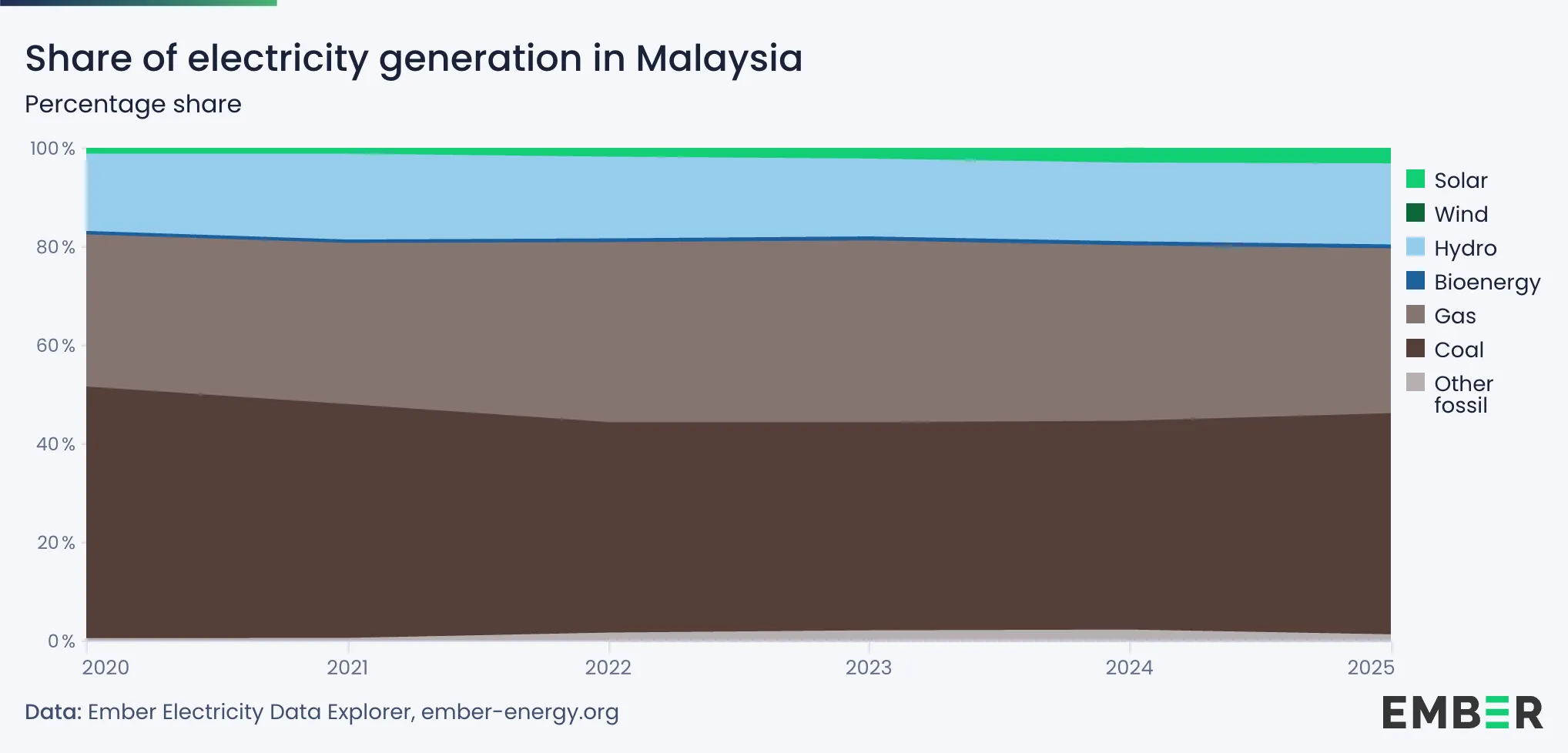
Figures for solar capacity differ sharply between sources. Data from the IEA’s Photovoltaic Power Systems Programme (IEA-PVPS) puts the cumulative total at the end of 2025 at 5,777 MW, with about 1,448 MW added during the year (Jowett, 2026). IRENA’s statistics, by contrast, show 3,074 MW for both 2024 and 2025, unchanged (IRENA, 2026). Both are estimates, and one or other may not have caught up. The more a country’s capacity sits in small rooftop installations, the harder it is to measure — and that weakness in the statistics is what this gap shows.
The 2.7 GW that net metering built
Malaysia introduced a feed-in tariff (FIT) in 2011 and moved to net energy metering in 2016. A 2019 revision made it one-for-one, offsetting each kWh exported against a kWh imported, and uptake accelerated. NEM 3.0, which began in 2021, split the scheme into three quotas:
- NEM Rakyat, for households
- NEM GoMEn, for government bodies
- NEM NOVA, for commercial and industrial users
The three together were capped at 2,400 MW. The residential quota was topped up repeatedly to 600 MW, and applications very nearly filled that as well (The Edge Malaysia, 2025). NEM closed in June 2025 with 2,747 MW installed across its three generations (Jowett, 2026). Rooftop installations alone thus exceed the 2,648 MW of large-scale solar (LSS).
What changed with Solar ATAP
Solar ATAP does not buy surplus electricity for cash either. What goes to the grid is recorded as a credit against the electricity bill, and that credit reduces what the utility charges for power bought in the same month. Two things matter to a household: what a kWh of credit is valued at, and what happens to credit that goes unused.
According to the guidelines the Energy Commission published in December 2025, Solar ATAP works as follows (Suruhanjaya Tenaga, 2025):
- Capacity may be installed up to 100% of contracted maximum demand. Households are limited to 5 kW single-phase and 15 kW three-phase; non-residential installations are capped at 1 MW
- A credit is worth, for households, the energy portion of the tariff (RM 0.27/kWh up to 1,500 kWh a month). For non-residential users it is the monthly average of the wholesale system marginal price (SMP)
- Credits can only be set against the energy charge, not against the fuel cost adjustment (AFA) or fixed charges
- Unused credit does not roll into the following month; it expires
- Participation runs for ten years. The government sets the overall capacity, and applications are taken first come, first served
Under NEM, unused credit could be carried forward. Solar ATAP removes that carry-forward and lowers the value of exported power to part of the retail tariff, or to the wholesale price. Covering a roof in panels in order to sell no longer pays. What is called for instead is sizing the system to daytime consumption and using the output yourself. The Edge Malaysia likewise notes that household savings come “not from selling but from daytime self-consumption” (The Edge Malaysia, 2026).
At the same time, the ceiling has widened to 100% of maximum demand, and the fixed national quota is gone (Baker McKenzie, 2026). The queues that formed under NEM when a quota filled are unlikely to recur. More people can take part, but each installation gains less from export. That is the trade Solar ATAP makes.
The household rebate pays less per kW and reaches more homes
For households, the 2024 SolaRIS scheme paid a cash rebate of RM 1,000 per kW [1], capped at RM 4,000. On 22 May 2026 the Ministry of Energy Transition and Water Transformation (PETRA) announced its successor, SuRIA Home, at RM 600 per kW and capped at RM 3,000. The budget is RM 150 million, expected to cover 250 MW across 45,000 to 50,000 households. Applications run from 1 June to 31 December on a first-come basis, and the home must be commissioned under Solar ATAP (Bernama, 2026).
The rate is down by 40%, but the budget now reaches more households. Even so, a household still faces RM 15,000 to RM 40,000 upfront. Professor Norasikin Ahmad Ludin, director of the Solar Energy Research Institute at Universiti Kebangsaan Malaysia (UKM), notes that unclear cover for damage from storms or lightning strikes is another reason people hesitate (Rajan, 2026). Alongside rebates, building trust in insurance and in installation quality is part of what makes adoption spread.
Corporate investment decisions, and data centres
For companies there is the Green Investment Tax Allowance (GITA). Solar for self-consumption falls under “Tier 2,” where 60% of the investment can be claimed. The allowance can be set against up to 70% of statutory income each year, and anything unused carries forward until fully absorbed. Battery storage (BESS) and EV charging equipment are “Tier 1,” at 100%. The allowance applies to investment spent by 31 December 2026 (MGTC, 2024). On an RM 1 million solar investment, GITA reduces tax by RM 144,000 at the 24% corporate rate; combined with ordinary capital allowances the relief approaches 40% of the investment. Solar leasing — where a developer rents a roof and sells the electricity — has its own incentive (GITE), exempting 70% of income for up to ten years.

A floating walkway fitted with solar panels at the Faculty of Engineering, Universiti Putra Malaysia (UPM), Selangor, January 2024. It is part of “SURIA 16,” a project with TNB’s GSPARX to extend solar across the campus roofs and grounds. Photo: Wee Hong (Wikimedia Commons, CC BY-SA 4.0)

What is changing corporate procurement most is data centres. According to the Energy Commission, data centres have risen to 9.28% of national electricity consumption, and are projected to reach 31% of peninsular demand by 2035 (Selan, 2026). In February 2026, citing shortages of power and water, the government restricted non-AI data centre development for 18 months to two years (Thoo & Egli, 2026).
Because roof area is finite, large consumers also use the Corporate Renewable Energy Supply Scheme (CRESS) to buy from a distant generator across the network. The system access charge for wheeling has come down in stages from 25 sen/kWh in 2024 to 14 sen/kWh by September 2026. Participants now number eleven generators and eight consumers, totalling 3.15 GW (Nair, 2026). Analysts at Aurora caution, though, that the charge is reviewed every three years, which unsettles the financing of long-term contracts (Thoo & Egli, 2026).
Growing solar takes grid flexibility
Ember estimates that the cost of solar generation in Malaysia fell to $0.029/kWh in 2023, 53% below fossil fuels. Peninsular demand, however, peaks twice, at 4 pm and at 8 pm, and solar cannot meet the evening peak on its own. Once solar passes 20% of the mix, Ember’s analysis finds, investment in storage becomes unavoidable (Nadhila & Setyawati, 2024).
That Solar ATAP removed the carry-forward and put self-consumption first fits these grid conditions. Rather than pushing the midday surplus onto the system, use it on site or move it to the evening with a battery. Making storage eligible for the full 100% allowance under GITA points the same way.
Malaysia’s rules are remaking rooftop solar from an investment recouped by selling into equipment that lowers a bill. The household rebate and the corporate tax incentive both come to a line at the end of 2026. How the 2027 budget treats them is what to watch next.
[1] “kW” here counts the alternating-current capacity of the inverter (kWac), not the direct-current rating of the panels (kWp). Panels are commonly oversized relative to the inverter by 10–30%, so a 5 kWac system typically carries around 6 kWp of panels.
References
- Baker McKenzie. (2026, January). Malaysia: 2026 updates to renewable energy schemes.
- Bernama. (2026, May 22). Petra launches SuRIA Home with solar rebates up to RM3,000 for domestic users – Fadillah.
- Ember. (n.d.). Malaysia. Retrieved October 2, 2026.
- International Renewable Energy Agency. (2026). Renewable capacity statistics 2026. IRENA.
- Jowett, P. (2026, April 3). Malaysia’s solar capacity surpasses 5.7 GW. pv magazine.
- Malaysian Green Technology and Climate Change Corporation. (2024). Guidelines for green technology tax incentive: GITA asset.
- Nadhila, S., & Setyawati, D. (2024, August 7). Solar and grid flexibility critical for Malaysia’s future electricity affordability and security. Ember.
- Nair, K. (2026, September 22). Solar gold rush gets CRESS lift. The Star.
- Rajan, K. (2026, March 27). Overcoming barriers to residential solar adoption. The Star.
- Selan, S. (2026, September 9). Data centres and prolonged heat are pushing Malaysia’s power demand higher. Eco-Business.
- Suruhanjaya Tenaga. (2025). Guidelines for Solar Accelerated Transition Action Programme in Peninsular Malaysia (GP/ST/No. 60/2025).
- The Edge Malaysia. (2025). Residential rooftop solar quota under net energy metering fully taken.
- The Edge Malaysia. (2026). Know your stuff: What homeowners should look at before buying a solar PV system.
- The Sun. (2026). Malaysia’s renewables capacity reaches 14.86GW.
- Thoo, D., & Egli, P. (2026, March 9). The limits to growth: The Malaysian way of navigating the data centre boom. pv magazine.