Sudan's solar and water pumping: an involuntary energy transition
In the civil war that began in April 2023, Sudan’s generating capacity fell to a quarter of its pre-war level. Amid long blackouts and high fuel prices, farmers, households and water facilities are installing solar panels themselves. This change, which barely appears in official statistics, has become a way to protect water and food — while running into high upfront costs, poor equipment quality and the absence of finance.
In Omdurman, next to the capital Khartoum, Randa al-Mansour, a 31-year-old housewife, says: “When kids arrive at school in the morning, they find no electricity there, so they are forced to head back home, where there is none either.” This is everyday life in Sudan as reported by the Associated Press in September 2026 (Associated Press, 2026). In many areas blackouts run to 16 hours a day, and in the intense summer heat both air conditioners and refrigerators stop. Manahel Madany, a 43-year-old civil servant with diabetes who lives in Shendi in the north, says: “Every three to four days, I am forced to throw away all my insulin stock after it goes bad due to heat and power outages.”
Solar power is spreading in this country. Not because of any large government programme. People who can no longer count on either grid electricity or fuel are putting panels on their own roofs and farmland, with their own money.
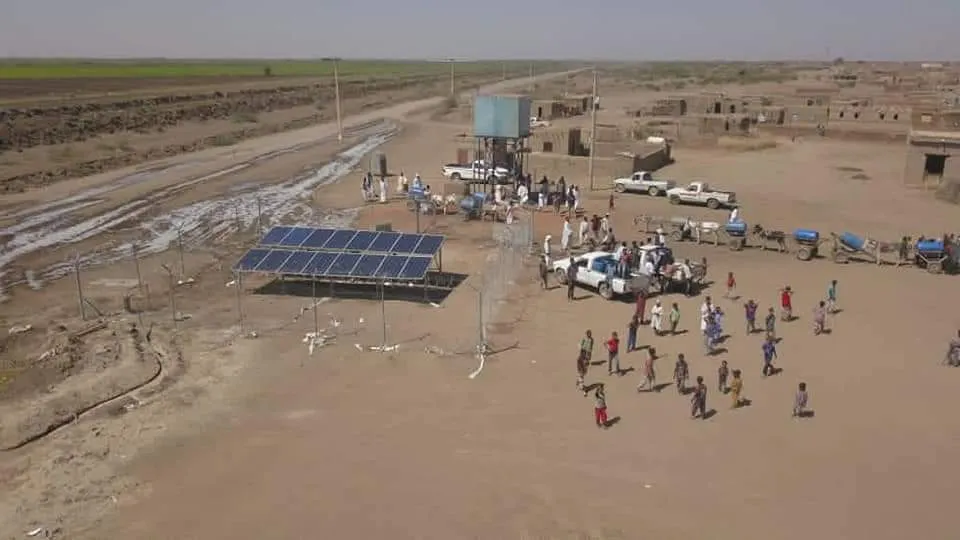
A solar-powered water station in the village of Arak al-Katib, with residents who have come by donkey cart to collect water (June 2021). Photo: Ibrahim Ali Mohamed (Wikimedia Commons, CC BY-SA 4.0)

A gigawatt that does not show up in the statistics
Judged by official statistics, solar in Sudan has barely grown. In the International Renewable Energy Agency’s Renewable Capacity Statistics 2026, Sudan’s solar capacity is flat at 190 MW from 2022 through 2025 — and that figure is treated as an estimate (IRENA, 2026).
Import data tells a different story. Data compiled by the UK think tank Ember from Chinese customs statistics shows solar panel exports from China to Sudan rising roughly tenfold, from about 60 MW in 2024 to about 580 MW in 2025. The cumulative total since 2017 reached about 1,250 MW by July 2026, more than six times the official installed capacity (Ember, 2026). Across Africa as a whole, Ember finds panel imports from China in the year to June 2025 up 60% year on year at 15 GW, and names Sudan among the countries where imports grew sixfold (Jones, 2025).
Imports do not translate directly into installations. At the same time, according to the United Nations Development Programme (UNDP), more than 90% of equipment bound for Sudan used to pass through Dubai’s Jebel Ali port before the war (UNDP, 2026). Since some volumes therefore do not appear in direct exports from China, the accurate statement is that nobody has a full grasp of how much has actually been deployed.
What drove this was the collapse in panel prices. Sudan’s import prices fell from $0.38 per watt in early 2017 to $0.05–0.10 by mid-2025. For the same monthly import value of around $15 million, capacity additions that were slight in 2022 amounted to about 100 MW by early 2025.
From 4,400 MW to 1,100 MW
Behind this lies the collapse of a centralised power system. Sudan’s electricity was generated by hydro on the Nile and by thermal plants, and delivered to cities over the transmission network. In IRENA’s statistics, hydro alone accounts for 1,482 MW.
Once fighting began, power plants, substations and transmission lines were damaged. According to the Associated Press, generating capacity fell from 4,400 MW before the war to 1,100 MW, and close to half of the country’s skilled power engineers left since 2023. UNDP estimates damage to generation and networks at up to $3 billion (UNDP, 2026). According to Tracking SDG7 2026, compiled by the International Energy Agency (IEA), the World Bank and others, 17.2 million people in Sudan were without access to electricity as of 2024 (IEA et al., 2026).
In the spring of 2026, tensions in the Middle East also sent fuel prices sharply higher. Al Jazeera reported petrol prices in Sudan rising more than 40% in a matter of weeks, and quoted Yasser al-Balhawi, a 48-year-old bus driver in Khartoum: “My day is no longer measured by the number of trips I make, but by the number of hours I spend at gas stations” (AlMan, 2026). Life that depends on a generator is also nearing its limit.
Sudan, meanwhile, is one of the world’s most sun-rich countries, often with more than 4,000 hours of sunshine a year. Repairing the grid takes time and money; panels generate electricity from the day they arrive.
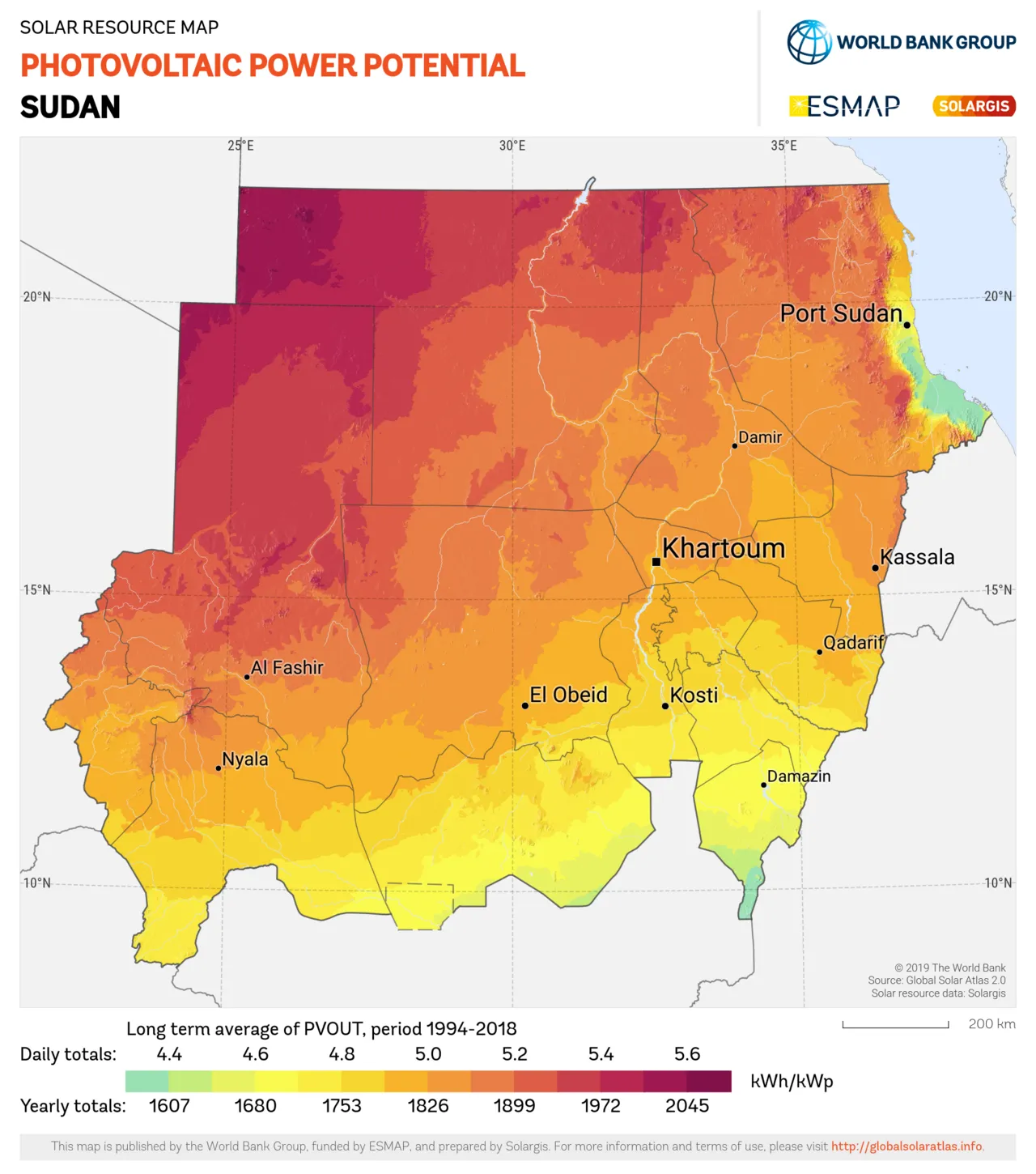
Sudan’s solar power potential (PVOUT). Annual generation per kW of installed capacity is about 1,600 kWh in the south and over 2,000 kWh in the north-west (long-term average, 1994–2018). Source: World Bank Group, ESMAP & Solargis, Global Solar Atlas 2.0 (Wikimedia Commons, CC BY 4.0)

Demand that says “I just want water”
Where the spread of solar is most visible is agriculture. Farming is a pillar of Sudan’s economy and employment, but irrigation pumps have relied on diesel or grid electricity. According to UNDP, the running cost of a diesel generator now reaches up to ten times that of solar.
In the Gezira irrigation scheme in central Sudan, there are areas where the canals have stayed dry since May 2024. As the environmental outlet Mongabay reported, Abdelhafiz Mohammed, who farms at South Shendi along the Nile, spent the equivalent of $17,900 on solar pumps that can irrigate about 6.3 hectares (15 acres) (Dahab, 2026). Demand has doubled since 2023, according to the local supplier GSB Solar, whose supply manager Mohamed Al-Haj said: “Most buyers do not ask about long-term returns. They repeat one phrase: ‘We just want water so we don’t lose another season.’”
The effects can be confirmed in the numbers. When UNDP piloted solar water pumping at 29 farms in Northern State with funding from the Global Environment Facility (GEF), land use and productivity rose by nearly 50%, and the area cultivated in the hot, dry summer grew 87%. About 960 litres of diesel per acre per season became unnecessary (UNDP Sudan, 2020). The African Development Bank (AfDB) also approved a $21.78 million grant in 2019 to install 1,170 solar pumps in North and West Kordofan, subsidising 75% of the upfront cost (UNDP, 2026).
Solar is entering urban water supply as well. In Kassala in the east, UNDP solarised two water pumps in August 2024, raising daily supply from 200,000 to 450,000 litres. Since the fighting began, UNDP has supported the rehabilitation and solarisation of more than 30 water stations, delivering about 13 million litres a day to some 850,000 people (UNDP Sudan, 2024). Here solar is the foundation that protects water, food and health care.
Cheap panels, expensive solar
The problem is that only a limited number of people can enjoy these benefits. Panels have never been cheaper on world markets, but the fall of the Sudanese pound has pushed local prices the other way. In UNDP’s interviews, a 550 W panel rose from about 75,000 pounds before the war to about 330,000 pounds in 2025, and a 200 Ah battery from about 250,000 to about 900,000 pounds. A typical 10 kW household system costs nearly $5,000. Mohey Eddin Abu-Bark, who runs a solar systems business in Khartoum, told AP: “For a low-income family, installing a solar panel system is a huge sacrifice but an inevitable choice.”
Distribution is another barrier. When the United Arab Emirates banned maritime trade with Sudan in August 2025, the supply route through Dubai was cut. Importers were left with no option but to buy directly from China by the container, paying in full in advance. Customs clearance at the port takes up to two and a half months, and transit fees and taxes that differ from state to state are added on top. Damaged panels and panels with labels misstating their rated output are circulating in the market, damaging consumer trust (UNDP, 2026).
International finance has not arrived either. According to Tracking SDG7 2026, international public flows for renewables in 2010–24 did not reach even 0.1 cents per person in Sudan. Countries in conflict are the places that need the money most and can receive it least.
How this differs from South Sudan
South Sudan, which became independent in 2011, is on a different path. In IRENA’s statistics, its solar capacity grew from 4 MW in 2021 to 45 MW in 2025. In the capital Juba, a 20 MW solar plant with 14 MWh of battery storage began operating in 2025 (SolarQuarter, 2025). REN21’s Renewables 2025 Global Status Report also notes that financing has been secured for an interconnector with Uganda (REN21, 2025). This is centralised development: strengthening the urban grid and connecting to a neighbour.
Sudan’s solar is doing the opposite, spreading in scattered fashion across farmland, homes and water stations. UNDP has called this an “involuntary” energy transition. It is resilient to blackouts, but the quality of installation and the maintenance are left to each individual owner. Panels exposed to high temperatures and dust storms — haboobs — lose performance if cleaning and parts replacement are neglected. According to REN21, renewable energy employment across the African continent stood at only 324,000 in 2023, and training of technicians is not keeping up. In Sudan, those technicians are themselves leaving the country.
Making scattered generation a foundation for reconstruction
What is needed are the institutions to support this spontaneous adoption: small loans repayable in local currency, quality testing and warranties, training of rural technicians, and statistics that capture how much is actually installed. As the cost of pumping falls, the risk of over-abstracting groundwater also appears. In Pakistan, the spread of solar pumps and falling water tables have already coincided. Managing how water is used has to be considered at the same time.
When the war ends, rebuilding the grid will begin. Whether the solar and storage scattered around the country are left behind at that point, or incorporated as part of the system, will make a large difference to what reconstruction looks like. In the dark, the people of Sudan have begun building the foundations of a distributed power system with their own hands. Whether institutions can be prepared to make use of that foundation is the next question.
References
- AlMan, A. (2026, April 16). Sudan power crisis: Studying using candles, counting gas station trips. Al Jazeera.
- Associated Press. (2026, September 6). Sudan’s war-driven blackouts push residents toward solar power but high costs shut many out. WTOP News.
- Dahab, A. (2026, March 17). War exacerbates long-standing irrigation crisis for Sudan farmers. Mongabay.
- Ember. (2026). China solar PV exports data [Data set]. Retrieved September 26, 2026.
- International Energy Agency, International Renewable Energy Agency, United Nations Statistics Division, World Bank, & World Health Organization. (2026). Tracking SDG7: The energy progress report 2026.
- International Renewable Energy Agency. (2026). Renewable capacity statistics 2026.
- Jones, D. (2025, August 26). The first evidence of a take-off in solar in Africa. Ember.
- REN21. (2025). Renewables 2025 global status report: Global overview.
- SolarQuarter. (2025, February 10). Ezra Group launches 20 MW solar power project with 14 MWh battery storage in South Sudan.
- United Nations Development Programme. (2026). Solar energy value chains in Sudan.
- UNDP Sudan. (2020, June 19). Solar for agriculture: Empowering farmers in Sudan. ESI Africa.
- UNDP Sudan. (2024). Solarized water pumps unveiled to deliver up to 450,000 liters of clean water per day in Kassala City.