Abu Dhabi's energy geopolitics: an oil producer's twenty-year strategy
On 1 May 2026 the United Arab Emirates left the Organization of the Petroleum Exporting Countries (OPEC) and OPEC+ (Al Jazeera, 2026a). The decision came at a time when fighting between the United States and Israel on one side and Iran on the other, which began at the end of February, had sharply reduced transits of the Strait of Hormuz and Gulf oil producers were close to losing their export outlet. The IEA has described the disruption as the largest supply interruption in the history of the world oil market (Hancock, 2026).
Abu Dhabi, the UAE’s capital, is also home to the headquarters of the International Renewable Energy Agency (IRENA) and to Masdar, which holds 65 GW of renewable projects worldwide. A country seeking to raise oil output is at the same time one of the world’s leading players in renewables, hydrogen and climate finance. This two-sidedness is not a contradiction but the front and back of a national strategy assembled over twenty years.
From an experimental desert city to IRENA’s headquarters
The starting point is 2006. Masdar was established under the state investment company Mubadala, and the concept of “Masdar City,” a zero-carbon city for 50,000 people, began to move. Construction started in 2008, but the global financial crisis that followed immediately drove investors away. In 2016 Suzanne Goldenberg of The Guardian reported that only about 5% of the planned area had been completed, that its residents amounted to some 300 graduate students, and that the zero-carbon goal had been dropped, writing that it risked becoming “the world’s first green ghost town” (Goldenberg, 2016).
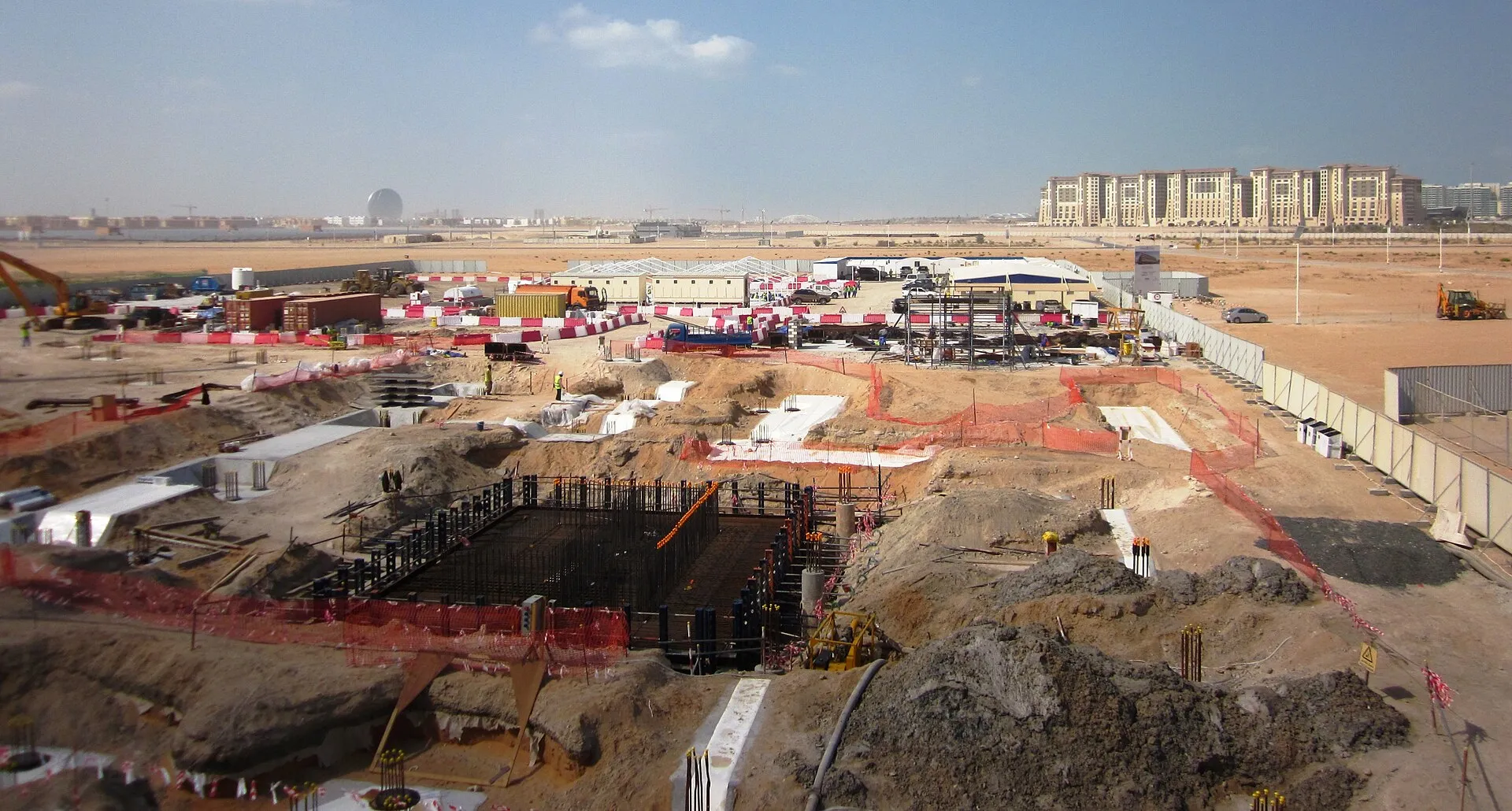
Masdar City under construction, Abu Dhabi, January 2012. Photo: Jan Seifert (cropped by Beyond My Ken) / Wikimedia Commons (CC BY 2.0)

While the city development stalled, the diplomatic stage produced a major result. In June 2009, at the IRENA preparatory commission held in Sharm El Sheikh, Egypt, Abu Dhabi was chosen as the seat of the headquarters. The contest with Germany (Bonn) and Austria was settled by a division of roles, with an innovation and technology centre in Bonn and a liaison office in Vienna (IRENA, 2009). By welcoming an international renewable energy institution, the capital of an oil producer acquired the standing of a petro-state that can speak about decarbonisation.
Masdar’s value then shifted from “city” to vehicle for investment and diplomacy. Masdar City itself has been reviving as a research and business cluster: by 2025 more than 2,000 companies were registered in its free zone (Masdar City, 2025). The original ideal was not realised, but the country’s shrewdness lies in having turned the failure into a base for building international networks and capital.
ADNOC’s “low-carbon barrel” and Masdar’s 100 GW
In December 2022 Masdar’s shareholding was restructured. In the renewables business, the Abu Dhabi National Energy Company (TAQA) holds 43%, Mubadala 33% and the Abu Dhabi National Oil Company (ADNOC) 24%; in the hydrogen business ADNOC became the largest shareholder with 43% (Masdar, 2022). Three pools of state capital — oil, power and investment — jointly support a single renewables company.
ADNOC’s aim is to supply “the barrel that is bought last.” It has brought forward its target of effectively zero emissions from its own operations (scope 1 and 2) from 2050 to 2045, and is pursuing “Project Lightning” ($3.8 billion, 3.2 GW), which switches power for offshore oil fields to subsea direct-current transmission from shore. Around 1,000 km of cable had been laid by January 2026, in a plan to cut emissions from offshore operations by up to 50% (MEES, 2025). The reading is that even as world demand falls, crude with low production emissions will remain in the market to the end.
Masdar is expanding abroad. Its renewable capacity grew from 20 GW in 2022 to 65 GW in 2025, two-thirds of the way to a target of 100 GW by 2030 (Masdar, 2026). In April 2026 it agreed a $2.2 billion joint venture with France’s TotalEnergies to combine onshore renewable businesses across nine Asian countries (Hancock, 2026). At home, a project combining 5.2 GW of solar with 19 GWh of storage to supply 1 GW around the clock reached financial close in July 2026. Total project cost is $6.1 billion, with thirteen banks including Sumitomo Mitsui Banking Corporation in the lending group (The National, 2026b).
Official statistics show that change in the domestic generation mix is still gradual. According to IRENA, UAE solar capacity grew by 1,027 MW in 2025 to 7,525 MW (IRENA, 2026). Ember rates the country’s solar generation per capita (1,379 kWh) among the world’s highest, while also noting that the UAE is one of the countries building a lot of new gas-fired capacity (Ember, 2026). About 70% of generation is still natural gas, with nuclear (around 20%) and solar (around 10%) sharing the rest (World Nuclear Association, 2025).
Hydrogen and ammonia as links to Japan
For Japan, the UAE is its largest source of crude oil, at 43.2% of crude imports in 2025, with the Middle East as a whole at 94% (Middle East Institute of Japan, 2026). Efforts have continued to extend this oil relationship into one built on decarbonised fuels.
In 2021 ADNOC made demonstration shipments of blue ammonia — produced from natural gas at the Fertil plant in Ruwais with the CO2 captured — to Itochu, Idemitsu Kosan and INPEX. Idemitsu completed a transport trial carrying it in ISO tank containers to its Yokkaichi refinery (Idemitsu Kosan, 2021). In 2023 JERA signed a strategic cooperation agreement with ADNOC on hydrogen and ammonia (JERA, 2023), and in May 2024 the world’s first bulk commercial shipment of low-carbon ammonia certified by a third party, together with underground CO2 storage, was delivered to Mitsui & Co. (ADNOC, 2024). In the TA’ZIZ chemicals industrial zone at Ruwais, a low-carbon ammonia plant with annual capacity of one million tonnes, in which Mitsui & Co. also holds a stake, is under construction with a target of starting up in 2027 (Mitsui & Co., 2024).
The war, however, has exposed this supply chain’s weak point. Both Ruwais and the Habshan gas processing hub lie inside the Strait of Hormuz. Between March and April 2026, Habshan halted operations because of debris from an intercepted missile, and a fire broke out at a petrochemical plant in Ruwais (Bloomberg, 2026; Arab News, 2026). In May, Japan’s Minister of Economy, Trade and Industry, Ryosei Akazawa, agreed with the UAE on additional procurement of 20 million barrels of crude by routes that avoid the strait, such as via the port of Fujairah (Nihon Keizai Shimbun, 2026). Ammonia shipped from the same ports as oil carries the same geographic risk as oil.
ALTÉRRA and climate finance after COP28
In December 2023, as host of COP28, the UAE launched ALTÉRRA, a $30 billion climate investment fund. It has two layers: “Acceleration” ($25 billion), investing on commercial terms, and “Transformation” ($5 billion), used to reduce risk for developing countries. It began with $6.5 billion committed in total to climate funds run by BlackRock, Brookfield and TPG, and aims to mobilise $250 billion by 2030 (Chief Investment Officer, 2023).
The activity has continued into 2026. In January, Spain’s BBVA announced a plan for a $1.2 billion co-investment fund to which it would contribute $250 million, registered in Abu Dhabi’s financial free zone ADGM (The National, 2026a). In April, ALTÉRRA committed to KKR’s climate transition fund (ALTÉRRA, 2026).
Journalistic scrutiny is more cautious. According to ImpactAlpha, the Transformation arm is expected to mobilise about $4 of outside capital per dollar invested, below the roughly $9 of the Brookfield and TPG funds. Jonathan Phillips of Duke University notes that the pool of private capital willing to invest long term in emerging-market infrastructure is still not deep (ImpactAlpha, 2025).
The war is also changing how money flows. The IEA’s World Energy Investment 2026 projects global energy investment of $3.4 trillion in 2026, of which $2.2 trillion goes to low-emission sectors, while analysing that in the Middle East projects under construction have stopped and investment is falling (IEA, 2026). UAE solar panel imports in March fell sharply from 767 MW the previous month to 160 MW. Robin Mills of Qamar Energy says that for Gulf money the investment environment for renewables abroad has, if anything, improved (Hancock, 2026). The more unsettled things are at home, the more easily Abu Dhabi’s capital turns outwards.
Abu Dhabi at war, and Japan’s role
Over twenty years Abu Dhabi has changed from a provider of a place that hosts international institutions into a provider of capital that moves enormous sums. It has left OPEC to secure the freedom to raise output, while connecting through Masdar and ALTÉRRA to renewable demand in developing countries. Being needed by countries that want oil and by countries that want decarbonisation finance is the source of its bargaining power amid US–China rivalry and war in the Middle East. Attacks on tankers around the strait were continuing into September (Al Jazeera, 2026b), so that position sits alongside considerable danger.
REN21 concludes that renewables have become a pillar supporting energy security and industrial competitiveness (REN21, 2025). Within that trend, there is no reason for Japan to keep its relationship with the UAE confined to being a buyer of crude. In March 2026, negotiations concluded on a comprehensive economic partnership agreement (CEPA), Japan’s first in the Middle East and Africa (Ministry of Economy, Trade and Industry, 2026).
Two paths are open to Japan. First, using the large projects that Sumitomo Mitsui Banking Corporation and Mitsui & Co. have already joined as a foothold, to expand co-investment with Masdar in third countries across Asia and Africa. Second, designing procurement routes that do not rely too heavily on the Strait of Hormuz — including transport via Fujairah and domestic stockpiles — in peacetime rather than in a crisis. Whether the relationship can move from simply buying resources to creating new energy value together will shape Japan’s position in the post-war Middle East.
References
- ADNOC. (2024, May 16). ADNOC delivers first ever bulk shipment of CCS-enabled certified low-carbon ammonia to Japan [Press release]. https://www.adnoc.ae/en/news-and-media/press-releases/2023/adnoc-delivers-first-ever-bulk-shipment-of-ccs-enabled-certified-low-carbon-ammonia-to-japan
- Al Jazeera. (2026a, April 28). UAE leaves OPEC in blow to oil cartel during war on Iran. https://www.aljazeera.com/news/2026/4/28/uae-leaves-opec-and-opec
- Al Jazeera. (2026b, September 6). US, Iran engaged in tanker war: Where is the months-long conflict headed? https://www.aljazeera.com/news/2026/9/6/us-iran-engaged-in-tanker-war-where-is-the-months-long-conflict-headed
- ALTÉRRA. (2026). ALTÉRRA commits to KKR’s Global Climate Transition Strategy to accelerate investment in real-economy infrastructure. https://www.alterra.ae/news/alterra-commits-to-KKRs-global-climate-transition-strategy-to-accelerate-investment-in-real-economy-infrastructure
- Arab News. (2026). Iran strikes hit energy infrastructure in Kuwait, UAE, Bahrain. https://www.arabnews.com/middle-east/iran-strikes-hit-energy-infrastructure-in-kuwait-uae-bahrain-2638807
- Bloomberg. (2026, April 3). Abu Dhabi halts operations at Habshan gas facility after attack. https://www.bloomberg.com/news/articles/2026-04-03/abu-dhabi-halts-operations-at-main-gas-facility-after-attack
- Chief Investment Officer. (2023). UAE plans $30B climate fund with partners BlackRock, Brookfield, TPG. https://www.ai-cio.com/news/uae-plans-30b-climate-fund/
- Ember. (2026). Global electricity review 2026. https://ember-energy.org/latest-insights/global-electricity-review-2026/
- Goldenberg, S. (2016, February 16). Masdar’s zero-carbon dream could become world’s first green ghost town. The Guardian. https://dialogue.earth/en/uncategorized/8631-masdar-s-zero-carbon-dream-could-become-world-s-first-green-ghost-town/
- Hancock, M. (2026, June 1). The Iran conflict has disrupted oil supply. Gulf states are now looking to multi-billion-dollar investments in renewables. Fortune. https://fortune.com/2026/06/01/iran-conflict-disrupted-oil-supply-gulf-states-multi-billion-dollar-investments-renewables/
- Idemitsu Kosan. (2021, December 13). Completion of the first transportation of blue ammonia cargo from UAE to Japan. https://www.idemitsu.com/en/news/2021/211213.html
- ImpactAlpha. (2025). Is Altérra’s ambitious effort to mobilize climate finance for the Global South working? https://impactalpha.com/is-alterras-ambitious-effort-to-mobilize-climate-finance-for-the-global-south-working/
- International Energy Agency. (2026). World energy investment 2026. https://www.iea.org/reports/world-energy-investment-2026
- International Renewable Energy Agency. (2009, June). Abu Dhabi [News]. https://irena.org/newsroom/articles/2009/Jun/Abu-Dhabi
- International Renewable Energy Agency. (2026). Renewable capacity statistics 2026. https://www.irena.org/Publications/2026/Mar/Renewable-capacity-statistics-2026
- JERA. (2023, July 19). JERA and ADNOC signed a strategic collaboration agreement related to cooperation in clean hydrogen and ammonia fields. https://www.jera.co.jp/en/news/information/20230719_1566
- Masdar. (2022, December 8). TAQA, ADNOC, and Mubadala complete landmark transaction for stake in Masdar clean energy powerhouse. https://masdar.ae/en/news/newsroom/taqa-adnoc-and-mubadala-complete-landmark-transaction
- Masdar. (2026). Masdar reaches 65GW as it celebrates 20 years of renewable energy leadership. https://masdar.ae/en/news/newsroom/masdar-reaches-65gw-as-it-celebrates-20-years-of-renewable-energy-leadership
- Masdar City. (2025). Masdar City Free Zone recognized as the UAE’s fastest-growing free zone. Zawya. https://www.zawya.com/en/press-release/companies-news/masdar-city-free-zone-recognized-as-the-uaes-fastest-growing-free-zone-yvxk02bm
- MEES. (2025, January 24). Adnoc’s $3.8bn offshore electrification project hits key milestone. https://www.mees.com/2025/1/24/power-water/adnocs-38bn-offshore-electrification-project-hits-key-milestone/dac8c830-da61-11ef-af78-0700af7faaf5
- Middle East Institute of Japan. (2026). UAE: Japan’s largest source of crude oil in 2025, as in 2024 [in Japanese]. https://www.meij.or.jp/kawara/2025_118.html
- Ministry of Economy, Trade and Industry. (2026, March 5). Negotiations on the Japan–UAE Comprehensive Economic Partnership Agreement concluded [in Japanese]. https://www.meti.go.jp/press/2025/03/20260305005/20260305005.html
- Mitsui & Co. (2024). Construction begins on clean ammonia production facility in UAE, project loan agreement signed. https://www.mitsui.com/jp/en/release/2024/1249366_14372.html
- Nihon Keizai Shimbun. (2026, May 6). Japan to procure an additional 20 million barrels of crude from the UAE, seeking routes that avoid Hormuz [in Japanese]. https://www.nikkei.com/article/DGXZQOUA061RA0W6A500C2000000/
- REN21. (2025). Renewables 2025 global status report: Global overview. https://www.ren21.net/renewables-2025-global-status-report-global-overview/
- The National. (2026a, January 15). Abu Dhabi climate fund Alterra plans to launch investment vehicle worth $1.2bn. https://www.thenationalnews.com/business/energy/2026/01/15/abu-dhabi-climate-fund-alterra-plans-to-launch-investment-vehicle-worth-12bn/
- The National. (2026b, July 13). Masdar secures funding for $6.1bn ‘round-the-clock’ clean energy project. https://www.thenationalnews.com/business/energy/2026/07/13/masdar-secures-funding-for-61bn-round-the-clock-clean-energy-project/
- World Nuclear Association. (2025). Nuclear power in the United Arab Emirates. https://world-nuclear.org/information-library/country-profiles/countries-t-z/united-arab-emirates