Bulgaria's batteries: the market and rules that carry solar into the night
Looking across Europe’s battery market, attention tends to go to Germany and Italy. Yet one of the countries where the sharpest change has occurred in recent years is Bulgaria.
According to the energy research group Ember, the country’s battery capacity was close to zero in 2023, reached 3 GWh in 2025 and passed 8.6 GWh by May 2026. This is not a story about the largest absolute volume in the world. Bulgaria ranked first globally on a different measure: the new storage added was large enough, in theory, to move 77% of a day’s generation from the solar added in 2025 out of daylight hours. In practice, between 7 and 9 pm in the first half of 2026, solar and batteries together met an average of 24% of electricity demand (Ember, 2026).
Treating this as simply a small country’s success story misses something. What is happening in Bulgaria is a whole sequence: how batteries enter an electricity market where solar has grown, how they change prices, and what institutional problems they create next. Rather than a pioneer, it is closer to a case that shows, fast-forwarded, the problems that countries with rising renewable shares will soon face.
The solar surge created a place for batteries
Behind this lies the falling cost of solar and batteries worldwide. According to the International Renewable Energy Agency (IRENA), 692 GW of renewables was added globally in 2025, of which solar accounted for 511.2 GW. The International Energy Agency (IEA) estimates battery additions that year at 108 GW — up 40% year on year and eleven times the 2021 figure. About 80% of the new capacity was grid-scale, and lithium iron phosphate (LFP) cells, now the mainstream, underpinned the cost decline (IEA, 2026; IRENA, 2026a). REN21 similarly notes that alongside falling battery prices, the increasing frequency of zero and negative prices caused by growing solar and wind is encouraging investment in storage (REN21, 2025).
In Bulgaria this combination showed clearly. IRENA’s statistics put solar capacity at 1.74 GW at the end of 2022, rising to 5.91 GW at the end of 2025. When generation concentrates in the middle of the day, wholesale prices fall in sunny hours and rise after sunset. From a generator’s point of view, the same solar electricity is worth very different amounts depending on when it is sold, which makes the economics of charging in cheap hours and discharging in expensive ones easier to establish.
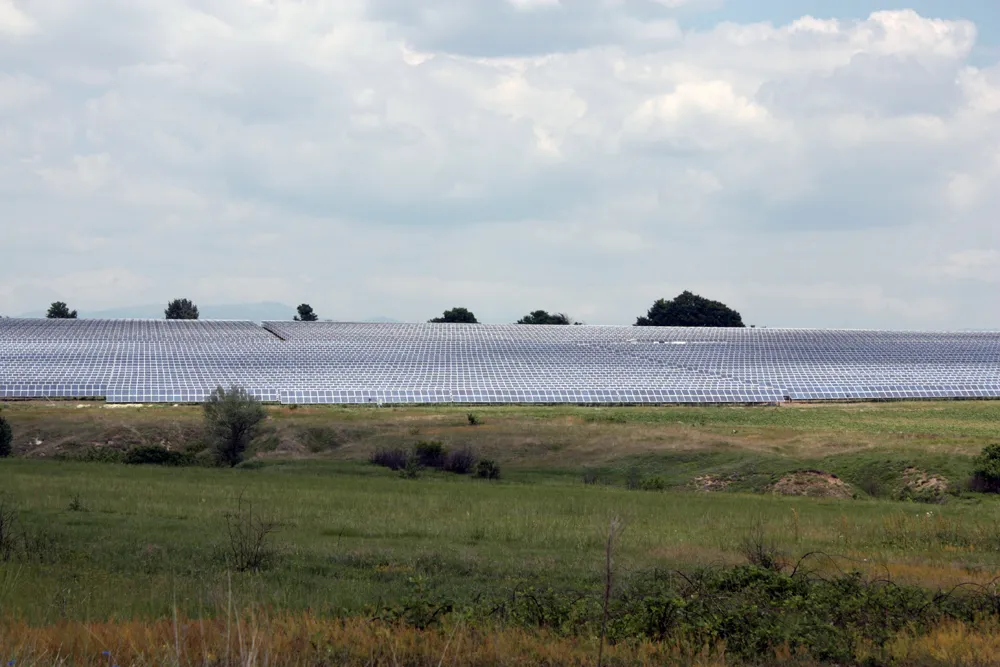 A solar plant at Gelemenovo, Bulgaria. Photo: Edal Anton Lefterov / Wikimedia Commons, CC BY-SA 3.0

Once batteries start operating, the shape of prices changes too. The Greek energy outlet Energypress, comparing the first halves of 2025 and 2026 using ENTSO-E data, found that morning and evening peaks in Bulgaria were dampened, with the difference largest after sunset when solar has stopped generating (Mastorakis, 2026). Batteries are not merely equipment that stores surplus power; they are market participants that narrow the gap between day and night prices.
RESTORE drew in investment far beyond its subsidy target
Added to the market economics was RESTORE, a support scheme funded by the EU Recovery and Resilience Facility. The first round, adopted by Bulgaria’s Ministry of Energy in April 2025, covered 82 projects with 9.71 GWh of usable capacity in total. The initial policy target was 3 GWh or more, so the capacity awarded came to more than three times that. Total grants were about 1.15 billion lev, or some €587 million (Ministry of Energy of the Republic of Bulgaria, 2025a).
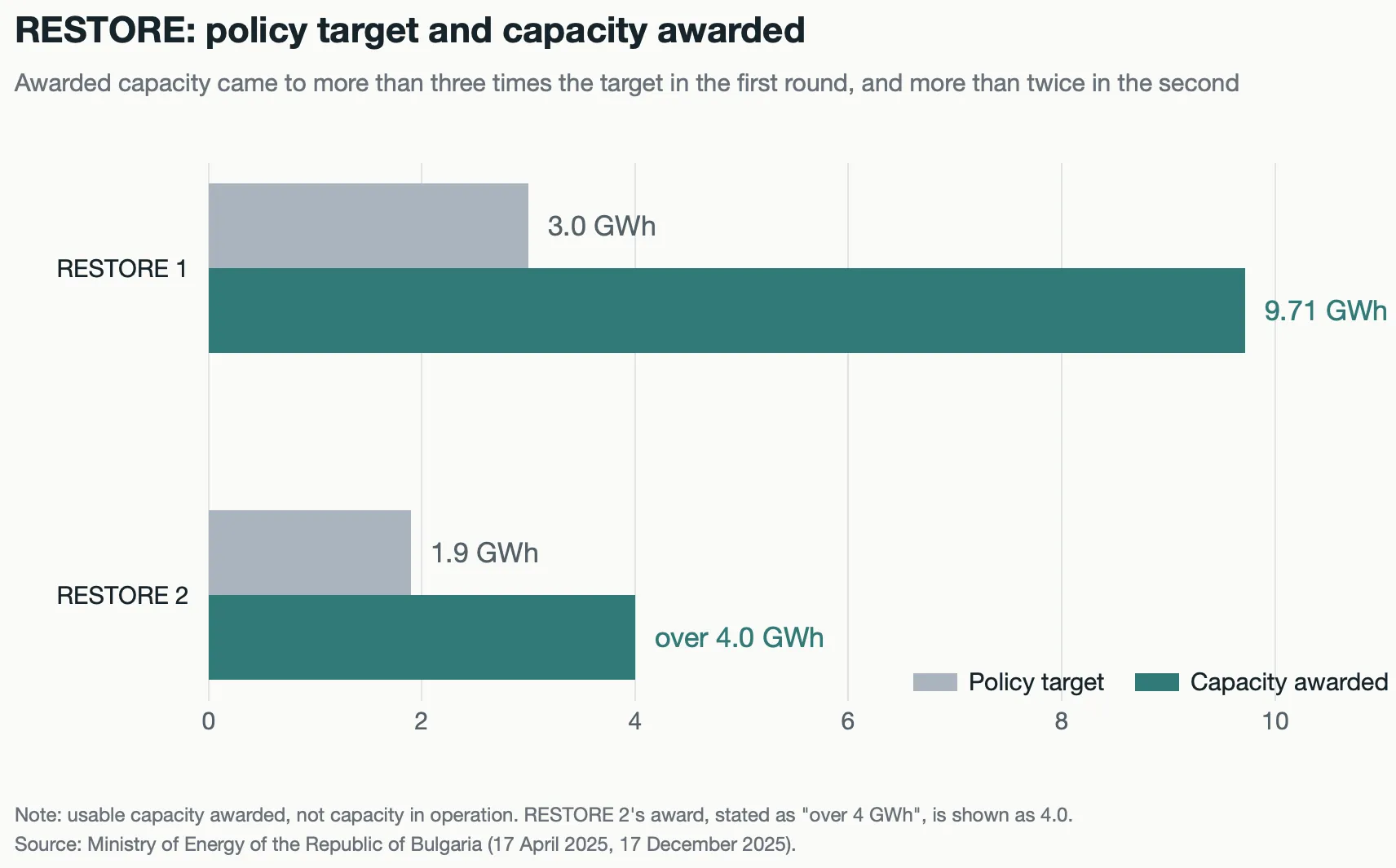
RESTORE’s policy target and the capacity awarded. These are awarded, not operating, volumes.
RESTORE 2, at the end of the same year, awarded 31 projects and more than 4 GWh against a target of 1.9 GWh, with grants of 228.9 million lev, about €117 million. There were 93 applications, and 30 went onto a reserve list for lack of funds (Ministry of Energy of the Republic of Bulgaria, 2025b). Public money did not cover the whole cost of the equipment. The ceiling was €80,000 per MWh of usable capacity, but the average among awarded projects was under €36,000. Falling battery prices and wholesale price spreads appear to have drawn in private capital.
The rules also guarded against speculative reservation of grid capacity. A 2024 amendment to the connection regulations requires battery developers to lodge a deposit or bank guarantee of 50,000 lev per MW of connection capacity, returned once the installation is connected. The Energy Act also charges network tariffs on the difference between energy charged and energy discharged to the grid, avoiding double charging of batteries. Putting connection and tariff rules in place at the same time as the subsidies, not subsidies alone, is what sustained the pace of development (Bulgarian Photovoltaic Association, 2024; Parliament of the Republic of Bulgaria, 2023).
Large projects are running, and domestic manufacturing has begun
The change is not confined to planning documents. In May 2025 a 124 MW / 496 MWh battery began operating at Lovech, built alongside a solar plant inside an industrial park in about six months (Bellini, 2025). In May 2026 Austria’s Enery brought a 150 MW / 601.8 MWh standalone battery online at Nova Zagora. With 120 battery containers, it is described as one of the largest in central and eastern Europe (Nova Zagora Municipality, 2026).
Financing is diversifying as well. In July 2026 the European Bank for Reconstruction and Development (EBRD) approved a loan of up to €30 million for a 246 MW / 512.5 MWh expansion alongside a solar plant at Tenevo. It is a project that tests whether the market can move from dependence on subsidies to one where project finance can be arranged.
A domestic supply chain is also taking shape. Near Sofia, the power conversion equipment maker IPS has opened a battery factory with annual capacity of 3 GWh, with plans to expand to 5 GWh in 2026 and 15 GWh by the end of 2027. Its power conversion technology won a 2026 smarter E AWARD (International Power Supply, 2026; Petrova, 2026). Planned production capacity and actual output need to be kept apart, though. The existence of a factory does not mean the whole supply chain, cells included, has been localised.
The more batteries there are, the thinner simple arbitrage profits become
What follows rapid growth is a redesign of the revenue model. If many batteries charge in the same midday hours and discharge in the same evening hours, midday prices rise and evening prices fall. The price flattening Energypress found is desirable for consumers and the power system, but it also means operators narrowing the very spread they have been earning. In a July 2026 interview with Bloomberg TV Bulgaria, it was likewise noted that while price spreads encourage investment, grid investment is not keeping up with the growth in batteries (Marinova, 2026).
The next source of revenue is “revenue stacking,” combining frequency regulation, balancing, intraday markets and imbalance settlement. Yet the balancing markets batteries can take part in are still limited in Bulgaria. The European Commission’s Joint Research Centre (JRC) assessment notes that while the law allows batteries and aggregators to participate in balancing, problems remain with flexibility assessment, smart meter roll-out and operating rules (Contini et al., 2026). Legal eligibility to participate and a market usable as a business are not necessarily the same thing.
Alongside chemical batteries handling short-duration variation, combination with long-duration storage is essential. At the Chaira pumped storage plant, shut down after an accident, two units returned by June 2026, bringing 420 MW back to the system. The Yadenitsa project to expand the lower reservoir is also on the 2026 EU list of projects of common interest (Gotsova, 2026; National Electricity Company, 2026). Batteries running for a few hours and pumped hydro that can run longer are less competitors than different roles.
What Bulgaria’s experience shows is not a simple story in which adding batteries ends the problem. A surge in solar created price spreads; the spreads and subsidies drew investment; and that investment is now narrowing the spreads again. What comes into question beyond this cycle is how far to open balancing markets, how much to invest in the grid and interconnectors, and how to combine batteries, pumped hydro and demand-side flexibility.
The growth in capacity catches the eye. But whether Bulgaria becomes a leading case in any real sense depends less on the speed of construction than on market design that converts the batteries it has added into value for the power system.
References
- Bellini, E. (2025, May 27). Bulgaria inaugurates 496 MWh battery system. pv magazine. https://www.pv-magazine.com/2025/05/27/bulgaria-inaugurates-496-mwh-battery-system/
- Bulgarian Photovoltaic Association. (2024, September 27). EWRC adopted final amendments and supplements to Regulation No. 6 on connection of energy facilities to the electricity grid. https://www.bpva.org/en/actual/ewrc-adopted-final-amendments-and-supplements-to-regulation-no-6-on-connection-of-energy-facilities-to-the-electricity-grid
- Contini, S., Chondrogiannis, S., Montero Cabrera, M., Tarantola, S., Kopustinskas, V., & Fulli, G. (2026). Implementation of Commission recommendation on energy storage in the Member States. Publications Office of the European Union. https://doi.org/10.2760/3945078
- Ember. (2026, August 12). Batteries have unlocked the era of anytime solar. https://ember-energy.org/latest-insights/batteries-have-unlocked-the-era-of-anytime-solar/
- European Bank for Reconstruction and Development. (2026). Tenevo BESS, Bulgaria. https://www.ebrd.com/home/work-with-us/projects/psd/57347.html
- International Energy Agency. (2026). Global energy review 2026: Technology—Battery storage. https://www.iea.org/reports/global-energy-review-2026/technology-battery-storage
- International Renewable Energy Agency. (2026). Renewable capacity statistics 2026. https://www.irena.org/Publications/2026/Mar/Renewable-capacity-statistics-2026
- International Power Supply. (2026, June 23). IPS wins the smarter E AWARD 2026 for energy storage. https://ips-group.net/news/ips-wins-the-smarter-e-award-2026-for-energy-storage
- Gotsova, S. (2026, June 10). The third hydroelectric unit at the Chaira Pumped-Storage Power Plant is back online. Economic.bg. https://www.economic.bg/en/a/view/the-third-hydroelectric-unit-at-the-chaira-pumped-storage-power-plant-is-back-online
- Marinova, E. (2026, July 17). България преживява бум на инсталирани системи за съхранение на електроенергия. Investor.bg / Bloomberg TV Bulgaria. https://www.investor.bg/a/518-energetika/433731-balgariya-prezhivyava-bum-na-instalirani-sistemi-za-sahranenie-na-elektroenergiya
- Mastorakis, M. (2026, July 15). Οι μπαταρίες περιόρισαν τις πρωινές και απογευματινές αιχμές στη DAM της Βουλγαρίας. Energypress. https://energypress.gr/index.php/news/oi-mpataries-periorisan-tis-proines-kai-apogeymatines-aihmes-sti-dam-tis-boylgarias-ti-deihnei
- Ministry of Energy of the Republic of Bulgaria. (2025a, April 17). 82 проекта на обща стойност почти 1.150 млрд лв. ще бъдат финансирани по RESTORE. https://www.me.government.bg/themes/82-proekta-na-obshta-stoinost-pochti-1-150-mlrd-lv-shte-badat-finansirani-po-restore-2598-0.html
- Ministry of Energy of the Republic of Bulgaria. (2025b, December 17). 31 проекта на стойност близо 229 млн. лв. ще бъдат финансирани по процедурата RESTORE 2. https://me.government.bg/news/31-proekta-na-stoinost-blizo-229-mln-lv-shte-badat-finansirani-po-procedurata-restore-2-3741.html
- National Electricity Company. (2026). Yadenitsa project. https://nek.bg/index.php/en/our-business/projects-of-common-interest/yadenitsa-project
- Nova Zagora Municipality. (2026, May 26). Мегапроект край Нова Загора дава тласък на енергетиката, бизнеса и развитието на региона. https://nova-zagora.bg/bg/node/2167
- Parliament of the Republic of Bulgaria. (2023). Закон за изменение и допълнение на Закона за енергетиката. https://www.parliament.bg/bg/laws/ID/164555
- Petrova, M. (2026, January 5). Bulgaria’s IPS aims for 15% of European battery market. KInsights. https://kinsights.capital.bg/energy/2026/01/05/4869764_bulgarias_ips_aims_for_15_of_european_battery_market/
- REN21. (2025). Renewables 2025 global status report: Supply—Solar PV. https://www.ren21.net/gsr-2025/downloads/pdf/supply/GSR_2025_Factsheet_Supply_SolarPV.pdf