Japan's lost energy dialogue: the record of the summer of 2012
In the summer of 2012 the Japanese government asked the public what should become of nuclear power, and gathered some 90,000 submissions and two days of deliberation by 285 citizens. The government website that held that record went offline earlier this year. What can be carried forward from a conversation held fourteen years ago?
Japan’s electricity still depends on fossil fuels for close to 70%. According to Ember, fossil fuels accounted for 67% of generation in 2025. Solar reached 10% for the first time, and nuclear, as restarts proceeded, 9%. Wind remains at about 1%. Clean sources together come to 33%, double what they were a decade ago but still short of the 38% of 2000 (Ember, 2026). Before the Fukushima Daiichi accident, nuclear alone was 25%.
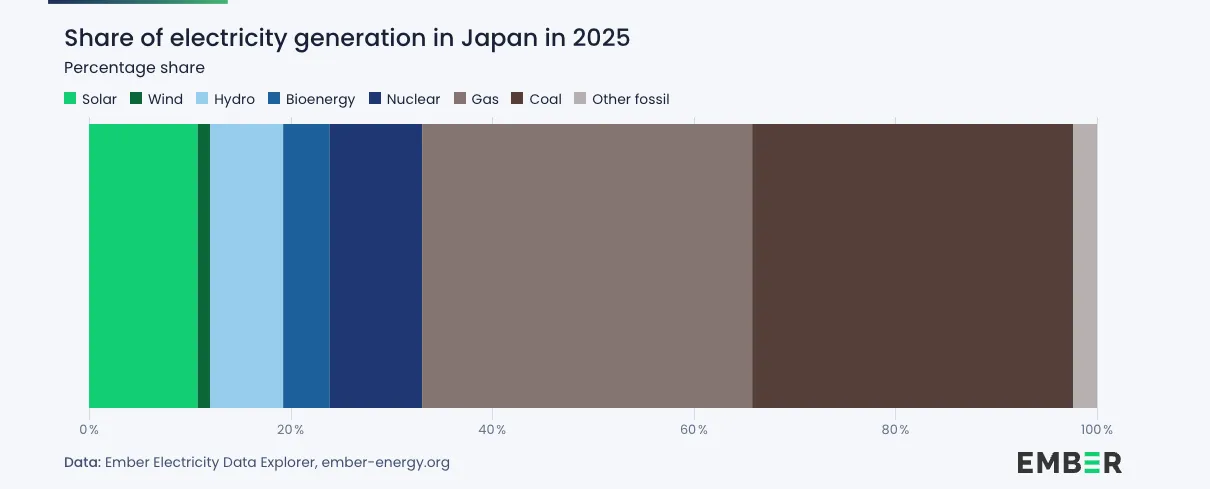
At this fork in the generation mix, the state once asked the public directly what it wanted. That was the “national debate” of the summer of 2012.
The site that disappeared: “Let’s Talk About the Future of Energy and the Environment”
“Let’s Talk About the Future of Energy and the Environment,” set up by the National Policy Unit of the Cabinet Secretariat, was an unusual thing for a government policy site. It carried explanations of the three scenarios, economic modelling, comments from experts, a glossary, even pages written for children. Yet that URL stopped resolving earlier this year, and as of 10 October 2026 returns “page not found.” The index of proceedings and the report of the deliberative poll are in the same state.
Fortunately the Internet Archive holds snapshots from July to October 2013 (National Policy Unit, 2013). Following them through, the sheer weight of the record is striking. Every public comment received had been published as a PDF: 58,986 by web, 19,684 by fax and 9,784 by post, running to 45 volumes. Alongside them sit the reports and venue surveys from the public hearings held in eleven cities, and the handouts and broadcast video from the “verification meetings” that argued over how to read the results (National Policy Unit, 2012).
Private sites from the same period, by contrast, are still up. Eco-Reso Web, a series of conversations the music producer Takeshi Kobayashi ran through 2011 and 2012, stopped updating in August 2012 and can still be read today (Oolong Sha, n.d.). The government’s own record of its own deliberation went first.
Not “a strategy made by a handful of people”
The government’s posture at the time comes through in the opening of the Innovative Strategy for Energy and the Environment of September 2012. It said the national strategy to date would be reviewed “from a blank sheet,” and that the new strategy must not be “a strategy made by a handful of people” but “a strategy made through national debate” (Energy and Environment Council, 2012b).
The starting point was the “Options for Energy and the Environment” presented on 29 June. Three scenarios set nuclear dependence in 2030 at 0%, 15% and 20–25%. The site named, as the shared direction, reducing dependence on nuclear power as far as possible over the medium to long term. On top of that it listed four points on which views diverged: over what period, how far, with what in its place, and at what cost (National Policy Unit, 2013).
Three mechanisms gathered views. Public comments eventually reached 89,124. Hearings were held in eleven cities, from Saitama on 14 July to Fukuoka on 4 August, where 136 people spoke and 1,276 venue questionnaires were collected. The third was a deliberative poll, the first ever used in national policymaking (Minister of State for National Policy, 2012).
It did not go smoothly. At the Sendai venue on 15 July, an employee of Tohoku Electric’s planning department, selected by lot, spoke in favour of the 20–25 scenario as “the company’s view.” At Nagoya the next day, an employee of Chubu Electric said that “there is not a single person who has died from the direct effects of radiation,” and drew criticism (National Policy Unit, 2012). The government switched to a policy of not permitting employees of the utilities and their affiliates to speak (J-CAST, 2012). The limits of a format in which people state their case one way, and are “heard,” showed early.
What 285 people worked through in two days
A deliberative poll gives randomly selected citizens briefing material, puts them through small-group discussion and questions to experts, and measures how their views change. A telephone survey of 6,849 people nationwide came first; from them, 286 gathered at Keio University’s Mita campus on 4 and 5 August, and 285 responses were tabulated. Professor Yasunori Sone chaired the executive committee (Sone, 2012).
The results were clear. Support for the zero scenario rose from 32.6% in the initial telephone survey to 41.1% before the discussion and 46.7% after it. The weight given to “ensuring safety” as a criterion also rose, from 8.88 to 9.27 on an eleven-point average. At the same time, about one in ten still answered “other or don’t know” after deliberating — a sign that the three options themselves were hard to choose between (Sone, 2012).
The verification meetings were held three times, on 22, 27 and 28 August, setting the public comments, the hearings, the deliberative poll and the media’s own opinion surveys against one another. The conclusion was that “at least a majority of the public share the direction of wanting a society that does not depend on nuclear power.” But the government also left on the record that people with strong views are likelier to submit comments, so the distribution may be skewed, and that opinion was divided on the timing of 2030 (Minister of State for National Policy, 2012). The value of this record lies in its publishing not just the conclusion but the fragility of that conclusion.
Dialogue outside government: MEEC and Eco-Reso
A year before the national debate, forums for dialogue had already started outside government. The first Minna no Energy, Kankyo Kaigi (MEEC, roughly “everyone’s energy and environment council”) met in Chino, Nagano, on 31 July 2011. Takeshi Kobayashi convened it, Junko Edahiro of the Institute for Studies in Happiness, Economy and Society moderated, and press enquiries went to the Institute for Sustainable Energy Policies (ISEP) (Institute for Studies in Happiness, Economy and Society, 2011).
Its founding statement observed that energy policy had been made through adjustment between the Ministry of Economy, Trade and Industry and the industry, and that there had been no “listening broadly to the thinking and the will of us who live with it, and reflecting that in policy” (MEEC, 2012). The second meeting, in November at the Tokyo Institute of Technology, took as its theme “how to actually wind down nuclear power.” Against Takeo Kikkawa’s framing, Tetsuo Sawada argued “we do not wind it down,” Akihiro Sawa made the case for an energy best mix, and Tetsunari Iida held that it should be left to ethics and democracy — people of genuinely different positions arguing on the same stage (Institute for Studies in Happiness, Economy and Society, 2011). Later meetings moved to Kyoto, Sapporo, Hiroshima, Saga and Wakasa, with sessions for young people alone.
On 5 August 2012 the third meeting was held at Miraikan in Tokyo, co-hosted with a voluntary subcommittee of the Advisory Committee for Natural Resources and Energy and streamed on Ustream (MEEC, 2012). It fell on the same day the deliberative poll participants were in their second day at Mita. MEEC’s site has since closed, and these records too can now only be read on the Internet Archive.
On Eco-Reso Web, Kobayashi held conversations with Hiroaki Koide, Mitsuhiko Tanaka, Shinichi Nakazawa, Seiko Ito and Shigeaki Koga, among others (Oolong Sha, n.d.). It was a place to discuss nuclear power not only as figures in a policy but as a question of how to live, and of culture. The dialogue of 2012 was running on three levels at once: government, civil society and culture.
Fourteen years after the blank sheet, what is worth keeping
On 14 September the Energy and Environment Council adopted a strategy committing to “mobilise every policy resource so as to make zero nuclear operation possible in the 2030s” (Energy and Environment Council, 2012b). Five days later the Cabinet decision amounted to a single sentence: that the government would, “taking the strategy into account,” discuss matters with the relevant municipalities and the international community and “carry it out with flexibility, under constant verification and review” (Cabinet decision, 2012). With the change of government in December, the zero-nuclear policy reverted to a blank sheet.
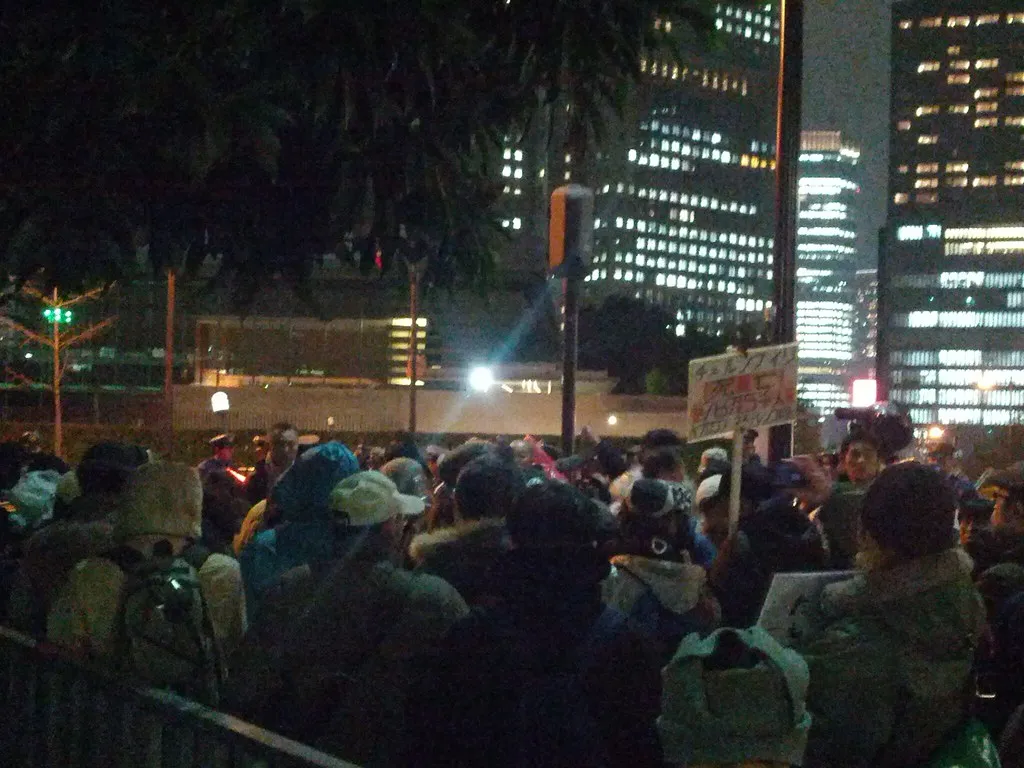
A protest outside the prime minister’s office on 28 December 2012. Two days after the new government took office, people gathered on a Friday despite the rain. Photo: jetalone (Flickr, CC BY 2.0)
Successive Basic Energy Plans carried forward the phrase about reducing dependence on nuclear power as far as possible. The seventh plan, in February 2025, removed it and wrote instead of making “maximum use of nuclear power.” Its targets for fiscal 2040 are 40–50% renewables, about 20% nuclear and 30–40% thermal (nippon.com, 2026). Electricity system reform, one of the pillars of the 2012 strategy, was realised, as wide-area operation of the networks and full retail liberalisation. It is not only the nuclear policy that disappeared. The procedure of asking the public before deciding did not continue either.
Two lessons remain from 2012. One is that how the conclusion of a deliberation connects to policy has to be settled before it begins. How the deliberative poll’s results would be treated stayed vague to the end, and that vagueness showed its weakness against a one-sentence Cabinet decision and a change of government. The other is keeping the record. If what was asked, who answered how, and how the government read it are not preserved, none of it can be examined afterwards.
The National Diet Library has archived public-sector websites comprehensively since 2010. Checking whether the National Policy Unit’s site survives there, and setting it beside the Internet Archive’s copies so that citizens can follow the record themselves — for the day the country asks the public about its energy future again, that is where I would start.
References
- Ember. (2026). Japan. Retrieved October 10, 2026.
- J-CAST. (2012, July 20). 「その後、どう仰っていますか?」 藤村官房長官、記者の質問に割って入る. J-CAST News.
- nippon.com. (2026, January 14). 原発「最大活用」は合理的か:「脱原発依存」削除の政府第7次エネ基本計画. nippon.com.
- Energy and Environment Council. (2012a, June 29). エネルギー・環境に関する選択肢 [Archived].
- Energy and Environment Council. (2012b, September 14). 革新的エネルギー・環境戦略 [Archived].
- Cabinet decision. (2012, September 19). 今後のエネルギー・環境政策について [Archived].
- National Policy Unit. (2012). 国民的議論の中でいただいたご意見等 [Archived].
- National Policy Unit. (2013). 話そう“エネルギーと環境のみらい” [Archived].
- Minister of State for National Policy. (2012, September 4). 国民的議論に関する検証会合の検討結果について [Archived].
- Institute for Studies in Happiness, Economy and Society. (2011, November 2). 「第2回みんなのエネルギー・環境会議」開催のお知らせ.
- Sone, Y. (2012). エネルギー・環境の選択肢に関する討論型世論調査 調査報告書(検証会合資料). Keio University DP Research Center.
- MEEC. (2012). みんなのエネルギー・環境会議 MEEC [Archived].
- Oolong Sha. (n.d.). エコレゾ ウェブ. Retrieved October 10, 2026.