Community power in Ontario: the legacy of the FIT and a restart on Indigenous equity
In April 2026 Ontario settled its first large procurement of new wind and solar in more than a decade. All fourteen projects selected carry Indigenous equity of 50% or more. The province that introduced North America’s first full feed-in tariff (FIT) in 2009, and then cancelled hundreds of contracts in 2018, is writing local ownership back into the rules in a different form.
A world expanding, a province built on nuclear
The world’s electricity has changed a great deal. According to Ember, renewables reached 34% of global generation in 2025, overtaking coal for the first time. Wind and solar alone account for 17% (Ember, 2026a). IRENA’s statistics put new renewable capacity added in 2025 at 692 GW, of which solar was 511 GW (IRENA, 2026).
Canada covers 77% of its generation with low-carbon sources, thanks to hydro and nuclear. Wind and solar, however, remain at 9%, far below the G7 average of 19% (Ember, 2026b). In Ontario, nuclear supplied 48.2% of generation in 2025. Demand rose 4.4% year on year to 145.6 TWh (IESO, 2026a). To fill the gap left by reactors out for refurbishment, generation from combustible sources in the province rose 23.7%, according to Statistics Canada (2026).
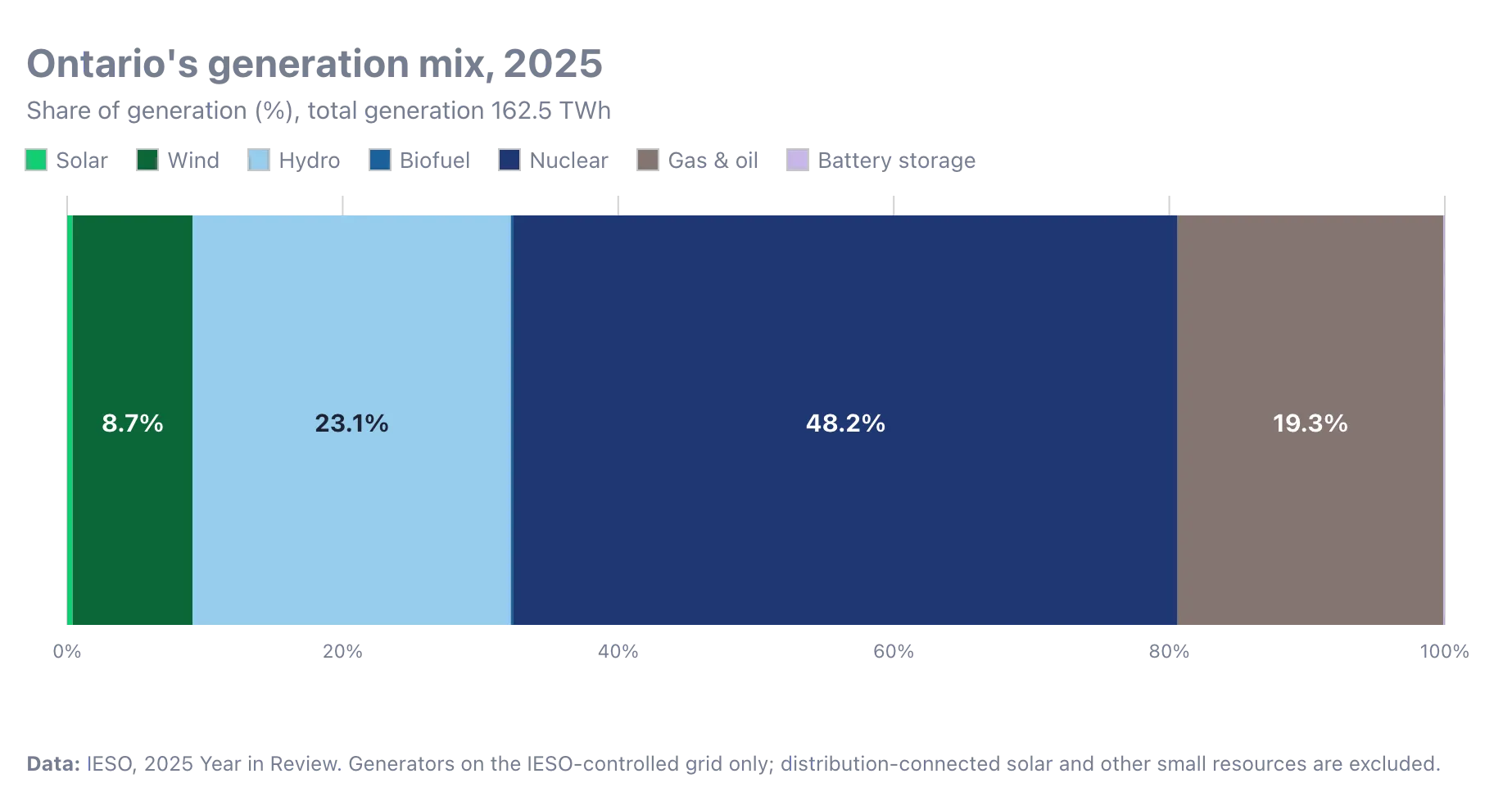
The system operator, the IESO, expects provincial electricity demand to grow by as much as 90% by 2050. In its integrated energy plan of June 2025, “Energy for Generations,” the provincial government set out an all-of-the-above approach with new nuclear build as the centrepiece (Torys, 2025).
The people who carried the European and Nordic experience to North America
Ontario was the first jurisdiction in North America to take up the idea of a feed-in tariff. The Ontario Sustainable Energy Association (OSEA), founded in 2001, pressed for a purchase scheme that would let citizens and farmers invest in renewables, and that led to the Renewable Energy Standard Offer Program (RESOP) in 2006 (OSEA, n.d.).
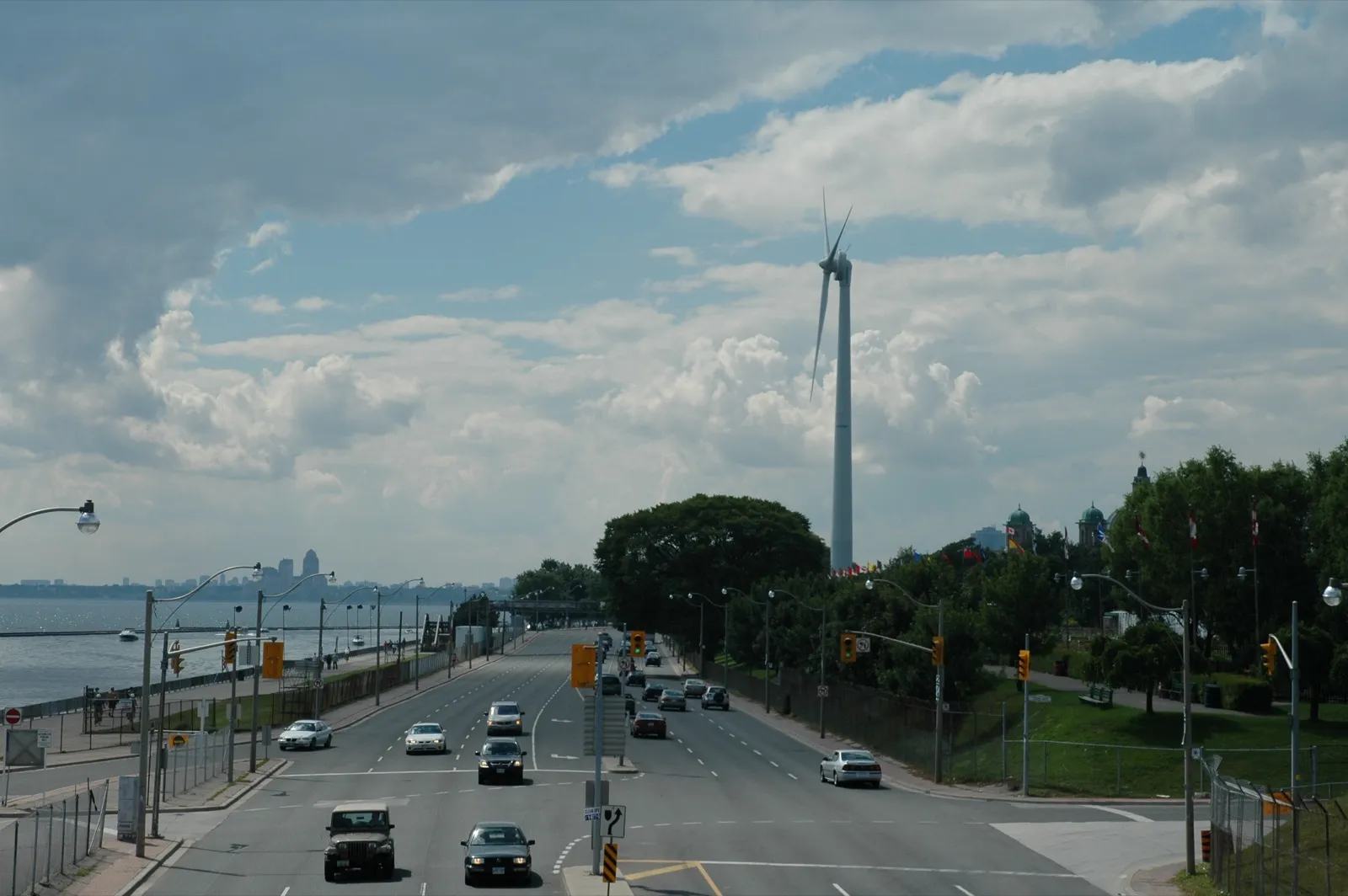
The WindShare turbine at Exhibition Place in Toronto, August 2004. Co-owned by WindShare, a citizen-funded co-operative, it began operating in January 2003 and is held to be Ontario’s first community-owned wind turbine. Photo: Stewart C. Russell (Scruss), CC BY 2.5, via Wikimedia Commons

The groundwork for the argument was laid by the World Wind Energy Association (WWEA). Preben Maegaard of Denmark, WWEA’s first president, founded the World Wind Energy Institute in Kingston in 2006. In June 2008, WWEA, OSEA and others co-hosted the 7th World Wind Energy Conference in Kingston, on the theme “Community Power: Energy Autonomy for Local Economies” (University of Western Ontario, 2008). By the author Paul Gipe’s account, more than 800 people attended, making it the first international conference to take up squarely how a feed-in tariff could be used to widen citizen ownership. Hermann Scheer, who drafted Germany’s Renewable Energy Sources Act (EEG), spoke there as well. At that conference WWEA gave its World Wind Energy Award to Gipe, Maegaard and Jane Kruse (Gipe, 2008).
In that same year, Kristopher Stevens, OSEA’s executive director, and others launched the Green Energy Act Alliance, which brought together farmers, First Nations, trade unions and environmental groups. Stevens introduced Scheer, Maegaard and Gipe to the premier and his ministers, creating occasions for them to describe at first hand how citizens in Germany and Denmark had come to own turbines and solar arrays (OSEA, n.d.).
In February 2009 the energy minister, George Smitherman, tabled the Green Energy and Green Economy Act (GEGEA), which passed that May. Scheer called its passage a legal milestone for a historic paradigm shift, and WWEA’s secretary general, Stefan Gsänger, described it as the most progressive renewable energy legislation in North America (Renewable Energy Magazine, 2009). WWEA went on to settle on a definition of community power requiring that at least two of ownership, decision-making and benefit rest locally. The discussions in Kingston are one of the starting points of that definition.
A price adder to encourage local equity
The FIT promised generators a fixed price for 20 years, or 40 for hydro. Under “microFIT,” for systems of 10 kW and under, rooftop solar opened at a high 80.2 cents/kWh. On top of that came price adders scaled to the share of local or Indigenous equity. For wind, community participation earned up to 1.0 cent/kWh and Indigenous participation up to 1.5 cents/kWh.
The result is still visible in the numbers. The IESO’s report for the second quarter of 2026 shows 3,191 FIT contracts, 4,126 MW, still operating. microFIT accounts for 29,788 contracts and 256.6 MW — more than 85% of all IESO contracts by count (IESO, 2026c). Households, farmers and small businesses joined the generating side. Even in the final round in 2017 (FIT5), more than 80% of contracts went to Indigenous communities, community groups, municipalities and the public sector (IESO, 2017).
Resentment over bills, and a trade dispute
The scheme also drew political criticism. A separate 2,500 MW agreement with a Korean consortium led by Samsung was later scaled back, and now stands at 1,367.5 MW (IESO, 2026c). The provisions requiring wind and solar components to be sourced within the province were found in breach of the agreements by the World Trade Organization’s Appellate Body in 2013, on complaints brought by Japan and the EU (WTO, 2013).
Rising electricity bills were another headwind. In 2015 the provincial Auditor General pointed out that the “global adjustment” — the amount paid to generators above the market price — had come to C$37 billion cumulatively between 2006 and 2014 (Auditor General of Ontario, 2015). It also estimated the premium paid for renewables under the FIT at up to C$9.2 billion, a figure the IESO disputed, putting it at C$5.3 billion. The adjustment covers nuclear refurbishment costs among other things, so the rise in bills cannot be laid at the door of renewables alone. The view that renewables had pushed up prices nonetheless took hold.
What the 2018 cancellations left behind
In July 2018 the newly installed government of Doug Ford announced the cancellation of 758 renewable energy contracts that had not yet begun construction (OKT, 2018). It said this would save C$790 million; in the event, cancellation costs of about C$231 million were booked (Jeffords, 2019). The White Pines wind farm, then under construction, was dismantled. Shawn Jeffords of The Canadian Press reported Ford saying in 2019 that “if we had the chance to get rid of all the wind mills we would.”
CanSIA, the solar industry association, argued that more than 90% of the cancelled contracts were small rooftop projects belonging to farmers, schools, municipalities and Indigenous communities (CanSIA, 2018). OKT, a law firm acting for Indigenous clients, found that many First Nations had waited to see how earlier projects fared before entering the later rounds, and so bore the heaviest blow from the cancellations (OKT, 2018). The Green Energy Act was repealed in January 2019.
A new procurement with Indigenous equity as a condition
Seven years on, the province has begun procuring wind and solar again. The results of the first window of the Long-Term 2 (LT2) procurement, published by the IESO in April 2026, selected 1,315 MW in total — twelve solar projects at 915 MW and two wind projects at 400 MW — expected to generate 3.02 TWh a year. The weighted average price is C$87.80/MWh, 73% below the FIT and 21% below the large procurement of 2016. All fourteen carry Indigenous equity of 50% or more, and ten are in the north. Prime farmland was avoided, and three are agrivoltaic (IESO, 2026b; CanREA, 2026a). In the storage procurement in June as well, all three of the eight-hour projects selected, 640 MW in total, carry 50% Indigenous equity (CanREA, 2026b).
Writing in Policy Options in September 2026, Michael Fox, an Indigenous consultant, notes that where Indigenous participation under the FIT was an optional adder worth a few cents, it is now built into the evaluation of bids, with an effect equivalent to lowering a bid price by as much as 10%. He cautions, at the same time, that the financial risk that comes with taking equity remains, and that the duty to consult and economic participation are not the same thing (Fox, 2026). Environmental Defence welcomed the renewables procurement while voicing concern about the additional gas-fired capacity being procured (Environmental Defence, 2026).
How to keep local ownership going
Ontario’s experience shows two things. One is that the European and Nordic experience of citizen energy can be translated into another continent’s legislation, through personal connections and international conferences. The other is that when such a scheme becomes a battleground over bills and politics, it is the small local players who are lost first.
The mainstream of renewables policy has moved from fixed prices to auctions. REN21 counted feed-in tariffs in 73 countries at the national level and 35 jurisdictions at the sub-national level in 2015; many countries have since switched to auctions (REN21, 2015). In its outlook for renewables to 2030, the International Energy Agency finds that distributed solar is the segment most exposed to policy change (IEA, 2025).
LT2 has reclaimed Indigenous ownership as a condition of large projects. The participation of households, farmers and co-operatives that microFIT supported, on the other hand, has had few routes open to it since 2017 apart from net metering. A scheme that can be foreseen, and administration held at a distance from politics: the price Ontario paid sets out, in concrete terms, what it takes to make community power last.
References
- Canadian Renewable Energy Association. (2026a, April). Ontario’s LT2 Energy Window 1 procurement goes all in on renewables
- Canadian Renewable Energy Association. (2026b, June). CanREA applauds Ontario’s battery storage leadership with LT2 capacity procurement
- Canadian Solar Industries Association. (2018, July). News archives: July 2018
- Ember. (2026a). Global electricity review 2026
- Ember. (2026b). Canada. Retrieved October 14, 2026.
- Environmental Defence. (2026, April 10). Statement: Renewables approved in Ontario—but gas is still a problem
- Fox, M. (2026, September 3). Ontario’s new hydro rules give Indigenous equity real weight. Policy Options.
- Gipe, P. (2008, July 9). Gipe receives 2008 World Wind Energy Award. Wind-Works.
- Independent Electricity System Operator. (2017, September). IESO releases final round of contract offers under Ontario’s FIT program
- Independent Electricity System Operator. (2026a). 2025 year in review
- Independent Electricity System Operator. (2026b, April). Results of the IESO’s Long-Term 2 Window 1 Energy Stream
- Independent Electricity System Operator. (2026c, July). A progress report on contracted electricity supply: Second quarter 2026
- International Energy Agency. (2025). Renewables 2025
- International Renewable Energy Agency. (2026). Renewable capacity statistics 2026. (Reported in pv magazine, 2 April 2026.)
- Jeffords, S. (2019, November 21). Doug Ford ‘proud’ of decision to tear up hundreds of green energy contracts. The Canadian Press / Global News.
- Office of the Auditor General of Ontario. (2015, December 2). Electricity power system planning (News release)
- Olthuis Kleer Townshend LLP. (2018). Cancellation of renewable energy contracts disproportionately hits First Nations and local communities
- Ontario Sustainable Energy Association. (n.d.). Our story. Retrieved October 14, 2026.
- REN21. (2015). Renewables 2015 global status report
- Renewable Energy Magazine. (2009, May 25). Ontario adopts North America’s first green energy act
- Statistics Canada. (2026). Electricity generation: Combustibles and renewables sharply increase amid another dry year
- Torys LLP. (2025, July). Ontario’s Integrated Energy Plan
- University of Western Ontario, Faculty of Engineering. (2008, April). World Wind Energy Conference 2008
- World Trade Organization. (2013, May 6). Canada — Certain measures affecting the renewable energy generation sector; Canada — Measures relating to the feed-in tariff program (WT/DS412/AB/R, WT/DS426/AB/R).