Denmark's energy planners: a lineage of system changers
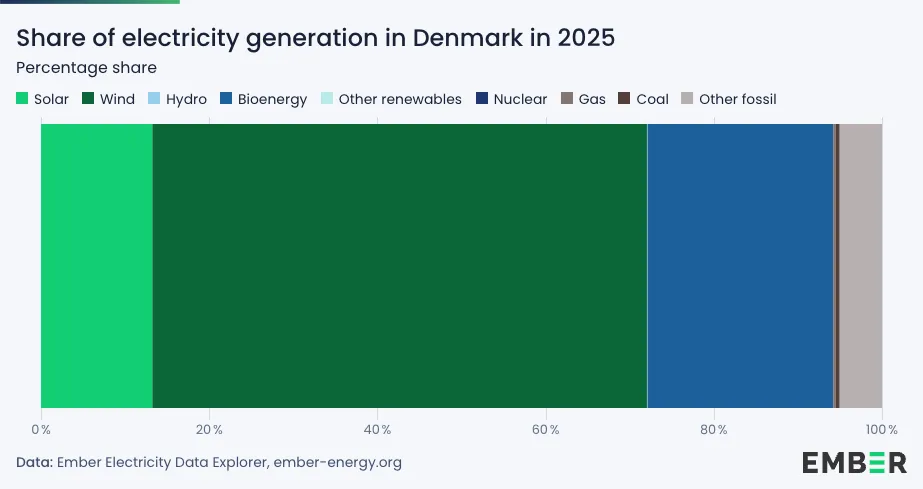
Seven tenths of Denmark’s electricity now comes from wind and sun. According to Ember (2026), wind and solar made up 71% of generation in 2025, the highest share of any EU member state. Turn to heating, and about seven in ten households are connected to the pipes of a district heating network (Danish Energy Agency, n.d.). IRENA (2023) puts the renewable share of total energy supply at 44% in 2021, up from 32% in 2016.
Figures like these are not explained by better technology or a generous wind climate alone. For half a century, since the 1970s, there have been people who drew “another future” in numbers, carried it into local communities, built it out of pipes and heat stores, and opened it up to society as a tool anyone could calculate with. I will call them energy planners. Their work falls into at least four faces.
The counter-experts who put numbers on an alternative to nuclear
When the oil crisis came in 1973, Denmark depended on imported oil for 94% of its primary energy supply (McKenna, 2016). The government declared car-free Sundays and dimmed the street lights to get through. The future it then sketched, together with the utilities, made nuclear power all but the only answer.
The objection came from OOA, the Organisation for Information on Nuclear Power, founded in 1974, and from independent researchers working alongside it. In 1976 the physicists Niels I. Meyer and Bent Sørensen, the economist Frede Hvelplund and five others published Sketch for an Alternative Energy Plan for Denmark (Blegaa et al., 1976). Combine wind, solar heat, biomass, energy saving and district heating, and the country’s energy needs could be met without nuclear power. They showed it as a quantified scenario.
Raising objections alone cannot answer the question that follows: what would you do instead? They answered it on the government’s own ground, in numbers and plans. Expertise of this kind is called counter-expertise. In 1978 some 50,000 people joined an anti-nuclear demonstration, and in March 1985 parliament resolved to leave nuclear power out of the country’s future energy planning (GWEC, 2013).
An energy planner’s first task is not to follow the single scenario the establishment presents. It is to build feasible alternatives that citizens and decision-makers can set side by side.
The companion who handed the technology back to communities
The drawing made by the counter-experts was set in motion in the countryside by Preben Maegaard (1935–2021). He moved from the economic civil service to teaching at a folk high school, and in 1983, out of Grundtvig’s tradition of popular education, co-founded the Nordic Folkecenter for Renewable Energy in northern Jutland.
What the Folkecenter aimed at was taking technology back from large companies and into the hands of local residents and craftsmen. It developed wind turbines in the 20–525 kW class and farm-scale biogas plants, and published construction manuals so that village smiths and machine shops could build turbines themselves. That became the ground on which wind co-operatives — farmers and residents holding shares in their own turbines — were built. At the Middelgrunden offshore wind farm off Copenhagen, completed in 2000, 8,650 citizens invested and covered half the project cost (Sørensen et al., 2003). Maegaard’s work did not stop at the border: he led the founding of Mali Folkecenter, which took on rural electrification in Mali, and was involved in a biogas plant in Yūbetsu, Hokkaido.
The same pattern can be seen on the scale of a whole island. In 1997 the Danish government ran a competition to choose a region that could become self-sufficient in renewable energy within ten years, and Samsø, an island with a population of about 4,300 at the time, was chosen. The person who carried the plan through from inside the island was Søren Hermansen, who had farmed there and taught environmental studies. He built up the conversation less in public meetings than in the course of everyday acquaintance, drawing residents in both as people with a stake in it and as investors. The island now has 11 onshore and 10 offshore turbines, 34 MW in all. Nine of the eleven onshore turbines belong to farmers, and the other two are held jointly by more than 500 islanders and summer-house owners. One of the four district heating plants is owned jointly by 240 households (Nordregio, 2016). Hermansen led the Samsø Energy Academy, which opened in 2007, until he stepped down in May 2026 (Altinget, 2026).
Citizen ownership is not a given in today’s Denmark either. The Renewable Energy Act of 2009 obliged new wind projects to offer at least 20% of their shares to local residents. The government judged that this purchase-option scheme was not achieving its aim of improving local acceptance, however, and abolished it for projects tendered from June 2020. In its place came the “VE-bonus,” which pays neighbouring residents a share of the generation revenue without their having to invest (Folketinget, 2020; Ingeniøren, 2019). The axis of the policy moved from ownership to compensation. The local life Maegaard envisaged, in which residents understand, manage and own what stands near them, turns out to be hard to sustain without the support of the rules.
A planner is not someone who hands technology down. They are a companion who designs, together with residents, the arrangements by which those residents can understand, manage and own it.
The practitioners who joined heat to electricity
From the 1980s onwards, district heating and combined heat and power (CHP) spread across Denmark. CHP is efficient, since the waste heat from generation goes to heating, but it carries a difficulty: in summer, when demand for heat falls away, both heat and electricity are left over.
The engineering answer came from PlanEnergi, an independent consultancy founded in 1983, and from one of its co-founders, the engineer Per Alex Sørensen (Errboe, 2018). Sørensen was also among those involved in founding Aalborg University, which opened in 1974. They refined a method combining large solar collector fields with an enormous hot-water store dug into the ground and lined with a waterproof membrane: pit thermal energy storage (PTES). Summer heat is stored and used in winter.
The best-known example is Marstal, a harbour town of about 2,300 people on the island of Ærø. Under the EU’s Sunstore 4 project, a 75,000 m³ pit store, some 33,000 m² of collectors, a heat pump, a wood-chip boiler and an ORC generator were integrated. Solar heat covers about 55% of annual heat demand and biomass the rest, making the heat for roughly 1,500 households 100% renewable (Solarthermalworld, 2015).
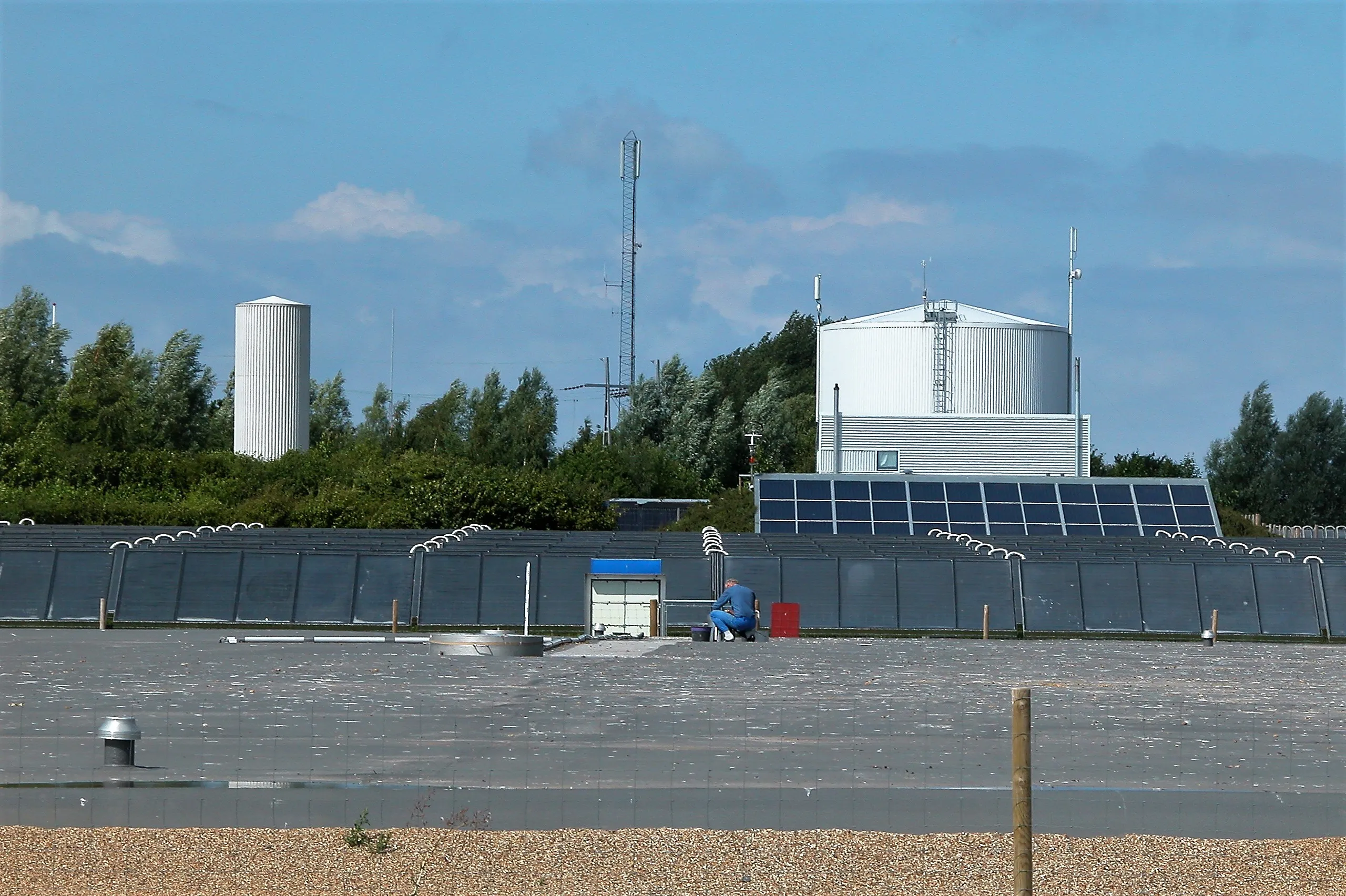
Solar collectors at Marstal on the island of Ærø. Photo: Erik Christensen (2013, Wikimedia Commons, CC BY-SA 4.0)

A 203,000 m³ store was later built at Vojens. In 2023, at Høje Taastrup near Copenhagen, a short-cycle pit store began operating — one used not for solar heat but to balance supply and demand across the heat network as a whole (Ingeniøren, 2022). It stores heat in the hours when heat is cheapest to make and releases it when it is dear. Large heat pumps and electric boilers now also do the work of turning surplus wind electricity into heat. In 2024, the heat produced by large heat pumps and electric boilers in district heating was 17% higher than the year before (Danish Energy Agency, 2025).
Batteries are not the only vessel that can take up variable renewables. Storing hot water is far cheaper to build than storing electricity. A planner has to keep both sectors, power and heat, in view at once.
The academic planners who opened the tools of analysis
Henrik Lund of Aalborg University set out the experience accumulated since the 1970s as the theory of Choice Awareness (Lund, 2000). Established organisations tend to present only the options that suit them. For that reason, making alternatives concrete within society, in a form that can be compared, is a condition for replacing a technology.
The tool built out of that theory is the energy system analysis model EnergyPLAN. It handles electricity, heat, gas and transport in a single model, calculating each of the 8,760 hours of a year. Because it was released free of charge, municipalities and NGOs could carry out analysis at the same level as the state and the large utilities (Lund et al., 2021). Lund and colleagues also advanced the concepts of smart energy systems, which tie together the electricity, heat and fuel sectors, and 4th generation district heating (4GDH), which distributes heat efficiently at low temperatures (Lund et al., 2014).
Colleagues have divided the work between them. Frede Hvelplund, one of the names on the 1976 alternative plan, analysed from institutional economics how an incumbent system keeps new actors out, and proposed arrangements for local ownership and local energy markets. Brian Vad Mathiesen and others led Heat Roadmap Europe, showing that raising district heating’s share in the EU from about one tenth to 50% by 2050, combined with cutting heat demand by 30–50% through insulation, is the cost-effective combination (Connolly et al., 2014). Poul Alberg Østergaard, as editor-in-chief of the International Journal of Sustainable Energy Planning and Management, built up a place for the research, and has examined 100% renewable plans for the municipality of Frederikshavn and for islands.
When the tools of analysis are transparent and reproducible, anyone can check their conclusions. The academic planner’s work is to open the chance to argue from numbers to citizens and municipalities as well.
What an energy planner is in the twenty-first century
The four faces are the stories of different people, and at the same time the elements of a single profession: the counter-expertise to set out alternatives in numbers, the governance design that lets residents own and run things, the engineering that joins heat to electricity, and the transparency that opens up the tools.
Looking at the world as a whole, the work that remains is in heat. The IEA (2025) puts renewables, excluding traditional biomass, at 14% of global heat consumption in 2024. REN21 (2025) reports district heating’s share of the energy used to heat buildings at 7% worldwide and 13% in Europe as of 2022. Electricity is being decarbonised while heat is left behind. What Denmark spent half a century building was precisely the capacity to design heat and electricity together.
Even there, who does the planning is changing. In 2023 the Inside Climate News reporter Dan Gearino saw, in the offices of the offshore wind company Ørsted, a display calling for “enabling industry-led green energy build-out” (Gearino, 2023). The more that giant projects such as offshore wind farms and energy islands multiply, the more easily the initiative in planning gathers in large companies and the state. The abolition in 2020 of the scheme giving local residents first refusal on shares in wind projects is unlikely to be unconnected to that current.
A transition to 100% renewables is not only a matter of replacing equipment. It also means continuing to raise, within society, the people who draw the alternatives, own things alongside their communities, design across sectors and publish the grounds for what they propose. What Japan’s municipalities and community energy businesses lack may be exactly this: people with that profession, and places where they can work.
Note: the people and organisations named here are only a small part of the story. Denmark's energy transition has been carried forward by countless energy planners in many different roles — municipal officials, people working in district heating companies and co-operatives, engineers, researchers and citizens' groups. This piece is put together from the author's experience of studying in Denmark and from material the author has gathered.
References
- Altinget. (2026, May 5). Generationsskifte på Samsø: Energiakademi får ny direktør.
- Blegaa, S., Hvelplund, F., Jensen, J., Josephsen, L., Linderoth, H., Meyer, N. I., Balling, N. P., & Sørensen, B. (1976). Skitse til alternativ energiplan for Danmark. OOA/OVE.
- Connolly, D., Lund, H., Mathiesen, B. V., Werner, S., Möller, B., Persson, U., Boermans, T., Trier, D., Østergaard, P. A., & Nielsen, S. (2014). Heat Roadmap Europe: Combining district heating with heat savings to decarbonise the EU energy system. Energy Policy, 65, 475–489.
- Danish Energy Agency. (n.d.). District heating in Denmark.
- Danish Energy Agency. (2025). Energistatistik 2024 (reported by DK Havenergi).
- Ember. (2026). European electricity review 2026.
- EnergyPLAN. (n.d.). Who is behind the model EnergyPLAN? Aalborg University.
- Errboe, N. (2018, June 28). Efter utætte fjernvarmelagre: Rådgiver svarer på læsernes spørgsmål. Ingeniøren.
- Folketinget. (2020). Forslag til lov om ændring af lov om fremme af vedvarende energi (L114).
- Gearino, D. (2023, December 14). What I learned about clean energy in Denmark. Inside Climate News.
- GWEC. (2013). Denmark (published by IRENA).
- IEA. (2025). Renewables 2025: Renewable heat.
- Ingeniøren. (2019, November 19). Kontanter til naboerne skal give mere grøn energi.
- Ingeniøren. (2022). The largest pit thermal storage of its kind is about to be put into service.
- IRENA. (2023). Energy profile: Denmark.
- Lund, H. (2000). Choice awareness: The development of technological and institutional choice in the public debate of Danish energy planning. Journal of Environmental Policy & Planning, 2(3), 249–259.
- Lund, H., Werner, S., Wiltshire, R., Svendsen, S., Thorsen, J. E., Hvelplund, F., & Mathiesen, B. V. (2014). 4th Generation District Heating (4GDH). Energy, 68, 1–11.
- Lund, H., Thellufsen, J. Z., Østergaard, P. A., Sorknæs, P., Skov, I. R., & Mathiesen, B. V. (2021). EnergyPLAN: Advanced analysis of smart energy systems. Smart Energy, 1, 100007.
- McKenna, P. (2016, May 10). Denmark is kicking its fossil fuel habit. Can the rest of the world follow? Inside Climate News.
- Nordregio. (2016). Local buy-in fuels low-carbon economy in Samsø. In Green growth in Nordic regions: 50 ways to make it happen.
- REN21. (2025). Renewables 2025 global status report: Buildings.
- Solarthermalworld. (2015). Denmark: 23 MWth cover 55 % of heat demand of 1,500 households.
- Sørensen, H. C., et al. (2003). Middelgrunden 40 MW offshore wind farm: A prestudy for the Danish offshore 750 MW wind program.