South Australia's power system: from a statewide blackout to a grid of wind and sun
In the year its last coal plant closed, the whole state lost power. South Australia took that as its starting point and kept expanding renewables. Ten years on, it is watched by system operators and researchers around the world as one of the grids with the highest share of wind and solar anywhere. Big batteries, rooftop solar, new transmission and the gas plants still in service: how do they divide the work between them? I follow the state’s present shape through official data and local reporting.
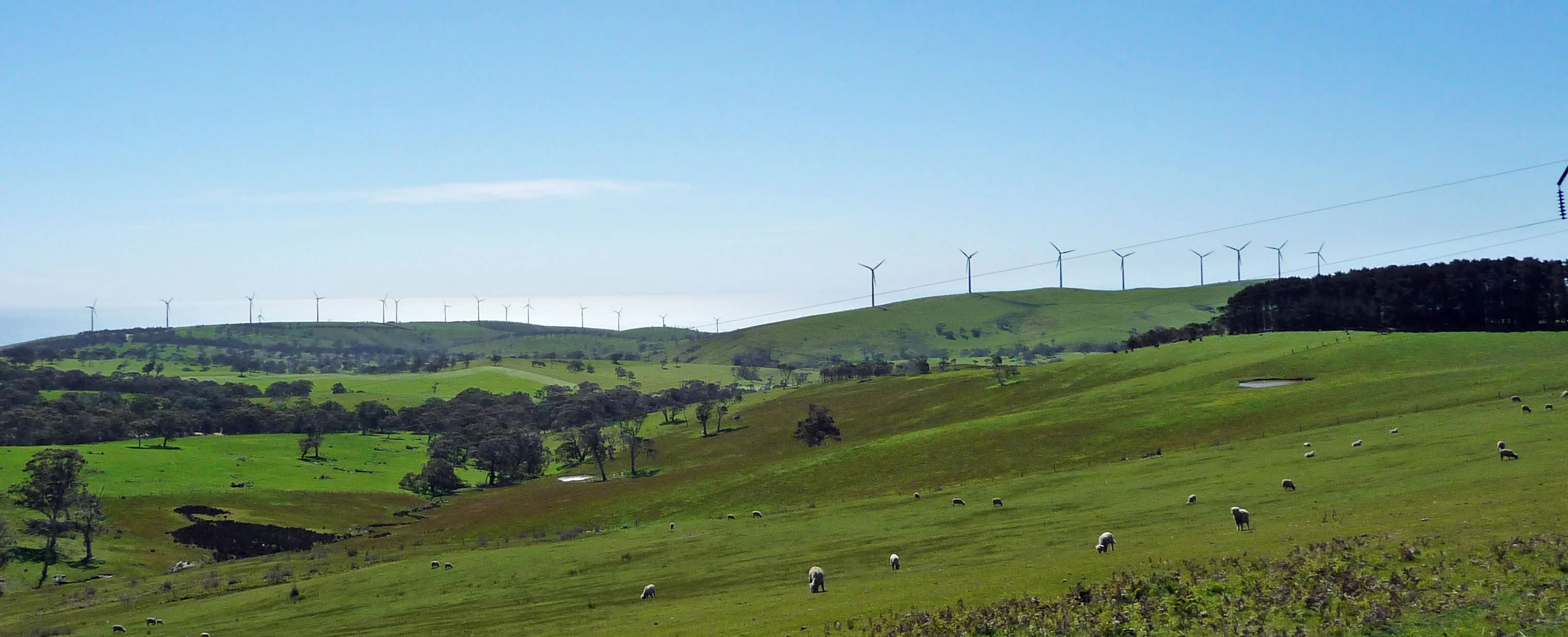
Starfish Hill wind farm near Cape Jervis, South Australia, with sheep grazing the pasture below. Photo: Christine Painter, CSIRO (Wikimedia Commons, CC BY 3.0)

What the blackout put in question
On the afternoon of 28 September 2016, a storm carrying tornadoes crossed the state and brought transmission towers down. Three 275 kV circuits tripped one after another, and after six voltage dips within about two minutes, the entire state went dark (AEMO, 2017). Some 850,000 customers lost supply, and losses to business were put at A$367 million (InDaily, 2016a).
Four months earlier, on 9 May, the Northern power station — the last coal plant in the state — had stopped generating (InDaily, 2016b). Criticism that the state had leaned too far on renewables followed, from the federal prime minister and his ministers as well.
The cause set out in the final report of the Australian Energy Market Operator (AEMO) is a little more involved. The wind farms were designed to keep running through voltage dips. But a limit had been preset on how many dips in quick succession they could withstand, and once that limit was passed they reduced output. The interconnector to Victoria picked up the shortfall all at once, overloaded, and the state, cut loose, was left islanded and without power (AEMO, 2017). What was at issue was something else: the control settings of the generating plant, and the rules by which the system was operated.
Jay Weatherill, then premier, answered not by going back to coal but by investing in new plant. The state energy plan he announced in March 2017 included procuring a large battery, building a state-owned gas plant, and new standards for keeping the system stable.
The battery that changed the frequency market
What came of that plan was the Hornsdale Power Reserve (HPR), built by Tesla and the French renewable energy company Neoen. Elon Musk declared on social media that it would be free if it was not finished within 100 days of the contract, and the battery — 100 MW of capacity, 129 MWh of storage — was completed in November 2017. At that point it was the largest lithium-ion battery in the world.
What it could do became clear the following December. When a coal unit in Victoria tripped and frequency fell, HPR started discharging in about 140 milliseconds, responding before the thermal plants held on standby (Electrek, 2017). In the market for keeping frequency steady — frequency control ancillary services, or FCAS — prices for local services fell by 75%, and the consultancy Aurecon estimated savings of around A$40 million a year across the market as a whole (ESD News, 2018).
HPR was expanded to 150 MW and 193.5 MWh in 2020, and in 2022, with AEMO’s approval, it began providing inertia as well. Inertia is the way the weight of a large spinning generator softens sudden changes in frequency. HPR reproduces that electronically, through the inverter control known as “grid forming” (pv magazine, 2022).
The role of batteries has widened considerably over ten years. According to the International Energy Agency (IEA), grid-scale battery capacity in the state was under 5% of peak demand in 2019 and reached about 15% in 2024. In February and March 2026, batteries covered more than 30% of the hourly ramping up and down of output (IEA, 2026). The International Renewable Energy Agency (IRENA) also presented HPR early on as a leading example of new ancillary services (IRENA, 2019).
Holding the system up from the rooftops
The other lead role belongs to the household roof. More than 400,000 homes in the state have solar, which is 49% of dwellings. In the 2024 financial year, rooftop solar accounted for 22.4% of the state’s generation, passing gas (20.8%) for the first time (AEMO, 2025a).
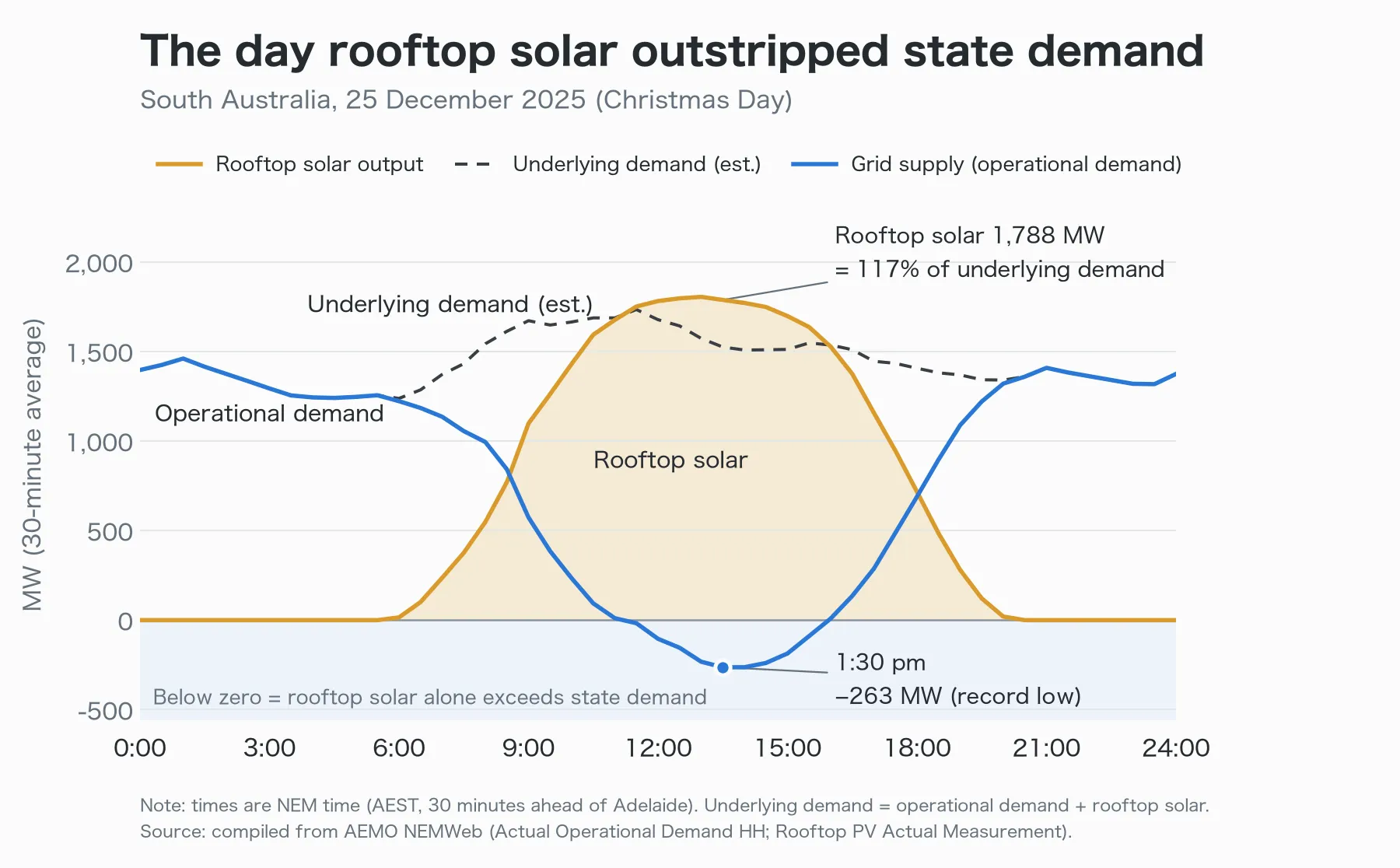
The result is that around midday on clear, mild days, the power supplied from the grid — operational demand — goes negative. At 1:30 pm on Christmas Day 2025, operational demand hit a record low of −263 MW, and rooftop solar produced 117% of the state’s actual demand (Parkinson, 2026). Between October and December 2025, wholesale prices were negative for 48.4% of the time (Government of South Australia, 2026).
Too much electricity makes the system hard to keep stable. In 2020 the state government introduced a mechanism allowing the distribution company to switch rooftop solar off remotely in an emergency. The distributor, SA Power Networks, is extending “flexible exports”, which vary each household’s export limit dynamically with the state of congestion. Under this arrangement, exports are estimated to fall below the 10 kW cap for only about 2% of daylight hours in a year (RenewEconomy, 2023).
Virtual power plants (VPPs), which bundle household batteries so that they behave like a power station, also moved ahead. The scheme Tesla and the state government set out in 2018 was to cover 50,000 homes; what was actually installed is about 7,000 units, mostly in public housing. The business was bought by the utility AGL in July 2025 (pv magazine Australia, 2025). In July 2026 a “Solar Sharer” tariff began, giving households three free hours of electricity in the middle of the day — an attempt to absorb surplus solar into household demand from the pricing side as well (PV Tech, 2026).
Closing in on a grid without gas
AEMO puts the state’s generation in the 2024 financial year at 44.5% wind, 22.4% rooftop solar, 10.1% utility-scale solar and 20.8% gas (AEMO, 2025a). Measured by calendar year, the renewable share reached 77.1% in 2025 (Kelsall, 2026). Ember puts the low-carbon share for Australia as a whole at 39% in 2025 (Ember, 2026). In the same year, neighbouring Victoria was at 41.9% (Kelsall, 2026). The IEA places the state, alongside Denmark, Ireland and Spain, among the “frontrunner” systems that reached the harder stages of renewable integration first (IEA, 2024). REN21’s global status report also features it as a case of combining zero coal with a renewable share above 60% (REN21, 2022).
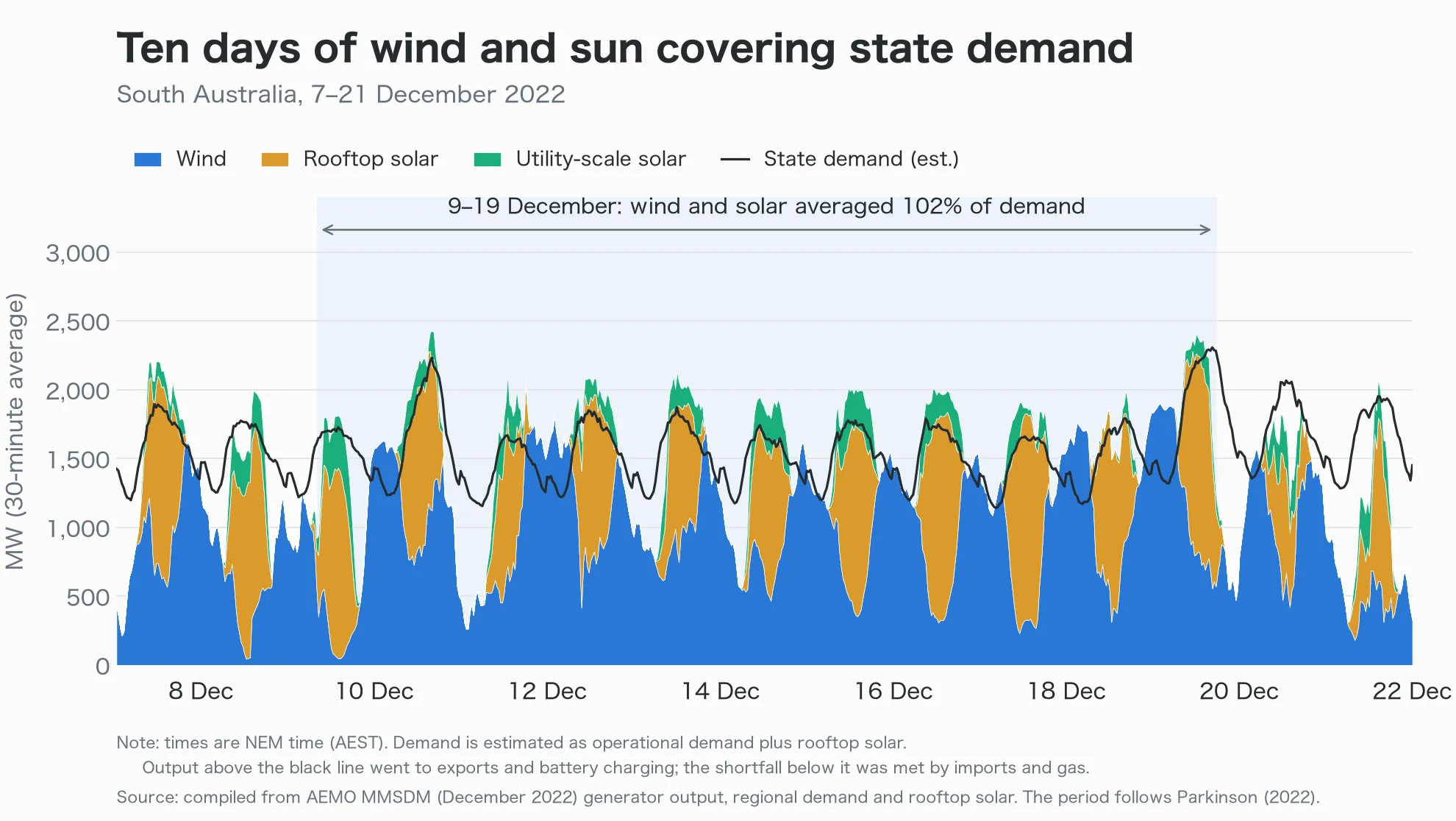
In December 2022, wind and solar covered the state’s demand, averaging 100%, for more than ten days (Parkinson, 2022).
Batteries are not the only thing supporting this. In 2021 the transmission company ElectraNet installed four synchronous condensers, which produce inertia physically through spinning mass. From September 2025, and subject to conditions, the number of gas units that had to be kept running to keep the system stable fell to one. AEMO is aiming to operate with no thermal generation at all once Project EnergyConnect, the new interconnector to New South Wales, is finished (AEMO, 2025a). The 800 MW link was energised along its full length in June 2026, but it has struggled with delays and cost overruns (RenewEconomy, 2026).
Challenges remain. In June 2026, four days of weak wind ran the gas plants flat out and sent wholesale prices spiking. In October, the state’s energy minister, Tom Koutsantonis, acknowledged for the first time that the 2027 target of “net 100% renewables across the year” may slip to 2028. Large wind projects are held up by the interconnector delays, and the Whyalla hydrogen plant, one of the grounds on which the target rested, has been shelved (Kelsall, 2026). In the same month, though, the state government selected developers for some 12.7 GW of wind, solar and storage on land west of Whyalla (Carroll, 2026).
Reliable supply without baseload
There are three things Japan can take from the state’s ten years.
(1) Reliable supply is decided more by control settings and operating rules than by which kinds of plant are on the system. The 2016 blackout was caused by settings rather than by the amount of wind, and the improvements that followed turned mainly on settings, measurement and market rules.
(2) The ability to provide inertia and voltage support can be secured by combining sources rather than relying on one. The state has used synchronous condensers, which are rotating machines, together with grid-forming batteries, which are electronic control, and has reduced the remaining thermal plant step by step. According to AEMO, every battery at the early stages of the state’s connection process is grid forming (AEMO, 2025a).
(3) Welcoming households into the system as participants takes time and trust. VPP uptake fell far short of the original scheme. What is being asked now is whether remote curtailment of rooftop solar, dynamic export limits and free midday tariffs can be designed in a form households find acceptable.
In Japan too, curtailment of solar output has become routine in Kyushu and elsewhere, and the midday fall in demand and the shortage of inertia are under discussion. With thin interconnectors and no neighbour to lean on, South Australia’s experience should be a concrete reference point for Japan, where each region holds its own grid.
References
- AEMO. (2017). Black system South Australia 28 September 2016: Integrated final report. Australian Energy Market Operator.
- AEMO. (2023). MMSDM historical data, December 2022: DISPATCH_UNIT_SCADA, DISPATCHREGIONSUM, ROOFTOP_PV_ACTUAL [Data set]. NEMWeb.
- AEMO. (2025a). 2025 South Australian electricity report. Australian Energy Market Operator.
- AEMO. (2025b). Actual operational demand (half-hourly) and rooftop PV actual measurement, 25 December 2025 [Data set]. NEMWeb.
- Carroll, D. (2026, October 19). South Australia selects developers for 12.7 GW renewables push. pv magazine.
- Electrek. (2017, December 19). Tesla’s giant battery in Australia reacted to coal plant failure in record time.
- Ember. (2026). Australia.
- ESD News. (2018). SA’s big battery saves $40m in first year.
- Government of South Australia. (2026). SA wholesale power prices lowest in nation [Media release].
- IEA. (2024). Integrating solar and wind: Global experience and emerging challenges. International Energy Agency.
- IEA. (2026). Battery storage is scaling up and taking on a larger system role. International Energy Agency.
- InDaily. (2016a, December 9). State-wide blackout cost businesses $367 million: Survey.
- InDaily. (2016b, May 9). SA’s coal era ends, but what’s next?
- IRENA. (2019). Innovative ancillary services: Innovation landscape brief. International Renewable Energy Agency.
- Kelsall, T. (2026, October 12). SA might miss its 2027 renewables target, but does it matter? ABC News.
- Parkinson, G. (2022, December 21). South Australia’s remarkable 100 per cent renewables run extends to over 10 days. RenewEconomy.
- Parkinson, G. (2026, January 23). Biggest battery on standby as rooftop PV sets stunning new records, meeting 117 pct of state demand. RenewEconomy.
- pv magazine. (2022, July 27). Tesla big battery begins providing inertia grid services at scale in world first in Australia.
- pv magazine Australia. (2025, July 4). AGL acquires South Australia virtual power plant from Tesla.
- PV Tech. (2026). Australia launches Solar Sharer offer giving households three hours of free midday electricity.
- REN21. (2022). Renewables 2022 global status report.
- RenewEconomy. (2023). Flexible export limits: The next phase for rooftop solar kicks off in an Australia first.
- RenewEconomy. (2026). “Not easy”: Australia’s biggest transmission project energised after delays and cost overruns.