Village solar in Mali: energy autonomy tested by a fuel blockade
In Mali, a landlocked country in West Africa, armed groups have blockaded fuel deliveries for more than a year, and a power supply that depends on diesel has been shaken. At the same time, solar power is doing more and more of the work of daily life: in village mini-grids, at well pumps and on hospital roofs. A quarter of a century ago a small NGO in Bamako set out an idea, that villages should make their own energy. That idea is now being tested under harsh conditions.
A capital the fuel cannot reach
Mali has no coastline. Every petroleum product is imported, most of it brought overland by tanker truck from Senegal and Côte d’Ivoire. Electricity depends on that fuel too. According to the U.S. Department of Commerce’s country guide, diesel generation supplied 66% of the power generated in 2023 (International Trade Administration, n.d.).
In September 2025 that supply line was cut. JNIM, an armed group affiliated with al-Qaeda, began attacking tanker trucks on the highways leading to the capital, Bamako. In June 2026, in the old northern city of Timbuktu, the thermal power station stopped when its fuel ran out, and the town went four days without water or electricity. In 40°C heat, only the hospital kept running, on generators and solar power, according to reports (Africanews, 2026).
The following month, the high-voltage line linking Bamako with the Manantali hydropower station was damaged in what appeared to be sabotage, and power and water were cut across much of the capital. “No fans, no fridge, and above all, not a drop of water from the tap for over 24 hours,” Oumar Toure, a teacher, told AFP. Residents turned to solar-powered boreholes and neighbourhood wells for water (Wabwireh, 2026).
In September, more than 900 tanker trucks reached Bamako under military escort, and fuel supplies recovered for a time. Even so, the risk that armed groups will close the highways again has not gone away (Aliyu, 2026).
The statistics and the imports disagree
By the international statistics, electrification in Mali has barely moved. According to the 2026 edition of Tracking SDG7, compiled by UN agencies and others, the share of people with access to electricity rose from 47.9% in 2019 to 49.5% in 2024, just 1.6 percentage points in five years. Some 12.36 million people have no electricity, and Mali is counted among the countries where the number without access grew between 2023 and 2024 (SEforALL, 2026). Rural access stays at around 25% (Ahmed, 2025).
Solar capacity looks stalled too. In the statistics of the International Renewable Energy Agency (IRENA), Mali’s solar stood at 137 MW in both 2024 and 2025, and both figures are estimates (IRENA, 2026).
The import data tell a different story. Figures compiled from Chinese customs statistics by Ember, a UK-based energy think tank that works globally, show solar panel exports from China to Mali rising from 38 MW in 2023 to 97 MW in 2024 and 122 MW in 2025. By September 2026 they had already reached 111 MW for the year. The total since 2017 is 456 MW, more than three times IRENA’s figure (Ember, 2026). The price per watt has fallen from $0.38 in 2017 to around $0.11 in 2026.
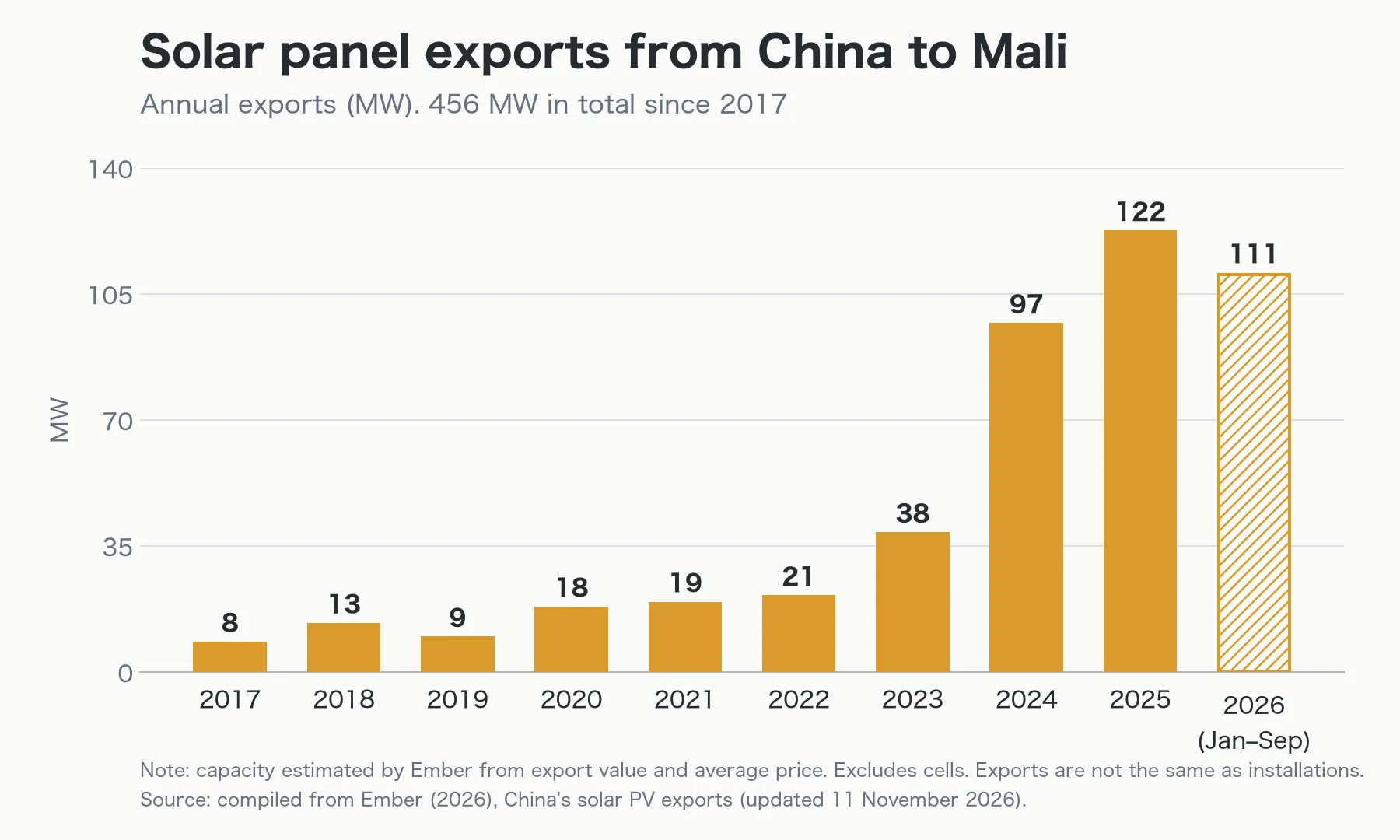
Annual solar panel exports from China to Mali. The 2026 figure covers January to September. Capacity is calculated from export value and average price, excludes cells, and does not match actual installations. Source: compiled from Ember (2026).
Month by month, exports fell to 1.5 MW in September 2025, when the blockade began, and to 0.6 MW in October. Cause and effect cannot be established from this alone, but the numbers suggest that panels, like fuel, arrive by the same roads.
Across Africa, panel exports from China reached 23 GW in the twelve months to June 2026, up 53% on the year before. Ember points out that only 14 of 54 countries have published official solar figures for 2025, and that installations in landlocked countries may be underestimated (Jones & Nana, 2026).
From a small NGO in Bamako
One person saw this coming more than 25 years ago: Ibrahim Togola, a Malian renewable energy researcher. He studied electrical engineering and economics, and took a doctorate in renewable energy.
Togola learned the practical side at the Nordic Folkecenter in north-western Denmark. After the oil crises of the 1970s, Danish citizens began building wind turbines themselves and owning them locally. The Folkecenter was one of the places that supported that technology and that movement. Its founder, Preben Maegaard, served from 1999 to 2002 as renewable energy adviser to Mali’s president, Alpha Oumar Konaré, and helped set up a renewable energy training centre in the southern region of Sikasso. In 1999, with the support of Maegaard and Jane Kruse, Togola founded the NGO Mali Folkecenter Nyetaa (MFC Nyetaa) in Bamako. It was the first Folkecenter in Africa.
At the time, only about 1% of people in rural Mali had electricity (Mali Folkecenter Nyetaa, n.d.). The reality Togola kept returning to was that villages would never be electrified if they waited for a power line from the capital.
In the southern village of Garalo, he worked on a mini-grid whose generator ran on oil from jatropha. Jatropha is an oil-bearing shrub that is not edible and grows even on poor land. If the fuel could come from the village’s own fields, it would not have to be brought from far away, and the money spent on fuel would stay in the village.
National policy moved in the same direction. Through its rural electrification agency, AMADER, the Malian government gave local operators 15-year exclusive rights to an area and supported their start-up costs with grants from a rural electrification fund. Instead of waiting for the national utility to run its lines out to the villages, operators would generate and sell electricity village by village.
Togola became one of the people running this system. Alongside MFC Nyetaa he co-founded a rural electrification company, ACCESS, which operates 23 concessions. In Zantiébougou, a village of about 6,000 people, it installed a hybrid system of 55 kW of solar with a diesel generator as backup. The shift away from diesel, with its heavy transport costs, toward hybrids that pair solar with batteries began in villages like this. By MFC Nyetaa’s account, its support had reached more than 800,000 rural people by 2015, a period in which rural electrification rose to 17% (Mali Folkecenter Nyetaa, n.d.).
Togola has always preferred electricity generated in the village to electricity delivered from outside, with local operators maintaining the equipment from what it earns. Not stopping at lighting, but pumping water, processing crops and keeping vaccines cold at the clinic: the idea is to tie electricity to the work and life of the village. He has argued again and again that every solar panel in Africa should be linked to agriculture in some way, and he is working on the first agrivoltaics trials in Mali and the Sahel.
His work has become known internationally. In 2010 he appeared alongside Hermann Scheer and Muhammad Yunus in The 4th Revolution: Energy Autonomy, a documentary about decentralised energy, and in 2012 he was named a National Geographic Society Emerging Explorer. In 2015 MFC Nyetaa received the World Wind Energy Award from the World Wind Energy Association (WWEA) (WWEA, 2015). In November 2018, together with WWEA and Japan’s Institute for Sustainable Energy Policies (ISEP), it brought the World Community Power Conference to Bamako. More than 400 participants from over 45 countries came, and they adopted the Bamako Declaration, calling for access to energy to be expanded under local leadership.
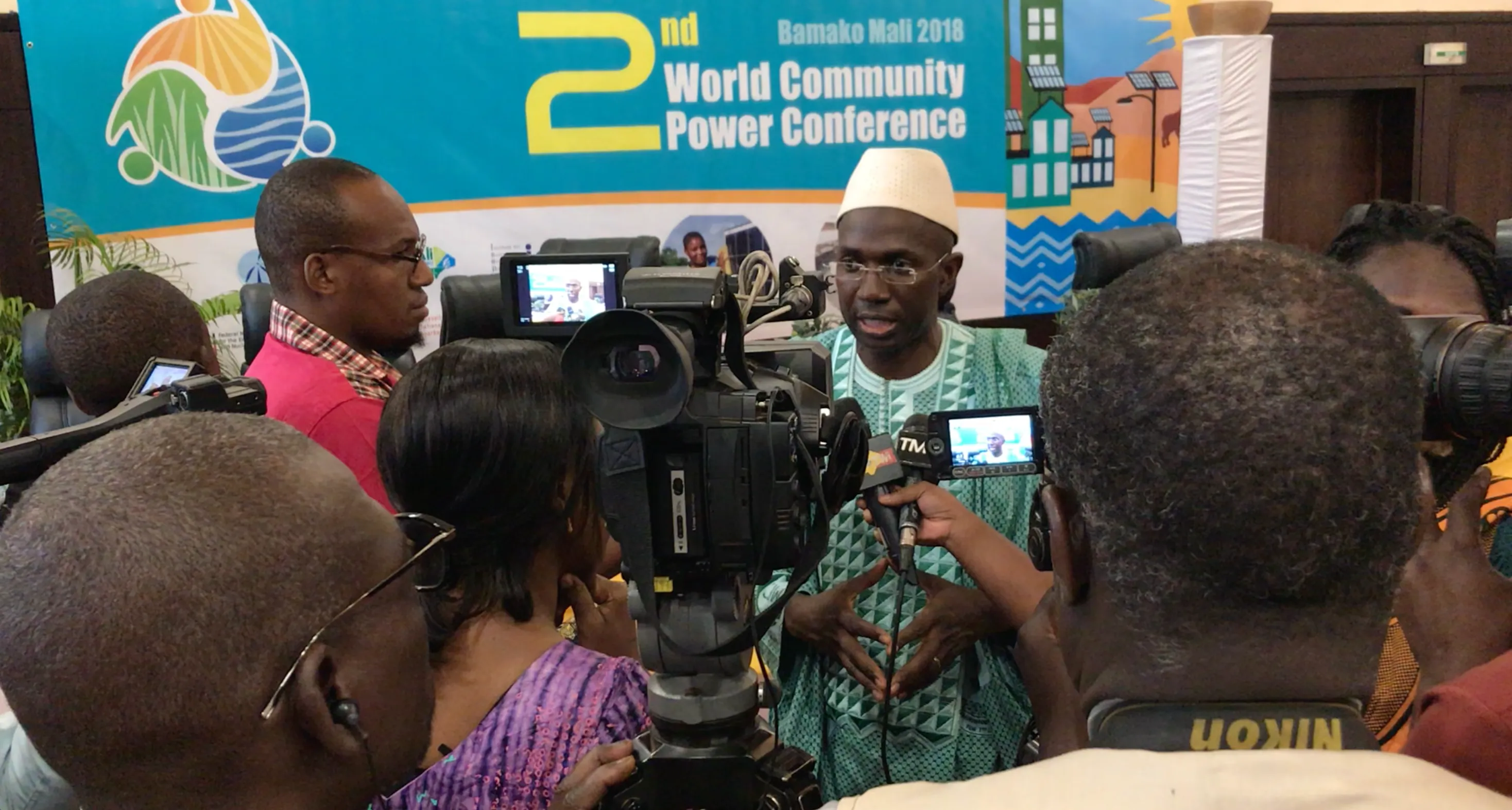
Ibrahim Togola speaking to the media at the World Community Power Conference in Bamako, November 2018. Photo: Shota Furuya
The mini-grid in Karan
The Associated Press has reported on how this kind of idea is working out in a village. In Karan, a village of about 3,000 people near the border with Guinea, WeLight, a company from Madagascar, has run a solar mini-grid since 2021, and electricity is now available around the clock. Connections have grown from 48 to more than 200 (Ahmed, 2025).
Samba Diakité, a baker, used to spend $100 a day on fuel for his generator. He now saves more than half of that. For Issa Doumbia, a welder, fuel costs fell from $16 to $23 a day to $8. Still, Doumbia says: “There’s not much of a market to make big profits. So, I would like to see the price of electricity go down.” Electricity costs about $0.50 per kWh, roughly twice the price of power in the cities without subsidy.
According to the rural electrification agency, 32 mini-grids are running in four regions in the south and south-west, supplying more than 2 million people. Bringing electricity to the whole country is estimated to need about $1.3 billion. Yet PHARE, a rural electrification project funded by France and others ($39.5 million), has been cancelled, and in 2024 the World Bank suspended $60 million in financing for the state utility, EDM. In the insecure north, it is hard for companies even to build mini-grids.
Gaps in money and policy
The problems are not Mali’s alone. The International Energy Agency (IEA) estimates that bringing electricity to everyone in sub-Saharan Africa by 2035 would take about $15 billion of investment a year. The money actually committed in 2023 was less than $2.5 billion, under a sixth of that. Some 220 million people, about 40% of those without electricity, cannot afford even a minimal electricity service (IEA, 2025).
According to REN21, about 10.2 million off-grid household solar kits were sold worldwide in 2025, more than 9 million of them in sub-Saharan Africa. Of the people without electricity, 64% live in areas affected by conflict, where buying a kit in instalments costs 57% more (REN21, 2026). Insecurity is added straight onto the price of power.
Governments are not ready either. The World Bank and the African Development Bank are pursuing Mission 300, to connect 300 million people by 2030, and asking each country to draw up a National Energy Compact. In SEforALL’s list of the 22 countries with the largest unelectrified populations, countries with a compact as of June 2026 are marked; Mali is not (SEforALL, 2026).
Meanwhile, the Malian government has put its effort into large solar plants. In May 2024, work began on the 200 MW Sanankoroba plant, built by a Russian company, and the 100 MW Safo plant, with a Chinese company involved. Both were due to be finished in about a year, but I have found no report confirming that either has started operating. And power from large plants cannot reach the capital if the lines leading there are targeted.
Power that needs no fuel trucks
The blockade and the sabotage have given Togola’s case an unexpected confirmation. Diesel power assumes that the roads that carry the fuel are safe. Solar power, once the panels and batteries are installed, needs no trucks bringing fuel. The hospital in Timbuktu and the wells in Bamako showed as much.
But the spread of solar power is not the same thing as energy autonomy. The people able to put up panels in Mali today are mainly households and businesses with the money to buy them. There is still no system to collect the batteries that wear out in a few years and dispose of them properly.
What Togola has pictured is a village where local people generate the power, the money circulates within the village, and electricity is joined to farming, water and health care. Can the panels that keep multiplying outside the statistics become more than emergency power for a few, and turn into electricity that communities own and run? What is being tested in the villages the fuel cannot reach is who owns the equipment, and in whose hands the benefits stay.
References
- Ahmed, B. (2025, March 27). Mali embraces solar power for rural areas but the challenges are still vast. Associated Press.
- Africanews. (2026, June 26). Timbuktu without water or electricity as fuel shortage shuts down power station. Africanews.
- Aliyu, M. (2026, September 22). Mali marks independence amid a worsening security crisis. Al Jazeera.
- Ember. (2026). China’s solar PV exports [Data set]. Retrieved November 12, 2026.
- International Energy Agency. (2025). Financing electricity access in Africa.
- International Renewable Energy Agency. (2026). Renewable capacity statistics 2026.
- International Trade Administration. (n.d.). Mali: Energy. Country commercial guides. U.S. Department of Commerce.
- Jones, D., & Nana, J. (2026, August 26). The take-off in African solar that official statistics can’t yet see. Ember.
- Mali Folkecenter Nyetaa. (n.d.). About us.
- REN21. (2026). Renewables-based economy tracker: Society & governance.
- Sustainable Energy for All. (2026). Tracking SDG7: The energy progress report 2026 – Deep dive perspective.
- Wabwireh, D. (2026, July 7). Mali: Sabotage plunges Bamako into water and power crisis. Africanews.
- World Wind Energy Association. (2015, October 28). World Wind Energy Award 2015 for Mali Folkecenter Nyetaa.